
Impact | The Grounding AI Map
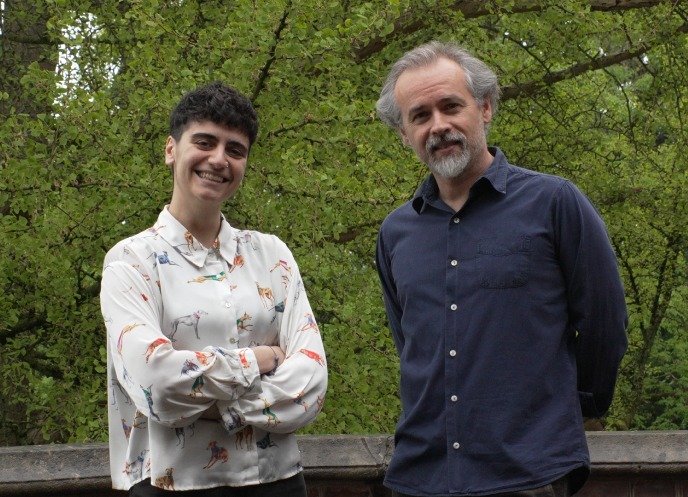
The nominees for the Ben Feringa Impact Award 2026 will introduce themselves and their impactful research or project. The winners will be announced on 9 June. This week: Matilde Ficozzi and Dario Rodighiero with the research on visualizing data with the Grounding AI Map.
Who are you?
We are Matilde Ficozzi and Dario Rodighiero.
Matilde Ficozzi is a researcher working at the intersection of techno-anthropology, controversy mapping, and visual communication. She is a PhD student jointly at the University of Groningen and Aalborg University (Copenhagen), where her work explores how to make social complex issues and public controversies more tangible to broader audiences through data visualizations.
Dario Rodighiero, Assistant Professor of Science and Technology Studies at the University of Groningen, is a designer working at the intersection of digital humanities, information design, and science communication. His practice turns open-access archives into visual form, opening them to interpretation and understanding.
We are both from Campus Fryslân.
Can you explain what your research was about?
The Grounding AI Map is a data visualization project that transforms two million scientific articles on AI, algorithms, and machine learning into an experiential format accessible to general audiences. The map organizes published research by how closely related topics are to one another, making visible the actual breadth and diversity of AI research through different fields — from medical imaging to climate modelling to financial systems. It is complemented by a smartphone web application that allows visitors to explore individual research clusters, read accessible summaries, and engage with contrasting AI-generated perspectives designed to spark reflection rather than provide answers. The project has been exhibited at the Danish Technical Museum in Denmark and at the European Researchers' Night in Groningen.
What made the research impactful?
Public debate about AI is loud but often narrow, focused on high-profile tools while missing the vast, nuanced landscape of what AI actually does across scientific disciplines. The Grounding AI Map addresses this gap directly. Rather than adding another opinion to the debate, it gives audiences a landscape to explore for themselves — one grounded in two million peer-reviewed articles spanning nearly four decades of research. By making scientific knowledge walkable and tangible, the project treats visitors not as passive recipients of information but as active participants in making sense of it. Crucially, the map also serves as a stage for public events where we facilitate dialogue between researchers and audiences who want to engage with AI beyond what mainstream media offers — conversations that are informed, open-ended, and grounded in scientific research.
What was your personal motivation to conduct this research?
The project began as an internal tool within the Algorithms, Data and Democracy research project in Denmark, where Matilde was affiliated, originally designed to help researchers orient themselves within the vast landscape of scientific work on AI and algorithms. Over time, we recognized its relevance for a wider audience. Since the explosion of generative AI, the public is daily flooded with coverage that tends toward either uncritical hype or absolute fatalism, as if there is one big AI controversy we all need to take a side on. One key takeaway from the project is that if we want to engage meaningfully with what is controversial about AI, we first need to ask what we are even talking about when we say "AI." The map is an attempt to do exactly that — to show that behind the buzzwords there is a multiplicity of specific practices, problems, and communities, and that engaging with that complexity could be more honest and more useful than picking a side.
More news
-
-
31 March 2026
Islands as testing grounds for a sustainable society
-
24 March 2026
A secure, resilient society starts at the local level