
Organize AI in the same way as the law
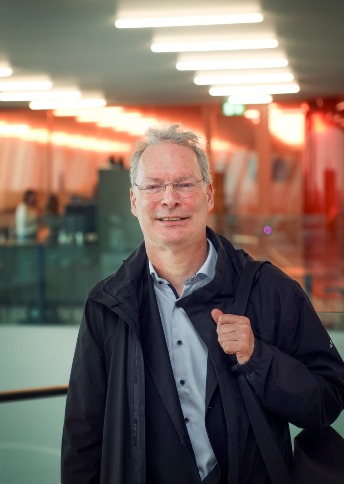
What can artificial intelligence learn from a court case? A great deal, says Professor of AI Bart Verheij. According to Verheij, intelligence is all about the exchange of arguments, just like in the courtroom. ‘My dream is that experts from as many other fields as possible will help to develop AI.’
Text: Jelle Posthuma, RUG / Photos: Henk Veenstra
Verheij was recently at a birthday party, where he spoke to a lawyer. The lawyer told him that he often first enters employment law questions into Google’s AI model, so that he can work more efficiently and cost-effectively for his clients. He still checks the answers, of course, as the models can make mistakes. ‘But is this making me stupid?’ he asked Verheij.
That is an interesting question, says the professor. ‘Some skills will disappear, just as we no longer do our own calculations thanks to the calculator. People are worried about their jobs because of the rise of AI, and while there are certainly many more changes to come, I have a very high regard for what people bring to the table: human value.’
What AI cannot yet do well
According to the professor, the use of artificial intelligence does not necessarily make us stupid, as long as we remain critical. But how can we make AI intelligent? This question is central to Verheij’s research. To attain intelligence, he highlights three important requirements: correct answers, comprehensible reasoning, and ethically sound choices. The first of these is now working fairly well, but reasoning and the making of ethical choices are still difficult to achieve with the current AI models, he argues.
Verheij focuses in his research on the role of argumentation. The exchange of arguments takes place in a discussion, based on reasons and varying perspectives. According to the professor, this exchange of arguments ultimately leads to sound answers, well-founded reasons, and ethical choices. ‘I regard the discussion model as intelligent behaviour, and studying it is my field of research.’

Law as a model
In the 1980s, Verheij studied mathematics in Amsterdam. He then moved to Maastricht, where he specialized in AI and the role of deliberative models as a PhD candidate at Maastricht University’s Faculty of Law. ‘The law is organized entirely as a deliberative model, as a debate. In parliament, where laws are devised and enacted, there is debate. In the courtroom too, there is debate between the parties, with a judge acting as an independent third party. Arguments are exchanged throughout the legal system, and that is precisely what I study. My starting point is therefore that AI must be organized in the same way as the law.’
Although the outcome is important in law, certainly for those in the dock, the path to it – the legal debate – is just as important. Verheij believes that this should also apply to AI, but this is exactly where it currently falls short. AI delivers impressive results, such as facial and image recognition, but without giving a clear explanation. ‘The “why” question is a tricky one for AI, because of the underlying technology of neural networks.’
Plagiarism or true intelligence?
The picture is becoming more nuanced with recent developments in the field of language models, says Verheij. These language models – the best-known being ChatGPT – do sometimes provide a reason. ‘The question is: is that reason correct? Often it isn’t, but sometimes it is. The behaviour of current AI models therefore leads to heated debates between supporters and opponents.’
‘As a researcher, you have to say that you don’t understand it, and you need to work hard to figure it out. Take logic puzzles for example: has the language model simply found enough examples on the internet and is reproducing them cleverly, or is there more going on? In other words: is it plagiarism, or does the language model arrive at a solution itself? That isn’t clear, and that’s what we’re investigating.’
Verheij emphasizes that the architecture remains flawed. ‘It works, but not well enough. Unlike with a calculator, you cannot guarantee that it will always be correct. As soon as a new version of a language model is released, people scramble to point out what it does wrong.’
That often makes models unsuitable for sensitive applications, the professor continues. ‘Take the law. Criminal law is about how a conflict should be resolved and whether someone is guilty. Those are serious questions, and the technology isn’t reliable enough for that yet. At the same time, some colleagues say that people make mistakes too, so what’s the difference? That’s an interesting question, and quite a philosophical one. In my view, this ultimately leads to the question: what is intelligence and how does it work, which is exactly what I want to understand.’

A critical eye
Back to the birthday party. There, a young student joined the conversation. “She said that she and her classmates study all day using language models.” “It sounds like you’re approaching it critically and sensibly,” I replied. “You stay alert and retain your independence, and that’s exactly the core of the discussion model: you have to listen carefully and maintain your own autonomy. It’s precisely the interaction between people and AI that’s interesting, just like the interaction between people themselves. There, too, you always see the most surprising things happen.”
At the same time, Verheij acknowledges the risks, as with virtually any new technology. He refers to social media: originally set up for accessible communication, but now also a means of influencing elections. ‘With modern AI, we’re already seeing all sorts of things go wrong.’ According to the professor, the solution to such risks lies not only in the development of technology. He highlights the importance of research at a multidisciplinary university: ‘AI is certainly not just a technology problem; quite the opposite, in fact.’
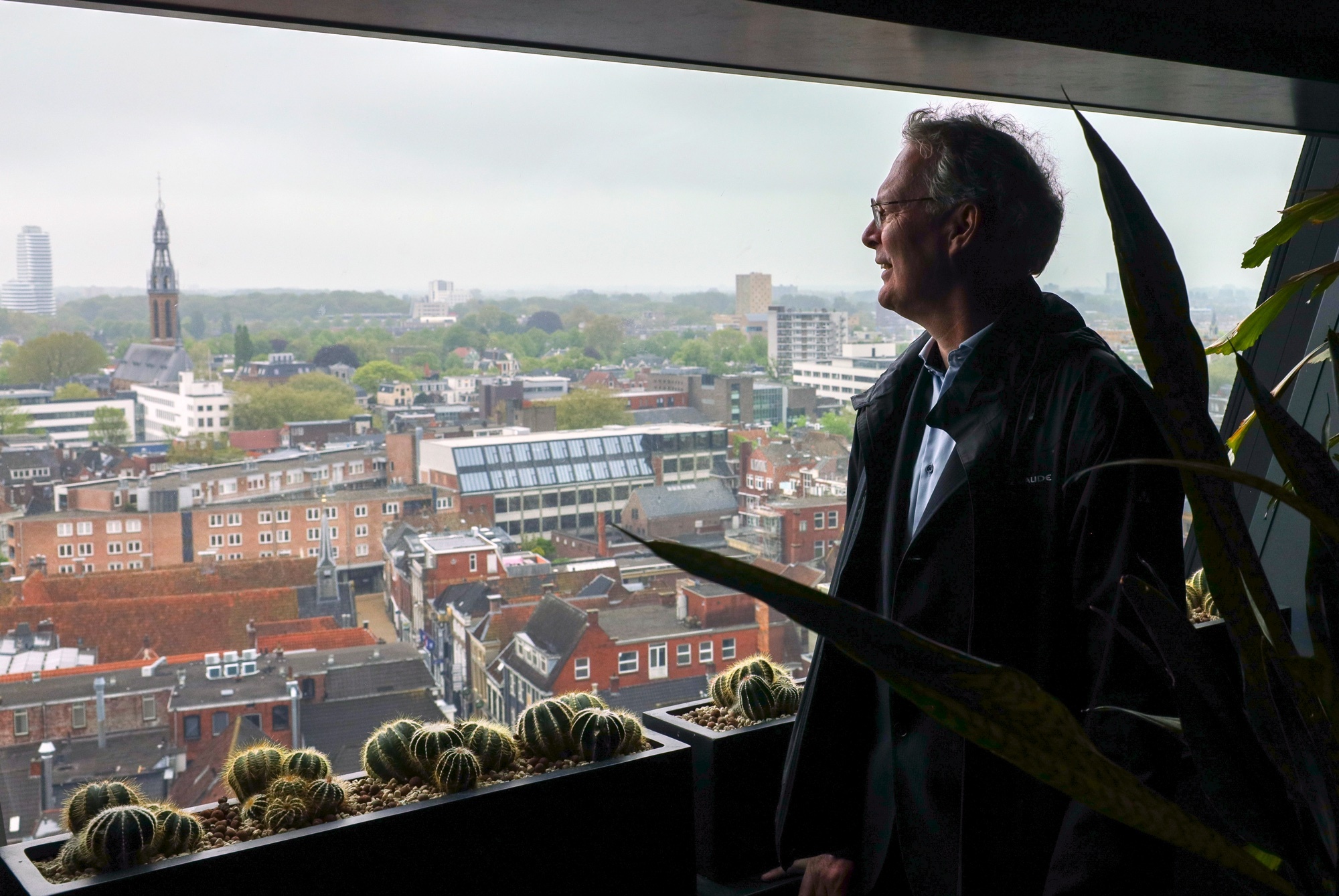
According to Verheij, that is part of his role as Scholar at the Jantina Tammes School of the University of Groningen: to foster collaboration between disciplines and faculties. ‘I am used to working in both a law faculty and a science faculty.
For me, back then as a PhD student at the Faculty of Law, it was a real learning curve at first, as a hardcore mathematician. In the law faculty, it was suddenly all about society and how we should organize it. That taught me a great deal. My dream is for experts from other fields to help develop AI. I believe very strongly in that expertise. Doctors, lawyers, philosophers: everyone can contribute to the development of better AI.’
An interdisciplinary approach is essential, argues the professor. ‘I am therefore delighted with the establishment of the European AI Factory in Groningen. It is a wonderful opportunity to show here in the north of the Netherlands that the digital transformation that we now find ourselves in the middle of can only succeed if we all get involved and don’t just stand on the sidelines.’
More information
More news
-
17 September 2026
NWO-KIC funding for new route to sustainable biocatalysts
-
15 September 2026
Enzymes break down textile fibres into useful resources
-
10 September 2026
Searching for the first generation of stars