
Science for Society | Recovering lithium from wastewater
Scientists work day by day on solutions to a variety of problems. From new drugs to smart farming techniques, our research helps society move forward. But this is not always immediately visible. In the Science for Society series, we use stories about impactful innovations, products and ideas to show that science works!
Text: Jaap Ploeger, Corporate Communicatie UG | Photo IonIQs
The energy transition calls for large-scale energy storage, and with it comes a growing demand for lithium. This metal is essential for batteries in electric cars and energy storage. But that growth comes at an enormous cost to the environment: the way lithium is extracted and processed is anything but sustainable. Refining lithium not only results in the loss of large amounts of material, but also requires vast quantities of fresh water. Groningen deep-tech start-up IonIQs has developed a solution that could radically transform lithium extraction.
‘Refining one tonne of battery-grade lithium requires around 50,000 litres of fresh water,’ says IonIQs co-founder Jasper Zuidervaart. ‘And this is often done in arid regions, such as the Lithium Triangle in South America.’ In countries such as Chile, Bolivia, and Argentina, water is first drawn from surface water sources, then from groundwater, and eventually even transported by lorry to keep the refining process running. The contaminated wastewater produced in the process is often discharged untreated into the surrounding area. It is precisely this wastewater that forms the starting point for IonIQs, which emerged from scientific research and focuses on recovering valuable raw materials from residual streams.
The science behind the solution
The basis for IonIQs lies in research into electro-membrane technology and water chemistry. IonIQs’ Chief Technology Officer, Anthony Cyril Arulrajan, who obtained his PhD in this field, developed a method for selectively separating ions from liquids. Instead of extracting lithium itself from wastewater — which consumes a great deal of energy — the technology focuses on removing unwanted substances, such as sodium.
‘You can think of it as a floor covered with a thousand ping-pong balls,’ Zuidervaart explains. ‘Of those, 20 are white and 980 are black. If you need to remove 15 white balls, that is far more efficient than trying to collect all the black balls. Responsible use in a battery requires a purity level of 99.5%, known as battery grade. In this case, that means there can be no more than five white balls left.’
In lithium refining, the white balls are the impurities that undermine the quality of the lithium, represented by the black balls. ‘We do not remove the lithium; we remove the impurities.’ This effectively converts wastewater into a valuable raw material. Whereas this level of precision was previously difficult to achieve, IonIQs has succeeded in tests in purifying lithium from wastewater to the required battery-grade quality of 99.5%.
Impact: less waste, more value
The potential impact of the technology is significant. In an average lithium refinery, IonIQs can recover an additional 7 to 8 per cent of lithium from waste streams. That may sound modest, but it translates into thousands of extra batteries per year, without any additional polluting mining activities.
In addition, the water that remains after treatment can be reused. This reduces the demand for fresh water and eases the pressure on vulnerable areas. ‘We are effectively making the process circular. The water can be reused and the lithium is not lost.’
What makes this technology special is that sustainability and economic value converge here. While sustainable innovations are often more expensive, this approach actually yields financial benefits. ‘This is one of the first cases in which sustainability and profitability reinforce each other, and that is what makes it so interesting for the industry,’ says Zuidervaart.
Continues after photo
From lab to application
The idea arose from scientific research, but only really took shape when various areas of expertise came together. Zuidervaart brought experience from the industry, including in scaling up technology and setting up R&D teams. Combined with the technical expertise of Cyril Arulrajan, and co-founder Cristopher Lacò’s industry experience in the battery sector, IonIQs was founded in 2024. Future Tech Ventures invested in the start-up on behalf of the University of Groningen. Funding to launch the pilot was also secured from NOM and SNN.
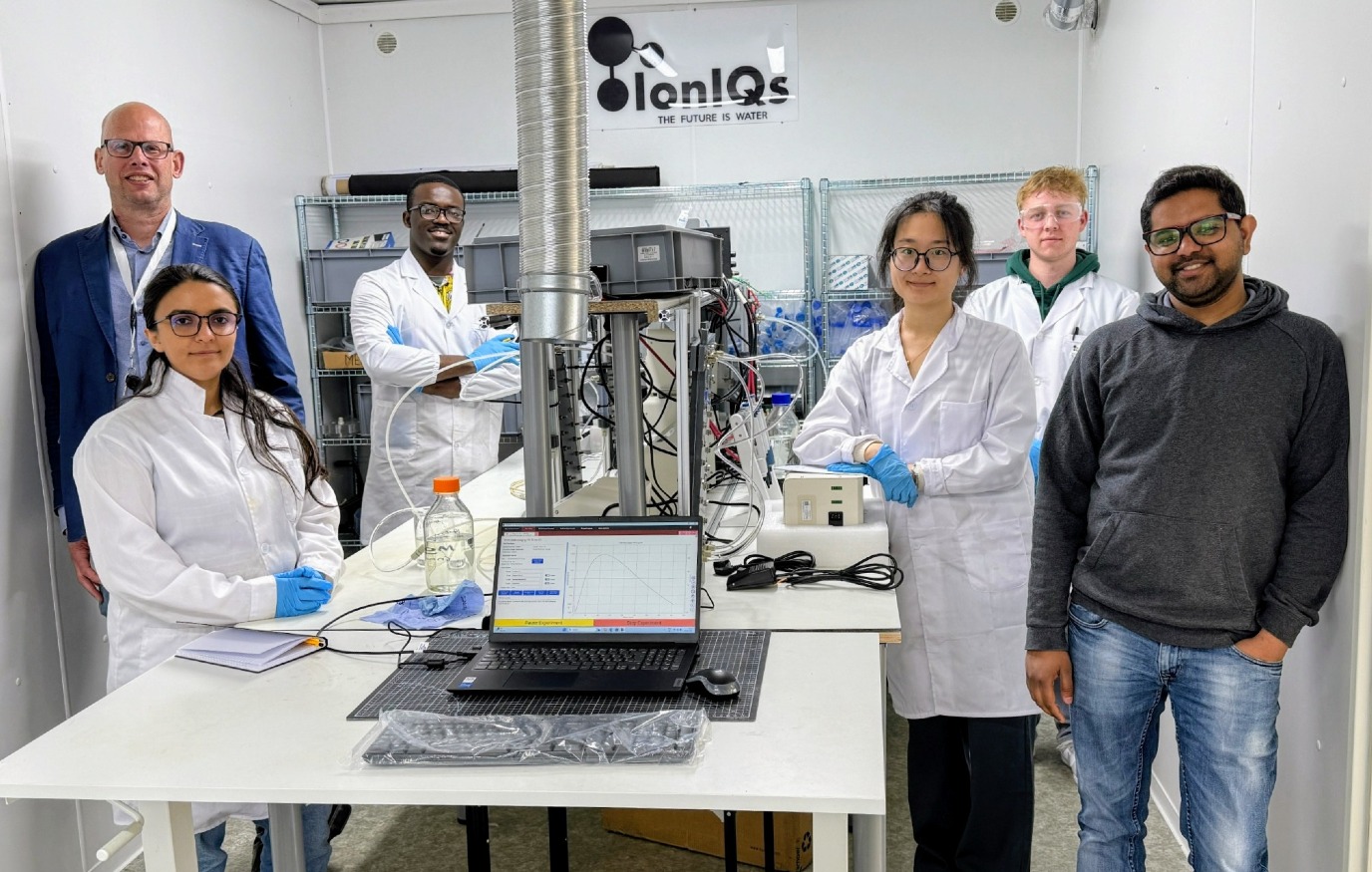
Since then, the company has been working to scale up the technology. The first experiments were carried out on a small scale: a few litres per hour. Work is now under way on a mobile testing system that can be deployed worldwide and fits precisely into a shipping container. This makes the system highly mobile and scalable.
The next step is a pilot in Chile, where IonIQs is working with major players in the lithium industry. ‘We first want to understand how robust the system is,’ says Zuidervaart. ‘What happens to the membranes during long-term use, and how does the system respond to variations in the wastewater?’ These questions are being investigated, among other things, in collaboration with the University of Groningen, where follow-up research is being carried out into aspects such as membrane lifespan and other elements of the system.
More news
-
17 September 2026
NWO-KIC funding for new route to sustainable biocatalysts
-
15 September 2026
Enzymes break down textile fibres into useful resources
-
10 September 2026
Searching for the first generation of stars