
Building Bridges Across Differences: ActiPLEx reflects on results and expands its outreach
A meeting was recently held in Groningen between the partners of the Erasmus+ project ActiPLEx (Action for Interactive Anti-Polarisation Learning Experiences for a Better Democracy).
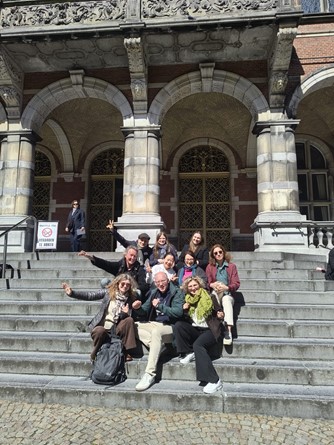
Teams from Tartu, Groningen, Warsaw and Berlin took the opportunity to review the results, refine the educational resources and make plans for future dissemination and collaboration.
Discussions focused on project outcomes and practical implementation, alongside a workshop titled “Teaching Opinion Dynamics and (De)Polarisation” with teaching staff of the University of Groningen. This session generated valuable feedback on the practical applicability of the workshops in the teaching activities.
MOOC on societal divisons
One of the project’s central achievements is the MOOC “Growing Apart: What Is Polarisation and What Can We Do About It?” Designed to help young people better understand societal divisions, the course combines simulation models, game-based learning, and storytelling. Learners follow the story of Mel and Ian in the fictional city of Bridgestone, making complex concepts more accessible through relatable scenarios. The course is supported by video lectures, animations, quizzes, simulations, and discussion forums.
Various platforms
The MOOC has reached a broad audience across platforms. More than 500 learners have enrolled in the FutureLearn course, while 441 participants have successfully completed the Moodle-based version at the University of Tartu. At the University of Warsaw, the course has been adapted into a wider course “Micro to macro. Social processes and individual behaviour”, helping students connect individual interactions with wider societal dynamics.
Research into the origins of polarisation
Another key output is the “Paper-Clip Game of Opinions”, an interactive workshop activity for university and high school students. The game has already engaged more than 500 participants, including sessions in schools in Poland and Estonia. It offers a safe and engaging way to explore how opinions evolve and how polarisation emerges through interaction.
ActiPLEx has also contributed to international academic exchange. At the 5th ISA Forum of Sociology in Rabat, partners facilitated a workshop where educators tested the game and provided feedback, helping to further strengthen the project’s materials and ensure their adaptability across different contexts.
Tackling polarisation through innovative educational approaches
“We’re very happy to see that the project has achieved impressive results, reaching an audience of 1,500 participants who actively engaged with its materials. Both the numbers and the feedback we got from students, confirm there is a real need to have a dialogue about polarisation.’ noted Agata Komendant-Brodowska, the project coordinator. ‘This strong interest highlights a growing need among both students and lecturers to better understand and address social polarisation through innovative educational approaches,” adds Tom Spits, the digital module coordinator from the University of Groningen.
This main results are developed within the framework of the Erasmus+ “ActIPLEx: Action for Interactive Anti-Polarisation Learning Experiences for a Better Democracy” (number:2023-2-PL01-KA220-HED-000179196). Co-funded by the European Union. Views and opinions expressed are however those of the author(s) only and do not necessarily reflect those of the European Union or the National Agency of Erasmus+ Programme. Neither the European Union nor the National Agency of Erasmus+ Programme can be held responsible for them.

More news
-
-
03 September 2026
Ming Cao reappointed as scientific director of the Jantina Tammes School
-
01 September 2026
Evrim Ursavas appointed scientific director Wubbo Ockels School