
Unlocking new possibilities for infrared optoelectronics with InSb quantum dots
How can we precisely control the size and optical properties of semiconductor quantum dots? A new study by Loredana Protesescu and colleagues sheds light on the formation of indium antimonide (InSb) quantum dots, promising nanomaterials for short-wave to mid-wave infrared applications.
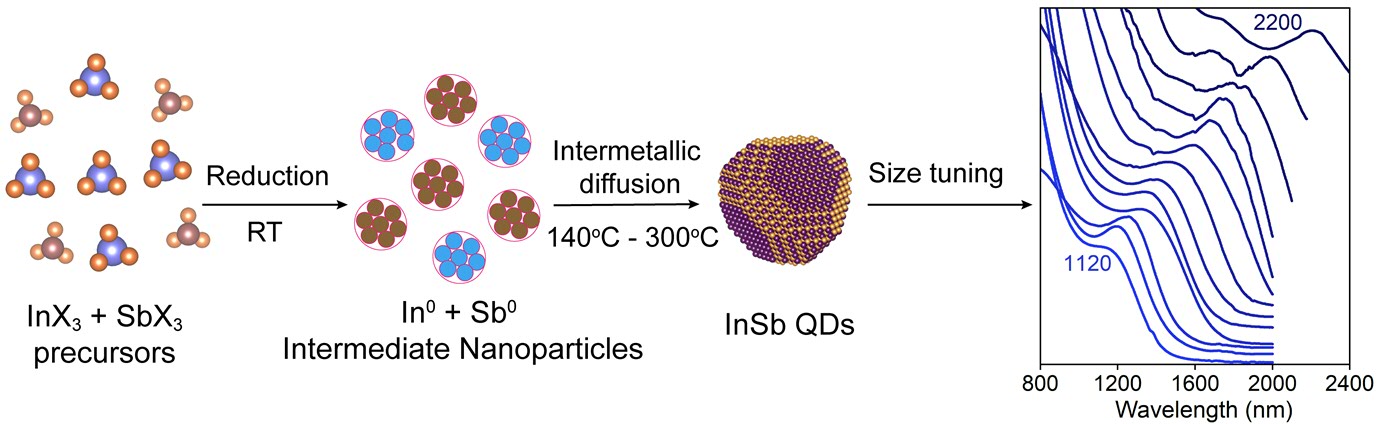
The researchers reveal how tiny zerovalent indium and antimony nanoparticles act as intermediate building blocks during InSb quantum dot synthesis. Their size determines how these materials interact, diffuse, and ultimately form quantum dots. By systematically adjusting reaction conditions, including precursor chemistry, composition and reaction time, the team achieved highly uniform InSb quantum dots with tunable optical absorption across an impressive wavelength range of 1,160–2,200 nm.
Beyond advancing our fundamental understanding of quantum dot formation, these findings provide practical strategies for controlling their size and optical properties. This opens up exciting opportunities for developing next-generation infrared technologies and optoelectronic applications.
Read the publication here: https://advanced.onlinelibrary.wiley.com/doi/10.1002/advs.78804
Zerovalent Metallic Intermediates in the Synthesis of InSb Quantum Dots: From Precursor Reduction to Optical Tunability
Yun Hai, Xavier Kirchherr, Riccardo Nardin, Wouter Smans, Sofia Iosifidi, Jacopo Pedrini, Chiara Trevisan, Darius A. Pacurar, Julia Kraft, Gabor Ersek, Dominic Gerlach, Majid Ahmadi, Antonija Grubišić-Čabo, Giuseppe Portale, Fabio Pezzoli, Loredana Protesescu
Congratulations to Loredana Protesescu and all co-authors on this important contribution!
More news
-
-
19 October 2026
From research to business: RUG Ventures helps ideas move forward
-
03 September 2026
Ming Cao reappointed as scientific director of the Jantina Tammes School