
Magnetism meets superconductivity
Researchers from the Universities of Hamburg, Kiel, and Groningen have investigated how different topological superconductors interact via interfaces. Their results show that a specific interplay of mag-netic and superconducting properties leads to the formation of novel, spin-polarized edge states—with promising potential for future quantum technologies. The scientists report their findings in Nature Communications.
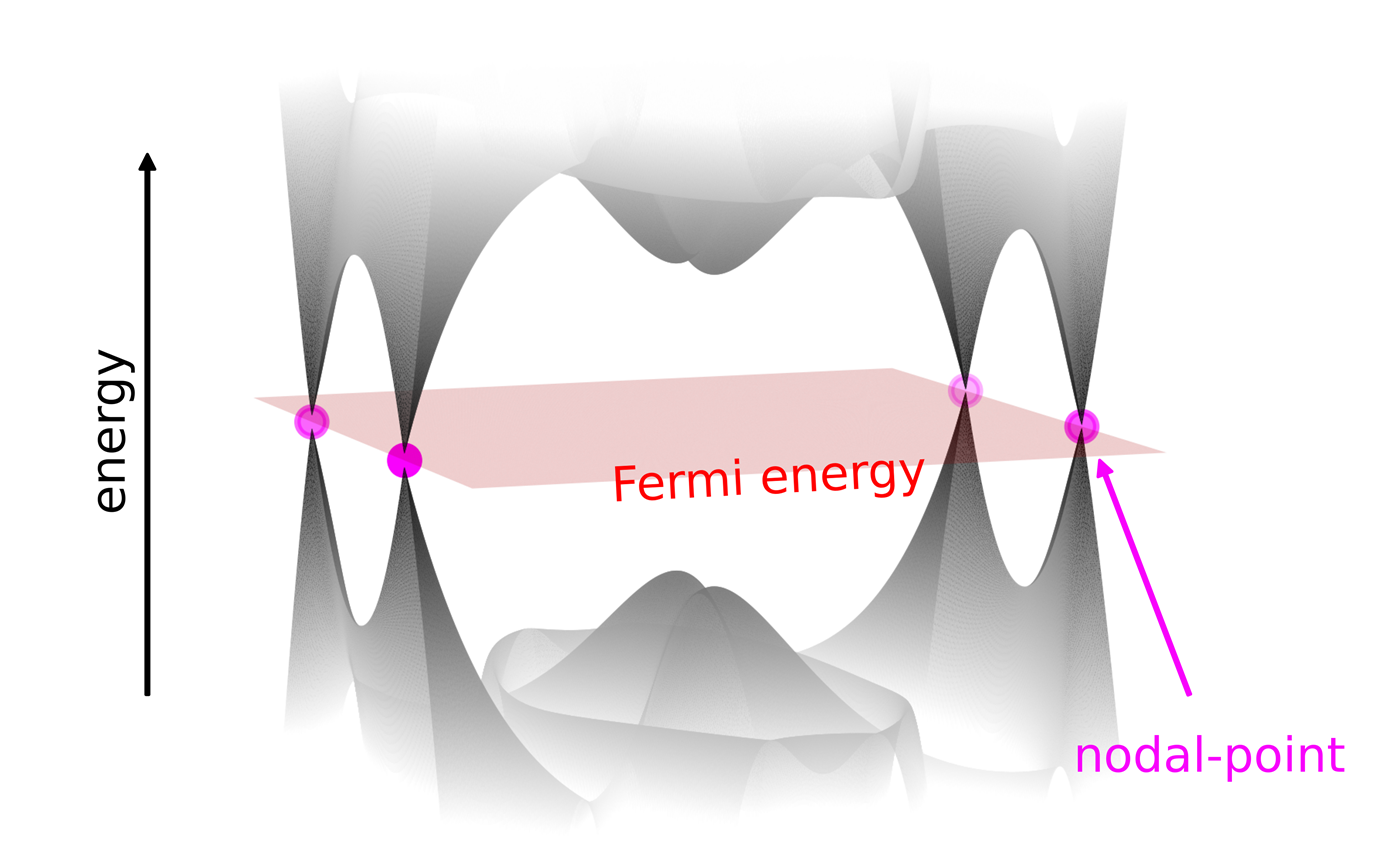
Magnetism and superconductivity are traditionally considered to be incompatible with each other. While superconductors transport electrical currents without loss, magnetism usually destroys this state. Under certain conditions, however, their combination can give rise to a special quantum state—so-called topological superconductivity. This is characterized by robust electronic states that occur at the boundaries of a material and which are largely protected against external disturbances.
The current study explores how two different topological superconductors interact when brought into contact. To investigate this, the research team studied ultra-thin manganese layers only one or two atomic layers thick, on top of the superconducting tantalum. In this context the magnetic order of the manganese layers turns out to be a crucial ingredient.
“Our experiments show that in these thin layers, the magnetic moments of neighboring atoms are aligned in opposite directions—known as antiferromagnetic order,” says Felix Zahner from the De-partment of Physics at the University of Hamburg.
“This special configuration leads to a form of topological superconductivity in which the energy gap does not persist everywhere in the electronic band structure of the hybrid material, but vanishes at cer-tain points” says Dr. Roberto Lo Conte from the Zernike Institute for Advanced Materials at the Uni-versity of Groningen. Experts refer to this as “nodal-point superconductivity.” Using high-resolution scanning tunneling microscopy and accompanying theoretical simulations, the team was able to show for the first time that two different nodal-point superconducting phases do not merge seamlessly. In-stead, clearly defined topological edge states emerge at their boundary.
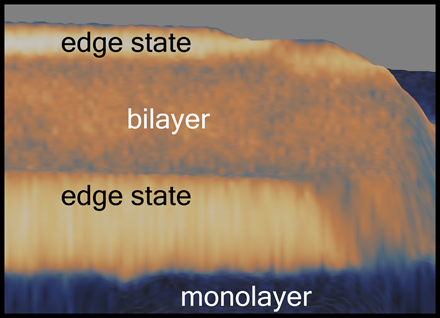
Another key finding: these edge states can be spin-polarized. This means that the magnetic properties of the manganese layers are directly imprinted onto the electronic states at the boundary. A special measurement method used at the University of Hamburg made it possible to demonstrate this effect experimentally. Dr. Felix Nickel from the University of Kiel adds: “With our theoretical model, we were able to trace this effect back to intrinsic properties of the two materials. This implies that it is a general effect that could also occur in other materials.”
The results open up new perspectives for the targeted creation and control of topologically protected states. Such systems could play an important role in the future, particularly in the development of spintronic devices and fault-tolerant quantum computers.
Original publication
Spin-polarized edge modes between different magnet-superconductor-hybrids, F. Zahner, F. Nickel, R. Lo Conte, T. Drevelow, R. Wiesendanger, S. Heinze, and K. von Bergmann, Nature Communications 17:3457 (2026). https://doi.org/10.1038/s41467-026-71687-3
Contact
Zernike Institute for Advanced Materials, University of Groningen
E-Mail: r.lo.conte@rug.nl
More news
-
-
03 September 2026
Ming Cao reappointed as scientific director of the Jantina Tammes School
-
01 September 2026
Evrim Ursavas appointed scientific director Wubbo Ockels School