
NWO SGW L "Gender and Power Dynamics"
Project Title: Gender ratio and power dynamics in mixed-gender teams
Applicants: Bernard Nijstad (University of Groningen), Mark van Vugt (VU Amsterdam)
Team: Xin Zhou (postdoc, University of Groningen) Helena Bieselt (PhD, University of Groningen) Sterre van Niekerken (PhD, VU Amsterdam)
Funder: Summary NWO (Open competition L)
Period: February 2023 – February 2027
Summary
Bernard Nijstad (University of Groningen), Mark van Vugt (VU Amsterdam) Xin Zhou (postdoc, University of Groningen) Helena Bieselt (PhD, University of Groningen) Sterre van Niekerken (PhD, VU Amsterdam) NWO (Open competition L) February 2023 – February 2027 Gender quota have been introduced in several countries, including recently in the Netherlands, to increase the participation and influence of women in organizational boards. However, the effect of gender ratio (number of women versus men) on the relative influence of both sexes in teams or boards is actually unclear, and simply increasing the number of women may not have the intended effect. Taking a new, dynamic approach to this issue, we examine how intersexual influence hierarchies emerge dynamically out of claiming and granting of influence by individuals. Factors such as gender ratio, leadership schemas (beliefs about leadership as being hierarchical versus shared), and level of competitiveness within teams are proposed to affect the dynamics of this claiming-granting process and its outcome. We propose that the resulting influence hierarchy affects the relative opportunities of men and women to make promotion in an organization. In three subprojects we study (1) the basic dynamics of this process of claiming and granting in a controlled laboratory setting; (2) these processes in organizational settings using survey and archival data; and (3) these dynamic claiming-granting processes in agent-based models.
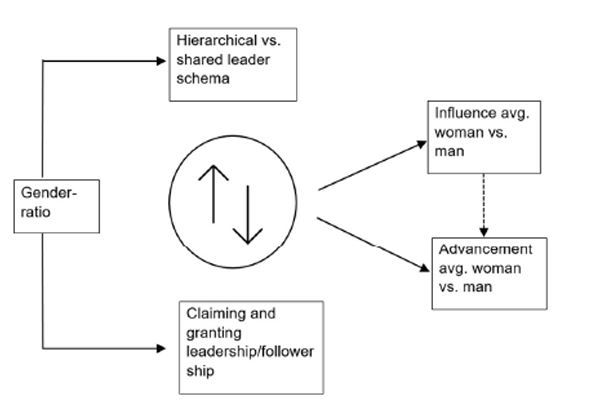
These projects will lead to a better understanding of how intersexual influence hierarchies emerge in small units, such as teams or boards, and what consequences they may eventually have for gender equality. It will provide more insight into the question of whether, when, and how increasing the participation of women also leads to a more equal distribution of influence between the genders.