
WEAVE (NWO/DFG) on Primate Parochialism
Applicants: Claudia Fichtel (German Primate Center Göttingen), Jörg Massen (Animal Biology, Utrecht University)
Collaborator: Carsten de Dreu (University of Groningen)
Team members: Menno Breiner (German Primate Center Göttingen), Josefien Tankink (Utrecht University)
Project Description: Group cooperation – and pro-sociality in general – can be of significant personal benefit, as it can create levels of safety and prosperity individuals can hardly achieve on their own. And yet, group cooperation and pro-sociality can also make individuals and groups dangerous to outsiders, as intergroup competition and conflict are likely to be settled in favour of those groups that harbour more rather than fewer cooperators amongst their ranks [8-10]. In fact, whereas primate cooperation and pro-sociality may have evolved bottom-up, as an emergent property of- and due to the benefits of group-living, the possibility that cooperation and pro-sociality (also) evolved ‘top-down’ cannot be excluded, specifically in the context of recurrent and violent intergroup conflict.
What often escapes the analysis is that both level and form of primate sociality should differ when cooperation and pro-sociality evolved bottom-up, or in the context of recurrent competition and conflict (top-down). Here we pursue this possibility to broaden our understanding of the mechanisms and functions of cooperation and pro-sociality in group-living species, non-human primates in particular. By using a complementary approach with field observations and lab(-in-the-field) experiments in two distantly related social primates – red-fronted lemurs and rhesus macaques – we aim to reveal, at the ultimate level, (i) whether and how intergroup competition and conflict shape cooperation, group cohesion and pro-sociality and their fitness consequences and, at the proximate level, (ii) the behavioural, neuroendocrine, and (epi)genetic underpinnings of cooperation and conflict (see figure 1).
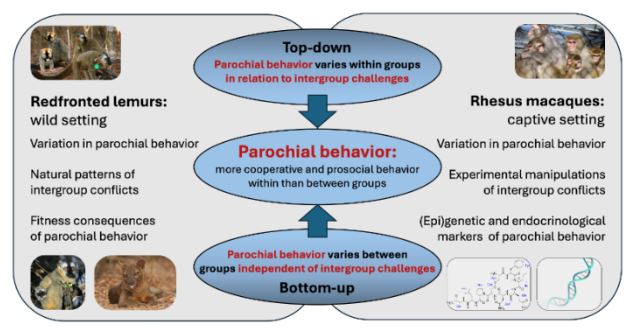
Findings are expected (i) to elucidate the forms and functions of primate pro-sociality, (ii) to identify whether and how competition and conflict shapes the forms primate pro- sociality takes, and (iii) to specify when and how an evolved capacity for cooperation and pro-sociality follows from or, instead, drives disruptive and costly conflict within and between primate societies.