
History of the Body, Health and Wellbeing
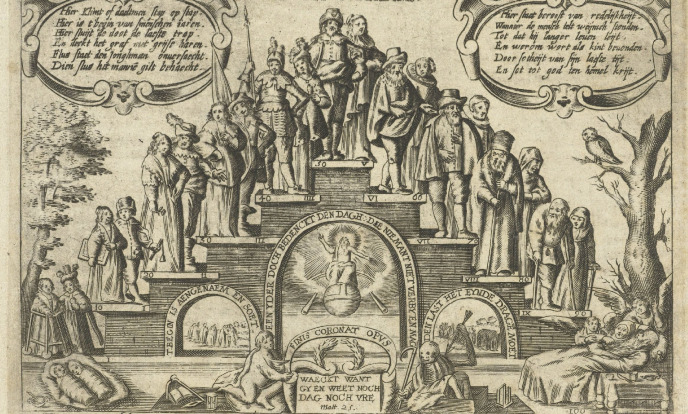
Our research into the history of health and wellbeing is concerned with the question of how health systems have changed and adapted over time. How are health and wellbeing rooted in (natural) philosophical, cultural, and societal concerns? And how can past mechanisms of health help in answering the important question of how we can live and age well?
Researchers
-
Dr. Karen Hollewand concentrates on the history of scholarship in seventeenth- and eighteenth-century Europe, focusing in particular on the scientific study of sexuality in this period. Her current research concentrates on perspectives on female bodies in anatomy around 1700 and the role of life cycles in the long-eighteenth century
-
Dr. James Kennaway examines the interactions between science, medicine and culture since the Enlightenment. In particular, he has written extensively on the relationship between medicine and music, musical hypnosis and brainwashing, and on gynaecological and psychiatric critiques of female musical education
-
Prof. Dr. Rina Knoeff holds the Aletta Jacobs Chair of Health and Humanities. She focuses on the (premodern) history of healthy ageing. This line of research combines history of medicine with medical humanities and is also directed at making history of medicine relevant to non-academic audiences
-
Prof. Dr. Onno van Nijf specializes in history of the body, sports and exercise in Antiquity
-
Prof. Dr. Catrien Santing is interested in the history of human well-being and welfare in the Late Middle Ages
-
Dr. Leonieke Vermeer focuses on life writing, illness experiences in self-narratives, and the cultural history of medicine in the 19th century
-
Dr. Patrick Outhwaite is a medieval literary scholar who takes an interdisciplinary approach to the history of medicine, combining insights from book history, legal studies and the medical humanities. His NWO VENI project, Licensing ‘Lechecraft’, explores the part that patient scepticism played in expediting medical regulation in late-medieval England. He also explores the intersections of religion and medicine in late-medieval Central European contexts.
PhD Projects
-
Núria Pujol Furelos's interdisciplinary project connects the disciplines of history of medicine, health humanities and public health. It aims to learn lessons from early modern history to solve contemporary public health problems, such as the definition of the concept of Sustainable Health
-
Merit Hondelink studies the development of Early Modern urban food preparation and consumption practices by analysing archaeobotanical samples from cesspits and historical sources like cookbooks and institutional accountbooks
-
Miente Pietersma analyses how books on sporting techniques from between 1400 and 1550 functioned as manuals, their written instructions guiding the reader through experiments with movement
-
Hanneke de Boer works on an interdisciplinary project on the menopause, connecting the fields of history and psychology. She investigates the historically developed socio-cultural attitudes towards menopause, and how these attitudes shape women’s experiences of the perimenopause.
-
Diedelot Denessen's project focusses on lovesickness in the Dutch Enlightenment culture of psychosomatic medicine. Using medical and cultural sources, she considers lovesickness as a concrete example to illustrate how ideas of the mind-body relation changed over the course of the eighteenth century.
Last modified:26 March 2026 4.20 p.m.