
PhD ceremony Emilio Ceccotti
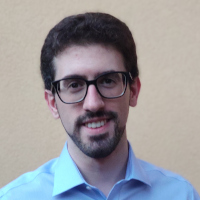
On Monday 26 January 2026, Emilio Ceccotti defends his thesis called
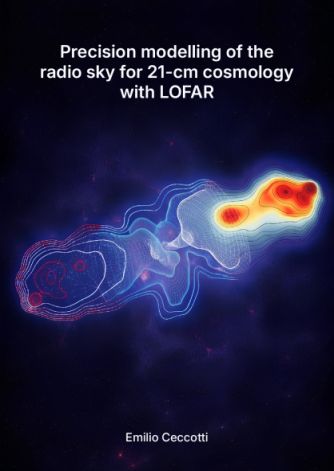
Precision modelling of the radio sky for 21-cm cosmology with LOFAR
Summary of his thesis:
Understanding how the first stars and galaxies formed is one of the central goals of modern cosmology. A unique way to probe this early phase of the Universe is through the 21-cm spectral line emitted by neutral hydrogen during the Epoch of Reionization. Detecting this signal, however, is extremely challenging: it is buried beneath much brighter radio emission from our Galaxy and from distant extragalactic sources, and its extraction requires both sensitive instruments and careful data analysis.
In his thesis, Emilio Ceccotti focuses on improving our ability to isolate the cosmological signal using observations from the Low Frequency Array (LOFAR). A central challenge lies in accurately modelling and removing bright radio sources, whose imperfect subtraction can obscure the faint 21-cm signal. Ceccotti pays particular attention to the development of advanced methods that provide more accurate spectral and spatial source models. Using these techniques, Ceccotti demonstrates significant progress in reducing foreground contamination and improving the quality of the recovered cosmological signal. These improvements are achieved through detailed modelling of both bright sources within the field of view, such as 3C61.1 and 3C196, and bright off-axis sources, such as Cygnus A.
In addition, Ceccotti presents the first results obtained from the 3C196 field, which represents a promising alternative to the traditionally studied North Celestial Pole field.
Together, these results show that accurate sky modelling across different observational scenarios is a key step toward a robust detection of the faint cosmological signal from the early Universe.
Link to Emilio's thesis
If available, you can follow the PhD ceremony via this livestream
More news
-
-
03 September 2026
Ming Cao reappointed as scientific director of the Jantina Tammes School
-
01 September 2026
Evrim Ursavas appointed scientific director Wubbo Ockels School