
PhD defence Luis Barba Escoto
Luis Barba Escoto (ConsEco)
Promotor: Prof. P.A. Tittonell; copromotor: Dr S. López-Ridaura (CIMMYT)
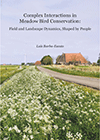
Complex interactions in meadow bird conservation
Field and landscape dynamics, shaped by people
Agricultural intensification and associated policy choices have driven widespread declines in farmland biodiversity across Europe. These pressures are particularly evident in meadow birds, including the black-tailed godwit (Limosa limosa limosa), a key indicator species in The Netherlands. Despite decades of conservation efforts through protected areas and agri-environment schemes (AES), godwit populations continue to decline in intensively managed dairy landscapes. The objective of this thesis is to assess how the diversity, quality, and spatial configuration of AES influence black-tailed godwit populations at field and landscape scales. Focusing on Southwest Friesland, it combines long-term field surveys (2007–2024), analyses of population trends before and after the introduction of the Agricultural Nature and Landscape Management framework (ANLb) in 2016, spatial analyses of landscape composition and connectivity, and stakeholder perspectives. Results show that godwit densities are higher in Site Protection Areas and AES-managed fields than in intensively managed agricultural land, but that AES measures differ in effectiveness. High-quality measures such as herb-rich grasslands and grazing mosaics support higher densities and more positive trends, yet cover only a small proportion of the landscape. Widely applied low-intensity measures show limited population responses. At the landscape scale, godwit abundance increases when high-quality habitats are sufficiently abundant and well connected, while landscapes dominated by intensive agriculture support low populations. Stakeholder analyses reveal economic, social, and institutional barriers that constrain implementation. This thesis demonstrates that effective meadow bird conservation requires prioritizing high-quality management, concentrating measures in connected landscape clusters, and aligning agri-environmental policy with ecological requirements and farming realities.