
Open-Source Artificial Intelligence Is Reshaping the Future of Humanity: Scientists Question, If the World Is Ready
Open-source artificial intelligence is advancing faster than the world can govern, and its consequences could reshape the future of sustainability, democracy, and global development. In a new comment published in Nature Communications, an international team of researchers warns that without coordinated action, open-source AI could also increase environmental pressures, deepen technological inequalities, and facilitate the spread of misinformation.
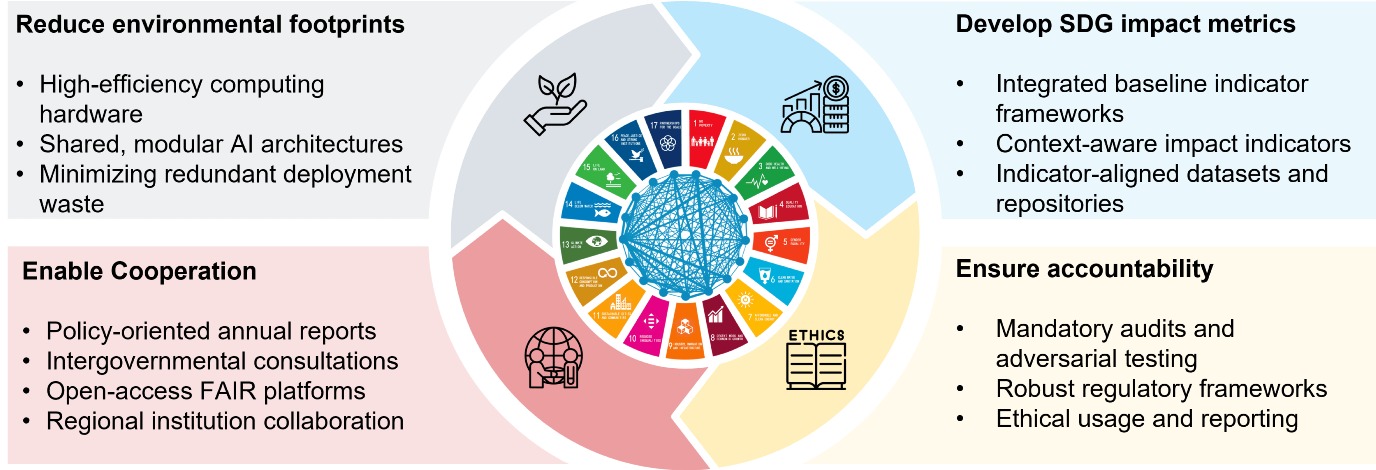
Open-source artificial intelligence (AI) is rapidly becoming a powerful tool for tackling some of the world's most pressing challenges, from climate change and food security to energy access and sustainable development. Min Chen, the lead author and a professor at Nanjing Normal University, emphasizes: “Open-source AI implementation strategies must now evolve. We therefore propose four governance actions to manage opportunities while reducing the uncertainties associated with open-source AI.”
In the comment, more than 20 researchers therefore propose four governance actions to ensure that open-source AI contributes positively to the Sustainable Development Goals (SDGs) while minimizing environmental, social, and political risks.
Prajal Pradhan, co-author and associate professor at the University of Groningen, highlights: “Its openness enables researchers, governments, and communities worldwide to adapt AI solutions to local needs, making it a promising accelerator of the Sustainable Development Goals (SDGs), but not without effective governance.”
To ensure open-source AI benefits society rather than creating new problems, the researchers identify four practical areas where action is urgently needed.
1. Integrate sustainability across the entire AI lifecycle
AI models rely on massive data centers, energy-intensive computing, and increasingly scarce raw materials. The researchers argue that the environmental costs of AI should be assessed across its entire lifecycle, i.e., from manufacturing computer chips to running large-scale AI systems.
For example, if an AI model helps cities to reduce energy use, those sustainability benefits should be weighed against the electricity and resources required to build and operate the AI system.
2. Develop SDG-focused evaluation frameworks
Many AI applications claim to support sustainability goals, but there are few systematic ways to verify these claims. The researchers therefore call for better tools and datasets that can measure how AI affects issues such as poverty reduction, food security, climate action, and inequality. Such frameworks would help policymakers distinguish genuinely beneficial AI applications from those that might create unintended social or environmental harms.
3. Strengthen accountability and governance
As AI-generated content becomes more difficult to distinguish from reality, stronger safeguards are needed. The researchers point to growing concerns over deepfakes, manipulated images, and AI-generated misinformation. They argue that governments, developers, and users must share responsibility for ensuring transparency, including clear labeling of synthetic content and stronger accountability when AI systems are misused.
4. Expand global cooperation and knowledge sharing
The researchers stress that unequal access to computing infrastructure, data, and technical expertise risks deepening global inequalities. They advocate for open-access platforms aligned with FAIR principles (Findability, Accessibility, Interoperability, and Reusability) and for stronger collaboration between global AI initiatives and regional research centers. In doing so, users from all over the world can access open platforms to upload locally relevant data and apply shared or pre-trained AI models to analyze context-specific challenges related to the SDGs.
Open-source AI beyond 2030
The comment resonates with discussions at the 2026 India Artificial Intelligence Impact Summit, held in February 2026, where policymakers and experts emphasized the growing importance of practical AI applications and their societal impact.
The researchers summarize that open-source AI could become a transformative force in shaping the post-2030 global sustainability agenda. By enabling more localized, inclusive, and evidence-based decision-making, open-source AI could help shift sustainability governance away from top-down systems toward more participatory approaches, bringing science, academia, civil society, governance, and the private sector together.
Klaus Hubacek, co-author and professor at the University of Groningen, concludes: “Governance decisions made today will determine whether open-source AI becomes a driver of sustainable and equitable development or a source of new inequalities and environmental pressures.”
Reference: Min Chen, Kai Wu, Prajal Pradhan, Cameron Allen, Stefano Nativi, Klaus Hubacek, Alexey Voinov, Felix Creutzig, Tatiana Filatova, Niklas Boers, Michael Meadows, Peilong Ma, Frank Biermann, Hans Joachim Schellnhuber, John Ludden, Maria Paradiso, Michael Batty, Huadong Guo, Min Cao, Peng Hou, and Guonian Lü. (2026): Steering Open-Source AI to Accelerate the Sustainable Development Goals. Nature Communications.
More news
-
19 October 2026
From research to business: RUG Ventures helps ideas move forward
-
-
03 September 2026
Ming Cao reappointed as scientific director of the Jantina Tammes School