
New frontiers in Microbial Ecology
A Postgraduate course on the Isle of Schiermonnikoog, The Netherlands,
14 - 19 February 2027
Organisers
Under the auspices of the Research School RSEE:
-
Prof. dr. Joana Falcao Salles (Microbial Community Ecology, University of Groningen)
-
Prof. dr ir. Eiko Kuramae (NIOO/UU)
-
Dr. Magdalena Kozielska-Reid (RSEE, University of Groningen)
Aims of the course
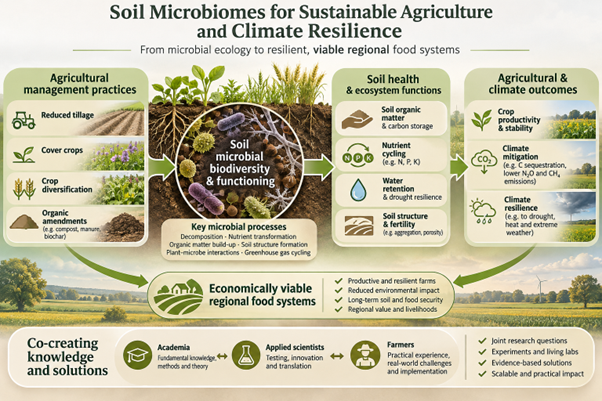
Soils are at the foundation of sustainable food production, biodiversity conservation and climate resilience. Soil microbial communities play a central role in maintaining soil health by regulating nutrient cycling, organic matter decomposition, carbon dynamics, soil structure and plant productivity. Yet, despite increasing recognition of their importance, translating our understanding of soil microbiomes into practical agricultural solutions remains a major scientific and societal challenge.
The overarching aim of this course is to explore how soil microbiomes can contribute to healthier soils, more resilient agricultural systems and climate change mitigation and adaptation, while bridging the gap between fundamental microbial ecology, applied agricultural research and farming practices.
The course will bring together PhD students, academic researchers, applied scientists, agricultural advisers and farmers to examine how scientific knowledge of soil microbial communities can inform the transition towards sustainable and regenerative agriculture.
A central ambition is to move beyond understanding what soil microorganisms do towards investigating how we can use this knowledge to improve agricultural practices, under which environmental and management conditions these approaches are effective, and how they can become practically and economically viable for farmers.
The course will encourage participants to develop interdisciplinary perspectives, challenge assumptions and identify opportunities for collaboration across scientific disciplines and agricultural practice.
It primarily targets PhD students in microbial ecology, soil science, agronomy, environmental sciences, and sustainability research, but will also welcome postdocs and professionals interested in soil health and sustainable agriculture.
Contents and structure
The course will combine lectures by experts in microbial ecology, soil science, agronomy and regenerative agriculture with interactive discussions, case studies and group activities involving researchers, applied scientists and farmers.
A distinctive feature will be integrating scientific understanding, experimental evidence, and farmers' practical experience. Rather than treating agricultural systems solely as experimental settings, the course will recognise farmers as essential partners in identifying research questions, evaluating proposed solutions, and understanding the opportunities and constraints of adopting new practices.
Participants will explore how agricultural management shapes soil microbial communities, how these changes affect soil functioning and crop performance, and how this knowledge can be translated into measurable indicators and management recommendations. The course will build on topics including soil management, soil organic matter, biodiversity, water availability, agricultural productivity and climate resilience. Working in groups with the help of lecturers and through interdisciplinary collaboration, participants will develop research concepts or practical solutions to real agricultural challenges. These could form the basis for collaborative research proposals, experimental designs, scientific perspective papers or recommendations for agricultural stakeholders. For instance, participants may produce a publication in the form of a review or opinion paper (see Adam et al., 2016, Frontiers in Microbiology, doi: 10.3389/fmicb.2016.01079), which was developed during the third Frontiers in Microbial Ecology course in 2015.
Potential topics
1. Soil microbiomes as drivers of soil health
The course will explore the ecological mechanisms through which soil microbial communities contribute to soil functioning and health. Particular attention will be given to microbial biodiversity, community assembly, functional diversity and interactions among bacteria, fungi, archaea, protists and viruses.
Participants will examine how microbial communities regulate organic matter turnover, nutrient cycling, soil aggregation, carbon stabilisation and plant–soil interactions. A key question is whether particular microbial characteristics can serve as reliable indicators of soil health and whether these indicators can predict agricultural performance. Discussions will address the relationship between microbial biodiversity and ecosystem multifunctionality, as well as the challenges of translating complex microbiome data into indicators that farmers and agricultural advisers can interpret and use.
2. Agricultural management and the restoration of soil biological functioning
Agricultural practices strongly influence soil microbial communities, but their effects depend on soil type, climate, management history and the combination of practices implemented. This topic will examine how regenerative approaches, including reduced tillage, cover cropping, crop diversification, organic amendments and mixed cropping, influence soil biodiversity, organic matter dynamics and biological functioning.
Participants will discuss the mechanisms through which these practices may restore degraded soils and reduce dependence on synthetic fertilisers and pesticides. Particular attention will be given to management legacy: how past agricultural practices shape current soil conditions and influence the effectiveness of regenerative interventions. This will raise important questions about whether universal recommendations are possible or whether successful soil management must be tailored to specific environmental and agricultural contexts.
3. Soil microbiomes and agricultural resilience to climate change
Climate change is increasing the frequency and severity of drought, salinisation and extreme weather events, creating new challenges for agricultural production. This topic will explore how soil microbial communities contribute to soil and plant resilience under environmental stress. Discussions will focus on the relationships between soil organic matter, soil structure, water retention, microbial activity and plant responses to drought and salinity.
Participants will investigate how microbial diversity and plant–microbe interactions may influence nutrient and water acquisition, plant stress tolerance and recovery following disturbances. The course will also address microbial contributions to climate change mitigation through carbon cycling and greenhouse gas dynamics, particularly carbon dioxide, methane and nitrous oxide. A central question will be whether agricultural practices that enhance soil biological functioning can simultaneously improve crop resilience, reduce greenhouse gas emissions and support long-term soil carbon storage, and what trade-offs might emerge between these objectives.
4. From microbiome knowledge to agricultural solutions
Although advances in molecular techniques have transformed our understanding of soil microbial communities, their practical application in agriculture remains limited. This topic will explore how microbiome research can help develop and evaluate agricultural innovations, including microbial inoculants, compost and compost teas, organic amendments, and management strategies designed to stimulate beneficial microbial functions.
Participants will critically evaluate the scientific evidence supporting these interventions, considering their effectiveness, reproducibility, scalability and dependence on local soil and farming conditions. The course will also discuss experimental approaches for establishing causal relationships between microbial community changes and improvements in soil functioning or crop productivity. An important focus will be identifying the circumstances under which managing existing soil microbial communities may be more effective than introducing external microbial products.
5. Measuring soil health: From scientific indicators to practical decision-making
Understanding soil health requires integrating biological, chemical and physical measurements. However, the large number of potential indicators creates challenges for monitoring, interpretation and practical application. Participants will explore approaches for assessing soil health, including microbial diversity, functional genes, enzyme activities, soil organic matter, nutrient availability, soil structure and water-holding capacity.
The course will examine how these measurements can be integrated to assess the effects of agricultural management and identify early signs of soil degradation or recovery. Particular attention will be given to developing context-specific indicators and decision-support approaches that can help farmers evaluate soil conditions and select appropriate management strategies. Discussions will address the added value of microbiome-based indicators relative to conventional soil measurements, considering the balance between scientific accuracy, costs, accessibility and practical usefulness.
Interactive activities and group assignments
A defining characteristic of the course will be its emphasis on interaction among participants from different backgrounds.
Farmer-led challenges
Participating farmers will introduce concrete challenges related to soil degradation, drought, nutrient management, crop productivity or the transition to regenerative practices. These challenges will provide starting points for group discussions and research development.
From mechanisms to solutions
Interdisciplinary groups will select an agricultural challenge and develop a conceptual framework linking management practices, microbial processes, soil functions and agricultural outcomes. They will identify knowledge gaps and propose experimental or monitoring approaches to test their hypotheses.
Science–practice exchange
Dedicated sessions will let researchers and farmers discuss differences between scientific expectations and practical experience. The aim is to identify where scientific knowledge can already inform management and where additional evidence is needed.
Final group presentations
Each group will present a research concept or proposed solution, explaining its ecological rationale, potential agricultural benefits, feasibility, uncertainties and how it could be tested in collaboration with farmers.
Expected learning outcomes
By the end of the course, participants should be able to:
-
Explain the mechanisms through which soil microbial communities influence soil health, agricultural productivity and climate resilience.
-
Critically evaluate how agricultural management practices affect microbial biodiversity, soil functioning and ecosystem services.
-
Identify opportunities and limitations for using soil microbiomes to improve nutrient efficiency, water resilience and climate change mitigation.
-
Assess the relevance and practical applicability of biological soil-health indicators and microbiome-based agricultural interventions.
-
Develop interdisciplinary research questions and experimental approaches connecting microbial ecology with agronomy and farming practices.
-
Communicate scientific concepts across disciplinary boundaries and engage with farmers and applied scientists in the co-development of research and agricultural solutions.
Longer-term ambition
Beyond transferring scientific knowledge, the course aims to establish a shared understanding of how fundamental microbial ecology can contribute to sustainable agricultural transitions.
By bringing together researchers who investigate ecological mechanisms, applied scientists who develop and evaluate agricultural interventions, and farmers who manage soils under real-world constraints, the course will create opportunities to identify research questions that are both scientifically relevant and practically meaningful.
The longer-term ambition is to stimulate collaborations that extend beyond the course, potentially contributing to joint publications, new research initiatives, living-lab experiments and practical tools for soil-health management.
Ultimately, the course seeks to demonstrate that the contribution of soil microbiomes to sustainable agriculture depends not only on understanding microbial processes, but also on connecting that understanding with agricultural management, environmental conditions and the needs of farmers.
Programme
This is a six-day intensive course, with academic and applied researchers participating throughout and farmers joining for dedicated interactive sessions. We arrive on Sunday 14 February (late afternoon) at the course venue, Field station the Herdershut , Schiermonnikoog, The Netherlands. We leave on Friday after lunch.
|
Day
|
Central theme
|
Main activity
|
|
14/02 |
Arrival and aims of the course |
General introductions and pitch talks |
|
15/02 |
Soil microbiomes and soil health |
Scientific foundations and identification of key challenges |
|
16/02 |
Regenerative management and soil restoration |
Mechanisms, management legacy and soil-health indicators |
|
17/02 |
Climate resilience and agricultural solutions |
Farmer-led challenges, and interdisciplinary discussions |
|
18/02 |
Co-developing resilient farming systems |
Group work on experimental design and practical solutions
|
|
19/02 |
Group presentations, feedback and departure
|
|
General Information
|
Required knowledge & preparation
|
* PhD students should work / have a strong interest in the field of Evolutionary Biology and/or Microbial Ecology
* Poster: You have to prepare a poster on your own work to be discussed at the course. Send in your A4 poster as pdf before 25 January at the very latest and prepare a pitch talk to start the discussion on your poster (5 minutes per participant). There is no need to print your poster. We will distribute the posters in a digital version in a course booklet so you can read them before the discussion. * A number of relevant papers will be made available for you to read in preparation for the course. |
|
Course material
|
PDF copies of relevant papers will be provided. Please bring your own laptop to the course.
|
|
Course credits
|
2 ECTS
|
|
Location
|
Course venue, Field station the Herdershut , Schiermonnikoog, the Netherlands. You will need to arrange your own transport to Schiermonnikoog. More practical information will be sent to the participants at the beginning of 2027.
|
|
Duration & date
|
The course will run from 14-02-2027 (late afternoon) to 19-02-2027 (early afternoon)
|
|
Costs
|
* Registration fee is € 360,- for PhD students with an approved TSP participating in RSEE, PE&RC or WIMEK. Other participants pay € 680,-
|
|
Participants
|
The minimum number of participants is 12, the maximum 25. If space allows for it, highly qualified Master students may be admitted. Master student participants: please contact Dr. Magdalena Kozielska-Reid
|
|
Information
|
|
|
Registration
|
The maximum number of participants is 25. PhD student applications will be handled on a first come, first serve basis. However, master student applications will be reviewed.
Registration
Please register by filling in the registration form. Please take note of our payment, registration and cancellation policy. |