
EMNLP Highlight Award for research into hate speech and disinformation
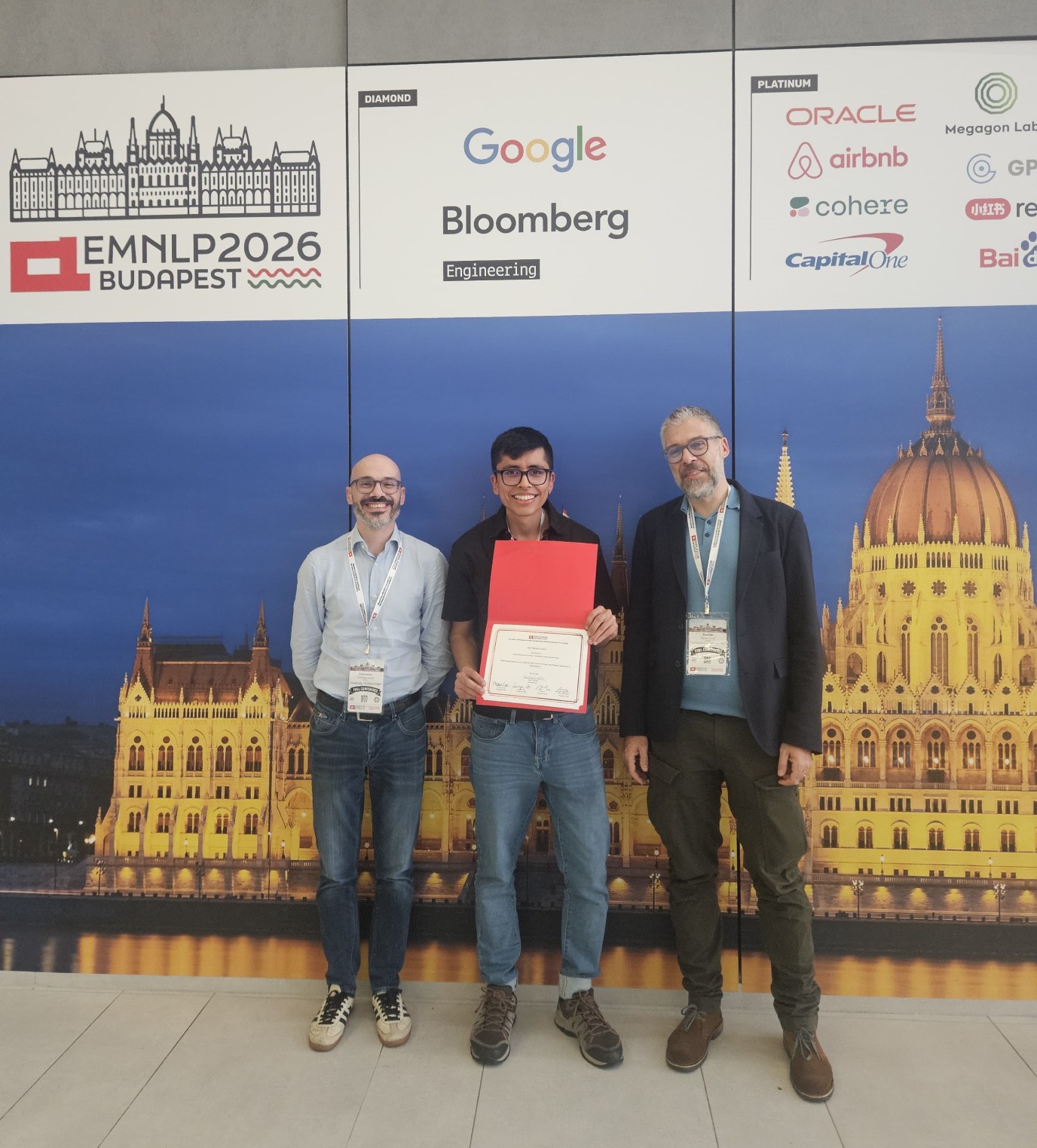
Humanities researcher Tommaso Caselli, together with his co-authors Benjamín Ocampo and Davide Ceolin from the Centrum Wiskunde & Informatica (CWI) in Amsterdam, received the Senior Area Chair (SAC) Highlight Award for their research paper on the detection of hate speech and misleading information.
Caselli is an Assistant Professor at the Centre for Language and Cognition Groningen (CLCG) and a scholar at the Jantina Tammes School (JTS). He and his co-authors were presented with this prestigious research award during EMNLP 2026, one of the leading international conferences in the field of Natural Language Processing.
Hate speech disguised as facts
Online hate speech is not limited to insults or threats. It frequently includes claims presented as facts that are not necessarily true - a tactic often seen in extremist propaganda and coordinated online harassment campaigns. Such claims can reinforce prejudices and harmful stereotypes, cause psychological harm to bystanders, and cloud public debate.
For moderators, this makes evaluating posts significantly more complex. They must not only determine whether a post is hateful or harmful, but also assess the factual accuracy of the claims it contains. This requires additional verification, which in turn demands more time.
New dataset and the use of AI
In a study titled 'When Hate Meets Facts: LLMs-in-the-Loop for Check-worthiness Detection in Hate Speech', the researchers present a new dataset that combines information about hate speech with data on whether the claims within those posts warrant factual verification.
Furthermore, the researchers developed a new method that leverages Large Language Models (LLMs) to assist in identifying and annotating verifiable claims.
Better detection of online hate
The research also shows that posts containing hate speech - along with claims that warrant fact-checking - tend to feature higher levels of hate and intimidation. Furthermore, the ability of language models to identify hate speech improves significantly when information regarding the verifiability of claims is taken into account.
By combining a new dataset with an AI-assisted annotation method, the researchers provide tools to more effectively detect and combat online hate and misleading information.
More news
-
29 October 2026
Opinion | Mending the broken branch
-
-
26 October 2026
Trump as King Midas