


When science goes green

“If science is committed to addressing global environmental challenges, then scientific practice itself should reflect those same principles.”
Laboratories are some of the most resource-intensive places within universities. Energy and water use, chemical waste, single-use materials and equipment replacement all have a negative environmental impact. How can behavioral interventions help scientists go greener?
Nearly every step of laboratory research has an outsized carbon footprint. From the energy required for constantly running fume hoods and fridges, to endless disposable gloves and pipette tips, to liters of water for experiments and for cleaning, to disposing of hazardous chemicals and frequently replacing equipment, the emissions and waste associated with chemistry labs is very significant.
A 2024 paper by University of Groningen scientist Thomas Freese and co-authors found that laboratories may account for as much as 60 to 65% of university energy consumption, and about 60% of water use.
At the University of Groningen, the annual work-related carbon footprint per researcher at the Faculty of Science and Engineering is estimated to be between 10 and 37 tonnes CO2e. To put that in perspective, the Paris Climate Agreement-aligned annual carbon budget for each person is only 1.5 tonnes CO2e.

What is a green lab?
Can science labs become more eco-friendly environments? What would a green science lab look like? Freese explains that green labs “actively reduce their environmental footprint while maintaining high-quality research and teaching.”
Freese, who is a member of Green Labs RUG and founding member of Green Labs NL, acknowledges that scientists face a paradox: “they play a crucial role in understanding environmental crises and developing solutions, yet the way science is often practiced—especially in laboratory settings—can still consume large amounts of energy and resources.”
That realization translated into action through a grassroots initiative at the University of Groningen in June 2021, when a group of researchers at the Stratingh Institute for Chemistry formed the Green Labs team.
They created a guidebook of easily implementable sustainability actions for labs, like monitoring water and energy use, reducing fume hood opening times, managing freezer temperatures more efficiently, reducing single-use plastics and gloves, and improving recycling and chemical waste practices.
Circularity and conservation
Some of the labs at the University of Groningen where Freese and his fellow Green Labs researchers have been testing out more eco-friendly science are located in the state-of-the-art Feringa building, which just opened in 2025. The labs have access to more energy efficient systems and equipment, but their unfettered access to materials and electricity can still result in high emissions and waste.
Reusing equipment and materials, repairing instruments, minimizing waste and designing experiments to avoid excessive use of scarce materials like reagents, are everyday practices in lab settings in less affluent nations. This sufficiency approach aligns well with circularity and conservation, and Freese says that universities in western countries would be wise to look to the sustainable practices of other countries and follow their lead.
Some researchers in labs that are rolling out greener practices have raised concerns about how doing their work with smaller quantities of water and chemicals could negatively impact their work. Freese says that in practice, the opposite is often true: as scientific research moves toward sustainability and thereby more rigorous documentation and transparency, scientific quality has been improving because of increased reproducibility. Higher reproducibility results in fewer failed experiments and repetition, thereby less energy, water, and hazardous chemical waste.
The role of behavior change
The behavior of individual researchers and their lab groups collectively is crucial to reducing the emissions and waste associated with the science they do. Freese, together with other researchers from the University of Groningen, recently carried out a study on what influences greener behaviour in chemistry labs.
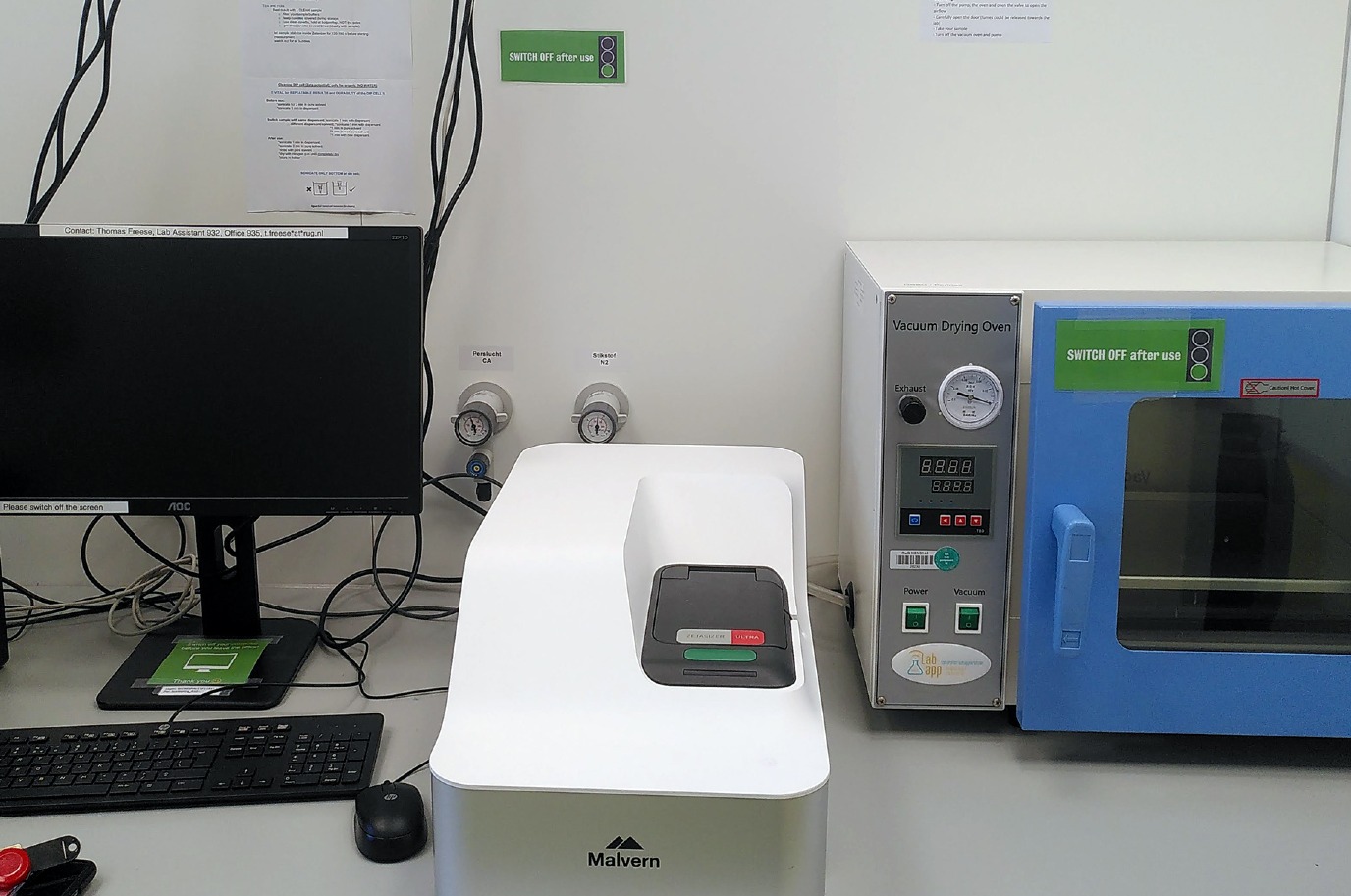
Freese and an interdisciplinary group of academics designed a range of behavioural interventions, including clear instructions and checklists, implementation intentions, visible commitments and group goals, and prompts in the lab setting. All of the interventions are relatively low-cost and could be adapted across different research fields as well. The researchers tested the interventions, evaluated their effectiveness and collected data on lab waste, energy use and fume hood opening times.
Brian Wagner is a PhD candidate in the environmental psychology group at the Faculty of Behavioral and Social Sciences, and he and Freese worked together to come up with and analyse the behavioral interventions. “This project is a cross faculty collaboration between chemists and psychologists, all working towards the shared aim of reducing the environmental impact of laboratory education while contributing their respective expertise”, Wagner says.
Influencing pro-environmental behaviour
Wagner’s field of environmental psychology focuses on what psychological factors (determinants) influence whether we behave pro-environmentally or not. Research from this field of behavioral psychology consistently finds that most people have high intrinsic motivation to act more pro-environmentally, but barriers often stand in the way of acting on that motivation.
Interventions are likelier to succeed if they effectively target sustainable behavior determinants, namely self-efficacy and social norms. Self-efficacy means people feel capable of acting sustainably in the lab, and that acting in a more environmentally-friendly manner is realistically achievable. When they feel that way, they are far more likely to adopt green lab behaviours. Social norms mean that we see our colleagues engaging in and approving of sustainable practices, which normalises those actions
We often don’t realize the real environmental impact that our jobs have. Together with Ellen van der Werff and Linda Steg, Wagner has studied what motivates employees to be more environmentally friendly while doing their job. They found that the more that people care about the environment and the more they believe their organisation cares about the environment, the more likely they are to adjust how they work to reduce their environmental impact.
Everyday actions
Wagner’s research findings that employees care about the environment and want to do more to protect it are reflected by other studies conducted in the Netherlands about what employees can do at work and how willing they are to do so. These shifts can be simple everyday actions, like reusing supplies in a lab, but they can also be things like encouraging our colleagues to act more sustainably at work and speaking up when we notice environmentally harmful practices on the work floor.
“Science is essential for understanding how to reduce environmental problems, yet science itself produces substantial emissions and waste”, Wagner says. Freese agrees: “The motivation behind the work is to align scientific practice with the values that science itself promotes: responsibility toward the environment and future generations. If science is committed to addressing global environmental challenges, then scientific practice itself should reflect those same principles.”
More news
-
19 October 2026
Concerns about reputation drive solidarity
-
08 October 2026
Diversity Week: What can I do for LGBTQIA+ acceptance?
-