

Empowering women in Vietnam to achieve their goals through a culturally responsive training
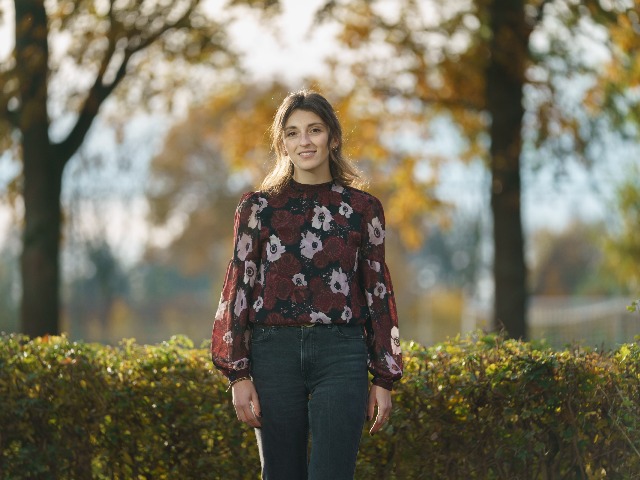
Claire Stein has received an acceleration grant to organize a dissemination workshop in Hanoi, presenting results from an interdisciplinary research initiative on women’s empowerment in Vietnam. Recognizing that pathways to goal achievement may vary across cultures, the PhD candidate co-developed a training with local partners that explores two distinct, culturally responsive models of agency. On the one hand independent agency, which emphasizes autonomy, and on the other hand interdependent agency, which prioritizes collaboration. Early results indicate promising outcomes, with participants in both groups reporting a 10% increase in monthly income.
From a young age, Stein was struck by the barriers girls and women face globally. When she joined Prof. Robert Lensink’s collaborative project in Vietnam, she learned that women benefiting from financial services in Northern Vietnam were relatively empowered in the economic sphere. However, they still carried substantial responsibilities at home. They often lacked time and space to think about their aspirations or how to achieve them. This inspired Stein and Dr. Nhung Vu (who obtained her PhD at FEB and currently works at RMIT Vietnam) to design a training focused on helping women identify, plan, and progress toward their goals.
Challenges in women’s empowerment in Vietnam
Across the world, including in Vietnam, women continue to face structural and social constraints. These include limited access to services – such as finance, health, and education – unequal participation in the labor market and leadership positions, unpaid care burdens, persistent gender norms, and internalized constraints resulting in low aspirations or confidence.
In Vietnam, as in many places, women juggle multiple responsibilities and have limited time to reflect on their own aspirations. Some also face constraints in achieving their goals because they doubt their capacities. Women’s empowerment is not only about supporting them in accessing resources, but also in supporting them to reach their full potential – which may be achieved by identifying personal goals, making them tangible, and planning pathways toward them.
Different pathways to achieve goals across cultures
In some cultures, individuals pursue their goals more independently, emphasizing autonomy and individual initiative, while in others, individuals might be more collaborative or interdependent – behaving in line with social harmony and traditions. These differences matter. If an intervention promotes messages that do not resonate with local ways of being, it might be less effective, or even counterproductive.
This means that women do not all approach their goals in the same way, and that culture especially shapes these different “models of agency”. For example, in Western contexts, independence may be emphasized, while in other societies – including Vietnam – interdependence may be equally or more important. Development programs focusing on women’s empowerment typically reflect the independence model, which may not always align with local values. In Vietnam, women show interdependent tendencies, valuing family and social harmony, but also demonstrate self-reliance. This led Stein and the research team to ask whether tailoring a training to a specific agency models could make it more effective, or if both might be effective.
Developing the training for both agency models
In collaboration with the research team, and with support from TYM microfinance institution and the Center for Women and Development (CWD) in Vietnam, Stein co-designed a training curriculum for women members of the microfinance organization. The training helps participants set realistic and tangible goals and identify pathways to achieve them, with a focus on self-efficacy – for example, recognizing personal strengths – and communication skills.
This project recognizes the importance of culture in achieving goals and explores different ways of supporting women in moving toward them. Therefore, two versions of the training using the same curriculum were created. The structure and activities are identical, but the messages conveyed differ because of the two possible agency models. For instance, both versions include a video of a role model who aspires to open a small shop. In one version, she reaches her goal through a more independent approach, while in the other, she does so more collaboratively, reflecting an interdependent approach. The full “Progress with Your Goals” curriculum is available online.

10% increase of reported monthly income for both groups
The first goal of the training was to improve outcomes for the women who participated, and the results are encouraging. The training increased reported monthly income by about 10% for both versions compared to the control group. There were no significant differences between the independent and interdependent versions, suggesting that in this context, multiple pathways may be effective.
Around 610 female members completed the 14-hour curriculum, delivered over two months in bi-monthly sessions – an 80% participation rate. The 370 women in the control group may receive the training later if the partner organization expands implementation. The research team is currently evaluating a range of outcomes: behavioral (e.g., willingness to compete), psychosocial, relational, and economic.
Improving the impact of interventions globally
Although designed and implemented in the Vietnamese context, the general approach of the training is relevant globally: many women face similar time constraints and internalized limitations. In addition, designing interventions that are more culturally sensitive can improve their impact.
The acceleration grant supported a recent dissemination workshop in Hanoi (September 2025), held in hybrid format. Around 30 participants joined – from research institutes, policy organizations, and NGOs in Vietnam and beyond. The workshop focused on lessons learned, early results, and opportunities for replication, scale-up, and research–practice collaboration.
Empowerment through coexisting agency models beyond the project
Stein hopes the findings contribute to the broader literature by showing that different forms of agency can coexist and work in practice. She is also interested in future questions, such as whether some individuals or environments are more adaptable, making several approaches equally viable.
Finally, she hopes the intervention itself will be useful beyond this study. Policymakers and practitioners in Vietnam and other countries could adapt and apply the training to support women’s goals in culturally responsive ways. Following the workshop, Stein and her team will continue sharing results and promoting the intervention developed through this project, hoping to forge new collaborations.
Learn more about the project on the UG website.