Religion, Equity and Environmental Justice
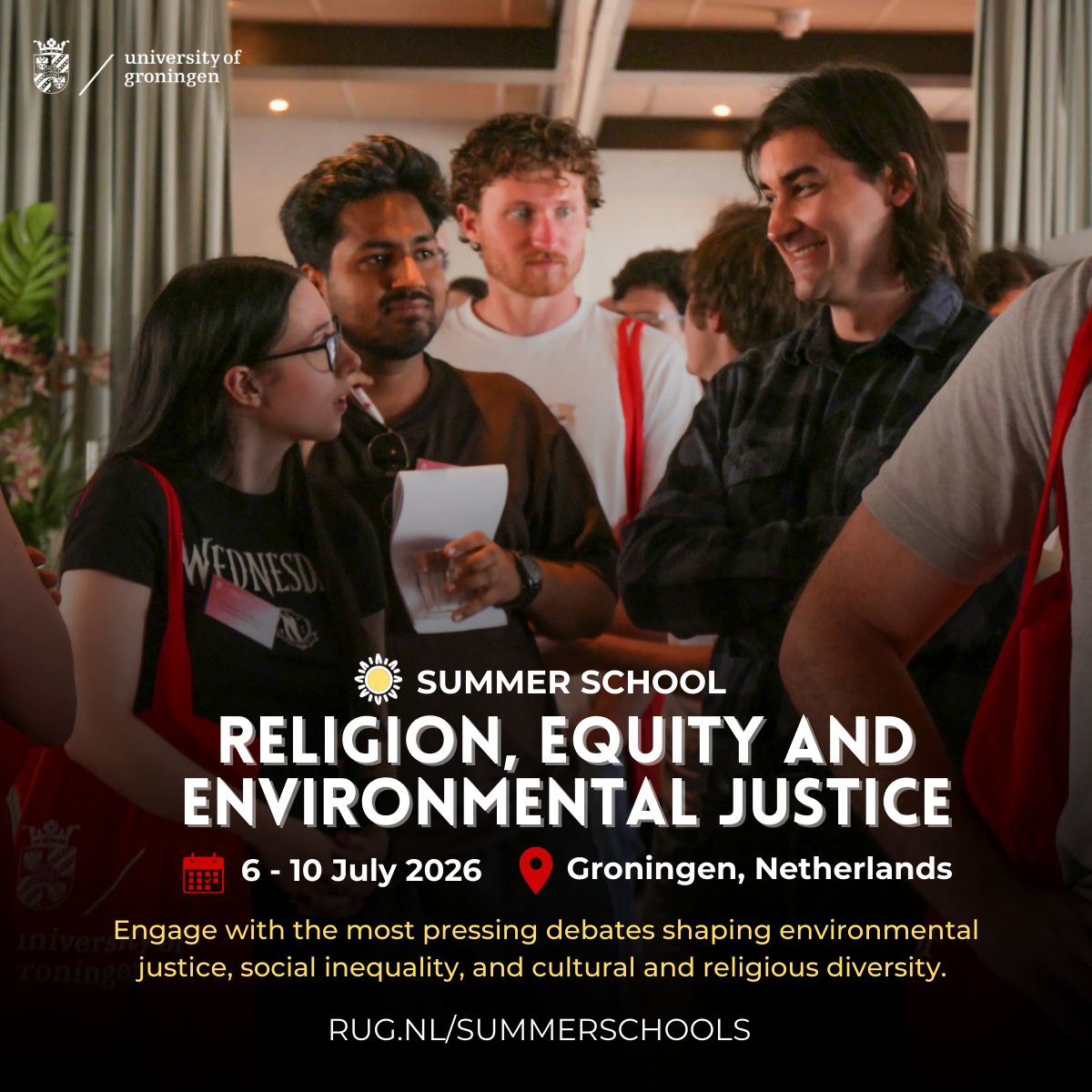
Are you interested in how religion, equity, and environmental justice intersect in contemporary societies? This interdisciplinary summer school offers a unique opportunity to engage critically with some of the most pressing debates shaping environmental justice, social inequality, and cultural and religious diversity today.
Over five intensive days, you will work closely with an international team of scholars through interactive lectures, facilitated discussions, and hands-on workshops. The programme combines theoretical perspectives from religious studies, sociology, anthropology, and political science with empirical case studies from diverse global contexts. Key questions include: How do religious worldviews shape responses to climate change and environmental injustice? In what ways do religion and belief intersect with gender, migration, inequality, and environmental governance? How can insights from the study of religion inform more equitable and just policies and practices at the intersections of cultural diversity, gender equality, and sustainability?
Beyond thematic knowledge, the summer school places a strong emphasis on academic and professional skill development. You will strengthen your research design, writing, and presentation skills, receive practical guidance on research funding and proposal development, and gain experience presenting and discussing your own work in a supportive, interdisciplinary setting. Participants will also become part of the GRACE-ETN alumni network, offering continued opportunities for international exchange, collaboration, and professional networking beyond the duration of the course.
Hosted in a hybrid format by the University of Groningen, the summer school also invites you to experience Groningen and the north of the Netherlands, while engaging with a vibrant academic community at one of Europe’s leading research universities.
Practical information
|
Dates
|
6 - 10 July 2026
|
|
Location
|
On-site in Groningen, the Netherlands and online participation is possible
|
|
Level
|
MA, PhD, Postdoc and early-career researchers |
|
Fees
|
No fees (third-party funding from ENLIGHT) Travel and accommodation fully reimbursed with ENLIGHT funding 2 dinners, 5 lunches, coffee breaks and course materials are included |
|
Academic coordinators
|
Manoela Carpenedo, Faculty of Religion, Culture and Society Ana Fernández-Aballí, Faculty of Religion, Culture and Society Julia Martínez-Ariño, Faculty of Religion, Culture and Society |
|
Contact |
Manoela Carpenedo and Julia Martínez-Ariño |
Requirements
Level and background requirements
This summer school is intended for MA students, PhD candidates, postdoctoral researchers, and early career researchers who work on, or are interested in, the intersections of religion, equity, and environmental justice. It is particularly relevant for participants from the social sciences and humanities, including religious studies, sociology, anthropology, political science, gender studies, migration studies, and environmental humanities.
Participants are expected to have, at least, started their MA programme at the time of application and to have a sufficient command of the English language to actively participate in the discussions and to present their own work in English. As the summer school is primarily aimed at candidates from the social sciences and humanities, applications from those in these fields will be prioritised over applicants from other disciplinary backgrounds.
Participants should have a basic familiarity with academic research and an interest in interdisciplinary perspectives on religion, equity, and environmental justice. While prior expertise in all three areas is not required, applicants should be motivated to engage critically with theoretical debates, empirical case studies, and peer discussions.
Who is this summer school designed for?
The course is designed for participants who seek to deepen their theoretical and empirical understanding of how religious beliefs, practices, and institutions shape responses to social inequality and environmental challenges across diverse contexts. It will also benefit those interested in interdisciplinary approaches, comparative perspectives, and the societal and policy implications of research on religion, climate justice, and equity.
Applicants who wish to strengthen their academic skills, engage in critical discussion, present their own research in an international setting, and build long-term connections with peers and senior scholars will find this summer school particularly valuable.
It is expected that the participants have a sufficient command of the English language to actively participate in the discussions and to present their own work in English.
Availability of spots and funding
Available places and funding
A total of 24 places are available under the following categories:
-
10 fully funded places for participants from ENLIGHT universities
Funding includes tourist class travel costs (up to €500), accommodation, summer school fee, course materials, coffee breaks, 5 lunches and 2 dinners. -
2 fully funded places for participants from non-ENLIGHT GRACE-ETN partner institutions
Funding includes tourist class travel costs (up to €500), accommodation, summer school fee, course materials, coffee breaks, 5 lunches and 2 dinners. -
2 fully funded places for students from low- or middle-income countries
Funding includes tourist class travel costs (up to €1500), course materials, coffee breaks, 5 lunches and 2 dinners. -
6 partially funded places
The summer school fee and course materials are covered; travel and accommodation costs are borne by the participant. Coffee breaks, 5 lunches and 2 dinners are included. -
4 places for hybrid participation
These places cover online participation in all academic activities. Applicants opting for hybrid participation are asked to consider time-zone differences when applying.
Accommodation
Accommodation for fully funded places will be arranged in student accommodation provided by the university. Participants in non-fully funded places may also use this accommodation at a discounted university rate. All accommodation consists of private rooms with a private bathroom.
Cancellation policy
Participants who cancel more than 4 weeks before the start of the course are liable to pay 15% of the full course fee, unless the Summer School in question decides otherwise.
Participants who cancel within 4 weeks before the start of the course are liable to pay the full course fee, unless the Summer School in question decides otherwise.
Participants who withdraw during the course are liable to pay the full course fee, unless the Summer School in question decides otherwise.
Course schedule
Learning approach
The summer school combines interactive lectures, skills-based workshops, hands-on methodological workshops, and participant presentations. All activities are delivered live and emphasize active participation, peer learning, and practical application. Teaching formats include short lectures, facilitated discussions, group work, practical exercises, and structured feedback sessions.
Throughout the week, participants will actively engage with instructors and peers, present and discuss their own work, and receive structured feedback. The programme balances conceptual depth with transferable academic skills while fostering long-term connections within the GRACE-ETN network. To support informal exchange and community building, participants will share daily lunches and two group dinners during the week.
Preliminary programme
Monday
-
Welcome session, icebreaker, and framing of key questions (interactive lecture)
-
Religion, equity, and environmental justice: core concepts and debates (interactive lecture)
-
Researching religion through a gender lens (hands-on methodological workshop)
Tuesday
-
Academic oral presentation skills (skills-based workshop)
-
Survey research methods in the social sciences (hands-on methodological workshop)
Wednesday
-
Transdisciplinary research methodologies (hands-on methodological workshop)
-
Research funding basics: opportunities, strategies, and proposal logic (skills-based workshop)
-
Free afternoon / informal networking activity
Thursday
-
Climate conflicts, equity, and environmental justice (interactive lecture)
-
Community knowledge and participatory approaches (interactive lecture)
-
Student research presentations (small-group presentation and feedback sessions)
Friday
-
Academic CVs and career pathways (skills-based workshop)
-
Student research presentations (small-group presentation and feedback sessions)
-
Collective reflection, evaluation, and closing session (plenary discussion)
Learning outcomes
Learning outcomes
After this course you will be able to:
-
Critically engage with key theories and debates on the study of religion in relation to equity and environmental justice.
-
Apply interdisciplinary perspectives and methodological approaches to analyse empirical cases at the intersections of religion, environmental justice, and social inequality.
-
Develop core professional skills relevant to academic careers, including research design, funding awareness, and academic career planning.
-
Strengthen research communication skills through effective oral presentation, structured feedback, and interdisciplinary dialogue.
Workload
-
Preparation: 8 hours
Participants are expected to prepare in advance by reading selected literature, reflecting on key concepts related to religion, equity, and environmental justice. -
Contact hours (lectures, workshops, discussions): 16 hours
The programme includes five days of in-person activities, combining interactive lectures, methodological workshops, skills-based sessions, and facilitated discussions. Daily contact time ranges between 2 and 4 hours, in line with the published schedule. -
Presentations and active participation: 4 hours
Participants will present and discuss their own work in small-group sessions and actively engage in peer feedback, group discussions, and collaborative exercises throughout the week.
Upon successful completion of the programme, the Summer School offers a Certificate of Attendance that mentions the workload of 28 hours (28 hours corresponds to 1 ECTS). Students can apply for recognition of these credits to the relevant authorities in their home institutions, therefore the final decision on awarding credits is at the discretion of their home institutions. We will be happy to provide any necessary information that might be requested in addition to the certificate of attendance.
Proof of Competence (digital credential)
Participants who successfully complete the summer school (including the final assignment) have also the possibility to obtain a Proof of Competence (digital credential) to acknowledge participation and engagement with the content. Participants who qualify for a Proof of Competence can obtain a digital badge via the EduBadges platform managed by SURF— the cooperative of Dutch education and research institutions. The digital badge is stored on this platform and contains metadata, making the content, learning outcomes, study load hours and language of instruction of the educational activity clear and transparent. The digital badge is therefore verifiable and can be shared on, for example, a CV or LinkedIn.
Application procedure
How to apply?
To apply, kindly fill out the online application form. Please note that you will be asked to upload the following documents:
-
Curriculum Vitae (max. 2 pages)
-
Motivation letter, clearly stating why you want to join this summer school, what you will bring to the school and what you hope to learn (max. 1 page)
Before applying, please refer to the sections on Requirements and Availability and funding.
The deadline for application is 9 March 2026, 23:59 CET. Selection will take place after the deadline has passed.
All complete applications submitted by 9 March 2026 (23:59 CET) will be reviewed together. Shortly after the closing of the application deadline, the selection committee will meet to assess applications. Selection will be based on academic background, motivation, relevance of the summer school to the applicant’s interests, and overall balance of the cohort. Gender balance and inclusion criteria will be explicitly taken into account.
Applicants will be informed of the outcome shortly after the selection meeting. Once accepted, participants will receive instructions to confirm their participation and complete the required enrollment steps within the indicated timeframe.
Participants will be expected to attend 100% of course sessions and fulfil all assessment requirements. Failure to do so will result in the cancellation policy being applied.