Developing Across Differences:The DMIS at Forty
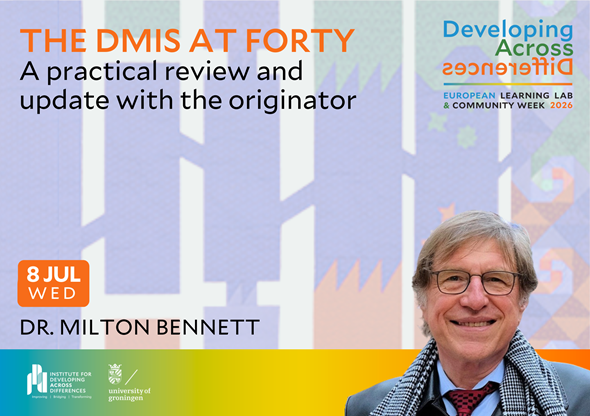
Proposed in 1986, the Developmental Model of Intercultural Sensitivity (DMIS) remains a leading perception-based approach to intercultural relations, bridging global and domestic multicultural contexts. In this 1-day session, DMIS originator Dr. Milton J. Bennett will trace its conceptual development, address common misunderstandings, and offer practical applications for today’s rapidly evolving social landscape.
Why should you attend?
The Developmental Model of Intercultural Sensitivity (DMIS) was conceived to answer the question, “what to do next.” For intercultural trainers, it offers a clear rationale for sequencing topics so trainees are not over- or underwhelmed on their path toward greater intercultural competence. For educators, it provides a coherent pedagogical model grounded in constructivist principles that foster critical thinking and consciousness development. For coaches, it serves as a diagnostic framework that suggests different interventions depending on readiness. And for consultants, it offers a vision of mutual adaptation that supports organizational and social viability in uncertain futures.
Forty years later, it’s old enough to have been tested, but still young enough to push back. With a theoretical base aligned with advances in neuroscience and social applications of quantum mechanics, the DMIS operates at multiple levels of complexity—making it both a strong introduction and an equally strong advanced application.
Join Dr. Milton J. Bennett, who developed the model, to explore how engaging otherness helps overcome ethnocentrism, consider the co-ontogenic and ethical implications of ethnorelativism, and reframe professional practice to support intercultural competence and consciousness.
Practical information
|
Dates
|
8 July 2026
|
|
Location
|
Academy Building (Broerstraat 5) or Harmonie Building (Oude Kijk in Het Jatstraat 26)
|
|
Level
|
PhD/Postdoc/Practitioners May be appropriate for some MA students; contact the organisers for consultation about eligibility |
|
Fees
|
€ 615 (until early-bird deadline, 14 February 2026) € 650 (after early-bird deadline, 14 February 2026) The fee includes course and materials, optional evening programming |
|
Academic coordinators
|
Dr. Milton Bennett |
|
Contact |
ic rug.nl or info iddifferences.org |
Requirements
This course is for you if are:
-
An early-career level intercultural practitioner (trainer, facilitator, consultant, coach) who wants a solid and updated introduction to the DMIS to inform your intercultural work of helping people in overcoming ethnocentrism.
-
An intermediate-/advanced-level practitioner (trainer, facilitator, consultant, coach) who designs and delivers intercultural training / learning in either domestic multicultural or global intercultural contexts and wants to support your audiences’ development of intercultural competence and consciousness.
-
Academic / scholar working in intercultural communication and related fields who wishes to explore an updated introduction to the DMIS from the originator.
Contact the organisers at ic rug.nlor info iddifferences.orgif you have questions about the suitability of this course for your circumstances.
Level requirements
The DAD is for multipliers who help individuals, organizations and societies better recognize, appreciate and use differences as a way of better communicating, working and thriving together.
These are (in-house and external) trainers, educators, consultants, coaches, researchers, scholars, facilitators, HR staff, advanced-level (MA+) students, and professional development specialists with 5+ years of experience/study in the greater Differences field. Contact the organisers at ic rug.nl or info iddifferences.org for consultation about appropriateness and eligibility.
It is expected that the participants have a sufficient command of the English language to actively participate in the discussions and to present their own work in English.
Course schedule
Course schedule
Monday, 6 July
15.00-18.00 Optional networking event
Wednesday, 8 July
09.00-17.30
Learning approach
This course format is one that uses conceptual inputs, discussion, and peer sharing.
Learning outcomes
In this course, you will learn how to help yourself and those you work with so that you/they can better:
-
Understand the DMIS’s enduring theoretical foundation of perceptual constructivism.
-
See how using the DMIS in perceptual terms makes it a more powerful diagnostic and guide for intervention.
-
Consider how the DMIS can be used to explain some aspects of our current global unrest and how it could provide a path towards a more viable multicultural future.
Workload
6 hours of in-class learning and active participation using experiential methods.
Upon successful completion of the programme, the Summer School offers a Certificate of Attendance that mentions the workload of 6 hours (28 hours corresponds to 1 ECTS). Students can apply for recognition of these credits to the relevant authorities in their home institutions, therefore the final decision on awarding credits is at the discretion of their home institutions. We will be happy to provide any necessary information that might be requested in addition to the certificate of attendance.
Application procedure
|
Deadline for application
|
Early bird registration closes on 14 February 2026. |
|
Date of selection
|
Within 72 hours following registration, you will be contacted directly by the organisers about your application. |
|
Application
|
Participants submit payment and details about their interest at the link below (click the "Apply now!" button). They will be contacted directly by the organisers about their experience and the suitability of the course.
|
Please note that as all courses are subject to meeting minimum enrolments, the DAD team will confirm on or before 19 May 2026 that your course is taking place. We strongly advise you not to book non-refundable travel until you have received this confirmation. In all cases, refunds for courses are not available except in the case of course cancellation by the DAD organisers. In the case that your preferred course is cancelled, you are welcomed to enroll in an alternative course or request a refund. You will be notified on or before 19 May 2026 if the DAD course is cancelled. This policy is different from that of other University of Groningen Summer School and Language Centre courses. Full details are available on the Developing Across Differences (DAD) Learning Lab & Community Week Terms and Conditions page.