Developing Across Differences: Psychological & Social Safety Today
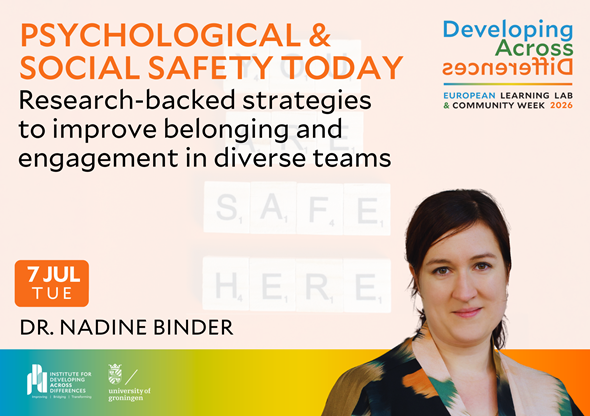
Research shows conclusively that psychological and social safety are essential preconditions for collaboration across differences, innovation, learning and growth in diverse teams. Building this sense of security in rapidly changing times can be challenging, but is possible to do successfully. This 1-day workshop demonstrates how, giving you a research-backed framework to create safety practices that serve all, not just the majority or the loudest voices.
Why Attend?
Studies clearly show that teams need psychological and social safety in order to collaborate effectively across differences and to support innovation, learning, and growth. In fast-changing environments and diverse teams, establishing this sense of safety can be difficult, yet it is entirely possible. This 1-day workshop offers a practical, evidence-informed four-step framework for shaping psychological and social safety practices that include and protect all members of the team, rather than centering only certain preferences, needs, or voices.
Going beyond buzzwords and one-size-fits-all tips, this workshop first examines what science says about how the differences in our identities and access to privilege and power shape our experiences of safety in groups today.
It then turns these insights into practical, customizable strategies that you can use — or help others use — to design settings and encourage behaviours that promote safety and effectiveness in your teams.
Throughout the course, you will map your own context and start designing a practical action plan ready to evolve further, test, and implement beyond the course.
Practical information
|
Dates & location
|
7 July 2026 Academy Building (Broerstraat 5) or Harmonie Building (Oude Kijk in Het Jatstraat 26) |
|
Level
|
PhD/Postdoc/Practitioners May be appropriate for some MA students; contact the organisers for consultation about eligibility |
|
Fee
|
€ 615 (until early-bird deadline, 14 February 2026) € 650 (after early-bird deadline, 14 February 2026)
The fee includes course and materials, optional evening programming
|
|
Academic coordinators
|
Dr. Nadine Binder |
|
Contact
|
ic rug.nlor info iddifferences.org
|
Requirements
Participant profile
This course is for you if you work with people from diverse backgrounds and identities and who want to build psychologically and socially safe environments, in roles such as:
● Organizational development trainers / facilitators, consultants and coaches,
● Higher education staff and faculty, program leaders, student support, international offices
● HR: People managers, Organizational leaders, L&D professionals,
● Diversity, Inclusion and Collaboration specialists
● Leaders who work with diverse interest holders whose differences span cultures, disciplines, functions, geographies or other considerations
No prior knowledge is required. Previous experience facilitating groups or leading teams will help you apply the tools immediately to your context.
Contact the organisers at ic rug.nl or info iddifferences.org if you have questions about the suitability of this course for your circumstances.
Level requirements
The DAD is for multipliers who help individuals, organizations and societies better recognize, appreciate and use differences as a way of better communicating, working and thriving together.
These are (in-house and external) trainers, educators, consultants, coaches, researchers, scholars, facilitators, HR staff, advanced-level (MA+) students, and professional development specialists with 5+ years of experience/study in the greater Differences field. Contact the organisers at ic rug.nl or info iddifferences.org for consultation about appropriateness and eligibility.
It is expected that the participants have a sufficient command of the English language to actively participate in the discussions and to present their own work in English.
Learning outcomes
In this course, you will learn how to help yourself and those you work with so that you/they can better:
1. Articulate a deeper understanding of psychological and social safety and how identity, context, and power dynamics shape risks, needs, and perceptions across differences.
2. Design concrete strategies using a four-step process to intentionally support psychological and social safety across different groups and situations.
3. Plan for specific circumstances and take a draft action plan back to your own context to build further, test and implement.
Workload
6 hours of in-class learning and active participation using experiential methods.
Upon successful completion of the programme, the Summer School offers a Certificate of Attendance that mentions the workload of 6 hours (28 hours corresponds to 1 ECTS). Students can apply for recognition of these credits to the relevant authorities in their home institutions, therefore the final decision on awarding credits is at the discretion of their home institutions. We will be happy to provide any necessary information that might be requested in addition to the certificate of attendance.
Course schedule
Course schedule
Monday, 6 July
15.00-18.00 Optional networking event
Tuesday, 7 July
09.00-17.30
LEARNING APPROACH
This course blends evidence-based input with practical, hands-on application. You’ll map your team context, work with tools and scenarios, and use a four-step framework to design and refine an actionable safety practice plan you can test and adapt.
Introduction to lecturer

Nadine Binder, PhD
Psychologist Dr. Nadine Binder is a certified professional Co-Active coach (CPCC), trainer, university lecturer, and consultant who supports individuals, teams, and organizations in their development, providing them with proven tools and techniques to help them realize their full potential and connect deeply and meaningfully with others. She specializes in Diversity, Equity, Inclusion, intercultural communication and global leadership, personal leadership, and mental health awareness.
In addition to her applied work as a coach, trainer, and consultant, Nadine publishes research on topics such as the intersections between intercultural competence and DEI, intercultural and global competence development and assessment as well as global leadership.
Dr. Binder holds external lecturer positions at various universities in Germany where she regularly teaches courses on diversity training, cross-cultural management, and intercultural business communication. She is the co-founder and co-host of the Globally Conscious Peacemakers (GCP) and is a partner at the Institute for Developing Across Differences (IDD).
Application procedure
|
Deadline for applicatio
|
Early bird registration closes on 14 February 2026. |
|
Date of selection
|
Within 72 hours following registration, you will be contacted directly by the organisers about your application. |
|
Application
|
Participants submit payment and details about their interest at the link below (click the "Apply now!" button). They will be contacted directly by the organisers about their experience and the suitability of the course.
|
Please note that as all courses are subject to meeting minimum enrolments, the DAD team will confirm on or before 19 May 2026 that your course is taking place. We strongly advise you not to book non-refundable travel until you have received this confirmation. In all cases, refunds for courses are not available except in the case of course cancellation by the DAD organisers. In the case that your preferred course is cancelled, you are welcomed to enroll in an alternative course or request a refund. You will be notified on or before 19 May 2026 if the DAD course is cancelled. This policy is different from that of other University of Groningen Summer School and Language Centre courses. Full details are available on the Developing Across Differences (DAD) Learning Lab & Community Week Terms and Conditions page.