
From theory to tap water: Ditmer's internship experience at Vitens
Ditmer is a third-year BSc Data Science & Society (DSS) student at Campus Fryslân, University of Groningen. Next to his studies, he works as a working student data science and also writes stories, both in text and comic form. In his free time, he enjoys reading, playing games or hanging out with some friends.
This year, though, he added something new to that mix: a curricular internship at Vitens, the largest drinking water company in the Netherlands. I asked him what it was like to swap the Campus Fryslân classrooms for big meeting rooms and theoretical models for real-world datasets, and here is what he had to share.
Stepping outside of the classroom
For Ditmer, choosing an internship as part of his minor came down to two clear motivations.
“While I already learned a lot during my bachelor, it felt like a large part of my data science knowledge was theoretical,” he told me. “I wanted to experience how it is to actually be a data scientist within a large organization.”
There was another reason, too. “I also wanted to take a step back from the course structure of education and experience learning in a different way.”
That desire to test his skills in a professional setting and to see what data science looks like beyond assignments and deadlines pushed him to look for something that felt meaningful and connected to society.
Knocking on doors and sending 12 emails
Finding the internship, however, was not straightforward.
“The application process was perhaps the hardest part of the journey”
Ditmer shared that "there are only a few companies that offer internship positions through vacancies, and often they ask for people with a diploma or experience.”
After several rejections, he decided to change his strategy. “I started emailing companies an open application asking if they would like a data science intern.” He focused on organisations that contribute to society or interact with it in visible ways, something that matches both his personal interests and the spirit of the DSS programme.
“In the end, I think I sent about 10 to 12 emails to different companies, of which only two responded.” Vitens was one of them, and after an interview, things finally started moving. “After that, everything related to officially organising the practicalities went quite smoothly.”
The first weeks: a lot at once
Starting at a large organisation was, for Ditmer, a steep immediate learning curve.
“I was immediately involved in meetings and team consultations, and we had to set up all the digital environments in the first days”.
He had expected that adjusting would take time (“you have to get to know the company and its practices”) but that does not necessarily make the first days less overwhelming. Still, adaptation came quickly. “After two or three weeks, I became used to it.”
Learning to explain what you do
One of the biggest lessons had little to do with coding and everything to do with communication.
“I think the biggest learning experience of my internship was how to convey the topic of data science to people without a similar technical background”
At university, presentations usually happen in front of classmates and lecturers who already understand the basics of machine learning and statistics. In a company like Vitens, the audience can be completely different. “It is quite different explaining machine learning models and statistics to people who have not studied it.” Learning how to translate technical insights into language that colleagues from other departments can actually use turned out to be just as important as building the models themselves.
Seeing theory in practice
The internship also gave more context to concepts from the DSS curriculum.
“Besides improving my presentation skills, the internship helped give more context to the things we learn in the DSS programme,” he said. “I came across machine learning models and legislation during my internship that I had only learned about as a theoretical framework. Now I have experienced how it is to apply those in practice.”
Working within a regulated sector like drinking water means that data science is never detached from policy, safety standards, and public responsibility. Seeing how legislation and models interact in day-to-day decisions gave him a clearer understanding of how layered the field really is.
Shaping what comes next
Spending several months inside a large organisation also helped Ditmer figure out what energises him most.
“Doing this internship helped me figure out what topics I find most interesting within the broad field of data science,” he reflected.
“Creating models for complex problems and thinking outside the box to find solutions or different approaches were the things I enjoyed the most.”
Ditmer's advice for future interns
For students considering a curricular internship, Ditmer advices:
“Don’t get discouraged if companies reject you or won’t respond to your application."
Behind that advice is his own experience of persistence: ten to twelve emails, several rejections, and eventually a spot at a company that supplies drinking water to millions of people. For DSS students wondering whether an internship is worth the effort, his story suggests that stepping outside the classroom can offer something lectures cannot: the experience of seeing your code, your explanations, and your decisions matter in a context that reaches beyond campus.
About the author
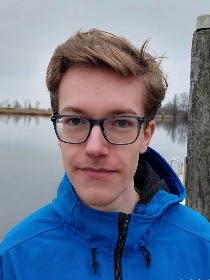
Hey, I am Ditmer a student of the BSc Data Science & Society at Campus Fryslân, University of Groningen. I like diving into complex topics and subjects, both technical and social. In my free time I enjoy reading, and writing stories where these themes are combined