
International partnership in practice: Dr Martin Massawe's PhD journey
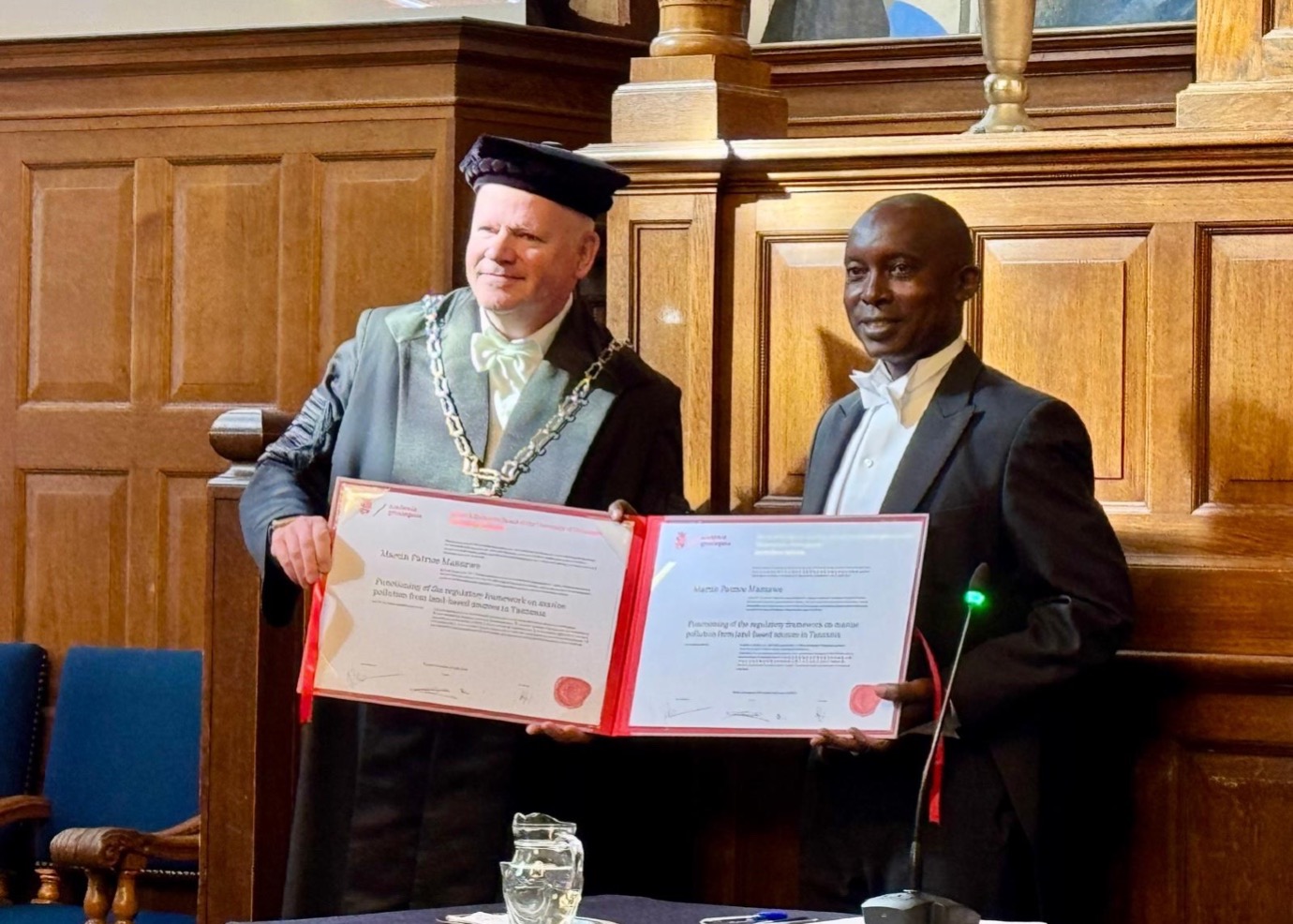
Recently, Dr. Martin Massawe (Law) successfully defended his PhD at the University of Groningen. Completing a joint PhD with limited financial resources, he combined determination, international collaboration, and careful planning to reach this milestone. In this interview, Dr. Marian Counihan (UCG) speaks with him about his PhD journey, the support that made it possible, and how the experience will shape his future work at Mzumbe University in Tanzania.
How did you come to work with Groningen?
"Mzumbe University has collaborated with the University of Groningen since 2005, and several Mzumbe staff have graduated from the university. There has been a partnership between the School of Public Administration and Management and the University of Groningen for more than 20 years. Through this collaboration, I was offered a PhD position as an external PhD candidate.
I am a lecturer at the Faculty of Law, so when the opportunity opened up, I applied. I was interviewed by Professor Albertjan Tollenaar, the head of the Graduate School, who was visiting Tanzania at the time. During that visit, we also agreed that he could act as my supervisor.
I was originally scheduled to start in 2021, but the start date was delayed due to COVID-19. I first came to Groningen in 2022 for a summer school, and then officially started my PhD in January 2023. I later returned for a winter school and began working on my proposal."
How was your PhD process?
"I completed my PhD through publications. I wrote four papers, along with an introduction and conclusion. Before starting in 2023, I had to prepare a study plan, and since I only had three years of leave from my home university, I knew I needed to stay focused and work efficiently.
I published two papers in 2024, another in 2025, and the final paper is currently under review. The process moved quickly because of the quality and strictness of the supervision I received. Towards the end, we were meeting weekly online.
It was my wish to pursue a PhD earlier, but there were no scholarships or opportunities. This was my first chance, and I am happy it was successful. My PhD was funded through a combination of Erasmus+ mobility grants, Sub-Saharan Africa travel grants, and support from Mzumbe University, which covered my stipend.
In total, I came to Groningen four times. My last visit was in 2025, when I stayed for several months to write the overarching introduction and conclusion. I am here again for my defence, supported by the Sub-Saharan Africa grant. This funding is very important for capacity building at Mzumbe.
The supervision process here was very different from what I was used to. My supervisor was a fast, thorough reader who provided timely feedback and clear guidance. Supervision makes a huge difference, and I was fortunate to receive excellent support, even compared with my bachelor’s and master’s studies."
What opportunities helped you in this process?
"The Erasmus+ mobility programme and Sub-Saharan Africa grants were essential, particularly for travel. I also benefited greatly from the academic and social environment and from access to the University of Groningen library—even while I was in Tanzania.
The University of Groningen offers excellent facilities. During my visits, I made full use of them, including accessing and copying materials that were not available online.
I also participated in faculty activities, including a research retreat on Schiermonnikoog, where PhD candidates and staff presented their work. This helped me build connections that I maintained even after returning to Tanzania.
The Graduate School also organises online sessions two or three times a year for external PhD candidates. These sessions focus on progress, research methodology, and integrity, and they also bring in alumni to share their experiences. It created a strong sense of community among students from around the world.
In addition, Dr Anita Kram from the Graduate School of Law and Maarten Goldberg from the University of Groningen provided continuous administrative support, which was extremely helpful. For a committed student, this environment makes it possible to complete the PhD efficiently.
Finally, I received a grant to print my dissertation as a book, which was a very nice opportunity."
What challenges did you face?
"I cannot think of any major challenges. Whenever I encountered difficulties, my supervisor was consistently responsive and supportive. For example, when I needed assistance with the embassy, he contacted them directly and helped me secure an appointment."
What suggestions do you have to improve the partnership?
"Staying in Groningen for a longer period would be beneficial. Working from home can be more difficult due to additional responsibilities, distractions and challenges such as unreliable internet connections."
How has this experience shaped you, and what will you take back to Mzumbe?
"One key lesson is the importance of rigorous and consistent supervision, especially for PhD students. A PhD is a major project, and students need structured guidance to complete it on time.
I also benefited from workshops on topics such as managing stress during the PhD journey. I realised that many PhD students experience stress and may struggle to recognise their progress, which can affect their mental health. Support systems are therefore essential.
When I return to Mzumbe, I will carry this approach with me—maintaining regular contact with PhD students, monitoring their progress, and offering support as needed. That level of engagement is very important."
Can you tell me about your PhD?
"My PhD examines the effectiveness of the regulatory framework addressing marine pollution from land-based sources in Tanzania. Pollution from sources such as untreated industrial and domestic wastewater often enters marine and freshwater environments without proper treatment, in violation of both international and domestic law.
However, enforcement remains weak due to a combination of legal and practical barriers. One key legal barrier I examined is restrictive locus standi, which previously required individuals to demonstrate a personal interest in a case before bringing environmental claims. This is problematic, as environmental harm typically affects society as a whole rather than specific individuals.
After I published a paper on this issue, the Supreme Court of Tanzania changed its approach, allowing public interest litigation without requiring proof of personal interest."
What are your future plans?
"I will return to my position at Mzumbe University, where I hope to improve student supervision practices. I also plan to develop policy briefs based on my PhD findings to ensure that policymakers can access and use this research. This is an important way to create real-world impact. I will maintain network with colleagues of the University of Groningen and collaborate with them in research and other projects."
More news
-
-
03 September 2026
Ming Cao reappointed as scientific director of the Jantina Tammes School
-
01 September 2026
Evrim Ursavas appointed scientific director Wubbo Ockels School