
Disinheritance is about much more than money
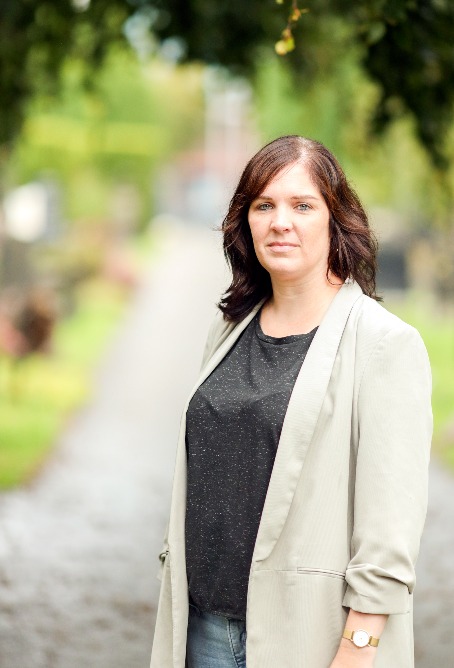
Your parents have passed away, but due to disinheritance, you have no right to photos or a piece of furniture. What does this mean for a child? The social and emotional impact of disinheritance has barely been studied. Sociologist Marieke Haan is changing that. Her research is still ongoing, but one thing is already clear: disinheritance hits hard. ‘Such a rejection has a major impact on almost everyone.’
Text: Beau Oldenburg, Faculty of Behavioural and Social Sciences / Photos: Henk Veenstra
Imagine this: your father passes away and leaves you a final message. Not in words, but in money - or rather, in the money you do not receive. You discover you have been disinherited. Maybe you do not know exactly why. Was it that argument that was never fully resolved? The partner you brought home? Something your father never told you? You can no longer ask him.
Legally speaking, you are not left entirely empty-handed. As a disinherited child, you can claim the 'legitime portie' (legitimate portion): the statutory minimum share of an inheritance. This usually amounts to roughly half of what you would have received had you not been disinherited. On paper, it is a safeguard against complete exclusion. But does such a provision ease the pain? Or is it merely a sticking plaster?
Broad Support
Since 2023, sociologist Marieke Haan has been researching disinheritance and the legitimate portion. The exact prevalence of disinheritance is unknown. It is not an official statistic, and the legitimate portion must also be claimed by the disinherited individual themselves. ‘That does not always happen,’ says Haan. Yet there are indications that disinheritance is becoming more common. ‘There are more divorces, and family relationships have become more complex, for example due to the rise of blended families.’
A few years ago, Haan - together with colleagues from the Faculty of Law - researched for the Dutch Research and Documentation Centre (WODC) whether there was still societal support for the legitimate portion. The study involved questionnaires and interviews with parents, disinherited children, siblings, policymakers, judges, and notaries. The result was striking: the legitimate portion still enjoys broad support.
According to Haan, this is linked to the importance Dutch people attach to family. ‘Contrary to what is often thought, families are generally still close. Digital communication has not changed that. Precisely because family is so important, disinheritance is seen as something very serious.’ The legitimate portion offers children a final legal certainty in such cases. ‘The idea is that the bond of care between parent and child essentially exists throughout your life.’
Attention for the disinherited
During the WODC research, Haan was deeply moved by the stories of people who had been disinherited. She delved into the scientific literature to see what was known about this group. Virtually nothing, she concluded. While there was a wealth of legal writing on disinheritance, sociological research was almost non-existent. This gap inspired a new study. With an NWO XS grant, Haan has been investigating the social, emotional, and legal consequences of disinheritance since September 2025. She aims not only to fill a scientific gap but also to give a voice to a group that, in her view, has barely been heard.
Heartbreaking stories
Finding participants proved challenging. Haan collaborates closely with colleagues from the Faculty of Law, particularly in reaching and recruiting participants. Eventually, through notary offices and a call on LinkedIn, she manages to speak to 19 disinherited individuals from across the country. Once at the table, these people are more than willing to share their stories. Some interviews last up to three hours. ‘Without exception, these are highly emotional conversations and complex stories.’
Haan cites the example of someone whose father owned a farm. To secure the business succession, he left everything to one son: the farm, the family home, and the money. The other children received nothing, even though they also had a good relationship with their parents and had even worked in the business. Another story involves someone who receives a message on Facebook from an unknown half-sister. When she confronts her father about it, he becomes so angry that he decides to disinherit her.
Sometimes it is clear why a parent decided to disinherit a child. More often, it remains a mystery. Many people do not even know they have been disinherited until their parent has passed away. ‘The parent went to the notary for that. The notary first has a conversation with the testator, but that conversation is private. There is no requirement to include a consideration, so there is no recorded explanation for why someone was disinherited. And after the death, you can no longer have that conversation.’
No photo’s
When Haan started her research, she expected financial loss to be the central issue. But the interviews revealed something else. ‘If you are disinherited, you also lose the right to your parents’ belongings.’ The legitimate portion does not compensate for this. A piano, photo album, or other item of emotional value is not covered. Sometimes, such heirlooms still end up with the disinherited person through the goodwill of other family members. ‘Then you see family members helping each other.’
Although the final interviews have now been completed and the analysis is still ongoing, Haan already feels confident drawing a first conclusion: the impact of disinheritance is significant. ‘Being disinherited comes as a huge blow. The emotional aspect is the worst. You are, as it were, erased from someone’s life.’ Many people experience the decision as unjust. Moreover, disinheritance can resurface old conflicts and pain.
Mapping family structures
The consequences are not limited to the disinherited individual. A will can change the dynamics within an entire family. Haan is making this visible by mapping the family networks of her interviewees. Participants reconstruct their family structure at different points in their lives. This reveals when relationships changed or tensions arose. ‘Often, there are certain events in someone’s life where you can already see the entire network starting to falter. That is fascinating, both substantively and methodologically.’
The full story
Haan does not have a strong opinion on the legitimate portion itself. In her view, reality is too complex for that. ‘It is highly context-dependent, and that is actually too complicated for the law.’ She sees the suffering of people who have been disinherited but also believes that people should have the freedom to draw up their will as they see fit. After all, it is their money or their business. In some cases, disinheritance can be understandable, for example when there has been no contact between parent and child for years. ‘But if a parent disinherits a child because of their religion or choice of partner - because the parent does not support that - it becomes a different story.’
Haan emphasizes that her research so far only shows one side of the story. After all, she only spoke to the disinherited. ‘That naturally introduces a bias into the story.’ A next step would therefore be to speak not only to the disinherited but to the entire family. Also, the brother or sister who did have a good relationship with the parents. In follow-up research, Haan would like to speak to these other family members as well to better understand what disinheritance does to an entire family.
More information
More news
-
31 August 2026
A digital game of cat and mouse
-
03 August 2026
Opinion: ‘AI must not take the place of the judge’
-
16 June 2026
Grid congestion is not just a lack of cables