

Lecture and Open Debate on Human Capital and the Future of Universities with Prof. Guy Standing
What happens when education is increasingly treated as an investment in “human capital” rather than a shared public good? What is lost when universities are expected to prioritise employability, productivity, and measurable outputs over curiosity, critical thinking, and civic engagement?
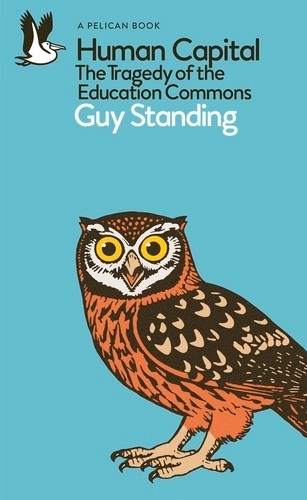
On the 29th of May, the Rudolf Agricola School for Sustainable Development is organising a lecture and open debate on human capital in the presence of economist and social thinker Prof. Guy Standing, who just published ‘Human Capital: The Tragedy of the Education Commons’. In this provocative and timely work that concludes his series on the commons, Standing examines how human capital as a factor of production has come to dominate education policy and institutional priorities. He argues that this shift has contributed to the erosion of education as a commons by changing how education is valued and organised. He insists that this has reshaped universities and schools around market logic, narrowing the broader social purposes of learning, such as truth-seeking, social ethics, and civic virtue.
Prof. Dimitris Ballas and Dr. Michiel Daams will introduce the event on behalf of the Rudolf Agricola School of Sustainable Development and the Faculty of Spatial Sciences. They will then give the floor to post-doctoral researcher Alvertos Konstantinis, who will briefly present his recently completed PhD thesis in a pitch format, where he will link his research on labour market precarity and the “politics of time" and their relationships with inequality and education. This will be followed by a lecture by Prof. Guy Standing. During his lecture, Standing will expose the central arguments of his recently published book on the tragedy of the education commons.
Prof. Danny Dorling will act as a discussant and will open the conversation to the rest of the panel of scholars, who will reflect on the themes introduced by Standing. The panel will discuss how the human capital framework has shaped contemporary higher education and what it might mean to reconsider education as a shared social resource. The panel will be moderated by Prof. Dimitris Ballas and will be composed of Prof. Guy Standing, Prof. Danny Dorling, Prof. Lisa Herzog, Prof. Aleid Brouwer, Prof. Justin Doran, Dr. Arjen Edzes, Dr. Femke Cnossen. They are all researchers and educators from different disciplines and institutions. The event will conclude with a discussion lunch where participants will be invited to meet each other and continue the debate.
During this event, the audience will play an important role, as it will be invited to share its thoughts and ask questions. The event is aimed at being an engaged collective discussion about the future of education and the role universities might play in shaping it. RAS Fellows, researchers, educators, impact-makers, students and anyone interested in the changing landscape of education are warmly invited to join this open conversation.
Attention! - Due to the high level of interest, this event has reached full capacity. You are still welcome to register for the waiting list below, and we will contact you if a spot becomes available before the event.
|
This event continues the conversations initiated within the Rudolf Agricola School community during the RAS 2025 symposium, which highlighted the importance of collaborations, interdisciplinarity, and the academic community and pondered around the role and relevance of the university in the 21st century. By bringing Standing’s critique into dialogue with these themes, the discussion invites participants to further reflect on how universities might navigate the tension between economic pressures and their broader intellectual and societal responsibilities. This event is thus a sequel to the dialogue momentum initiated during the RAS symposium in October. |
Further Information
Programme
|
09:15 - 09:30 |
Walk-in |
|
09:30 - 09:35 |
Introduction - Prof. Dimitris Ballas & Dr. Michiel Daams |
|
09:35 - 09:40
|
PhD pitch - Alvertos Konstantinis |
|
09:40 - 10:30
|
Lecture - Prof. Guy Standing |
|
10:30 - 10:40
|
Discussion - Prof. Danny Dorling |
|
10:40 - 11:45
|
Open debate with panel
|
|
11:45 - 12:30
|
Discussion lunch |
Reflection Questions
In order to guide the conversation, the panel and the audience will be reflecting on the following reflection questions, among others, during the open debate. We invite you to already reflect on them in the lead-up to the event but also to come up with your own and bring them to the event.
-
How did the concept of human capital become so influential in shaping education policy and institutions?
-
What are the consequences of treating education primarily as an economic investment?
-
Can universities still function as spaces of critical inquiry, public debate, and knowledge sharing and valorisation within this framework? Has the relevance of universities diminished in the 21st century?
-
What would it mean, in practice, to reclaim education as a commons? Would it lead to better support of democratic societies, collective wellbeing, innovation, and resilience?
-
Would multi-, inter- and trans-disciplinarity help in such reclamation?
-
What is, or should be, then, the role of universities in the local, regional and global contexts and in terms of creating (local, regional and global) positive societal impact?
Speakers
Guy Standing
Guy Standing has been a Professor at the universities of Bath, London and Monash.Before that he was a programme director in the UN's International Labour Organization and has been an advisor to many international bodies and governments on social and economic policies. He co-founded the Basic Income Earth Network and is now its co-president. He is also a Fellow of the Academy of Social Sciences. He has published multiple bestselling books, such as The Precariat: The New Dangerous Class (2011), Basic Income: And How We Can Make It Happen (2017), Plunder of the Commons: A Manifesto for Sharing Public Wealth (2019), The Blue Commons: Rescuing the Economy of the Sea (2023), The Politics of Time: Gaining Control in the Age of Uncertainty (2024) and Human Capital: The Tragedy of the Education Commons (2026).
Danny Dorling
Danny Dorling is a Professor of Human Geography at the University of Oxford and one of the leading voices on social inequality in the UK. He has published extensively on topics including housing, education, employment, health, and poverty. In 2006, together with a group of researchers, he co-founded Worldmapper, a project that visualises global data to reveal patterns of injustice. His latest book, The Next Crisis: What We Think About The Future (2025), draws on global polling data to show that the issues people worry about most are often very different from those covered in the news, offering insights into how we might better understand and respond to emerging global crises.
Alvertos Konstantinis
Alvertos Konstantinis is a post-doctoral researcher at the department of Economic Geography at the Faculty of Spatial Sciences of the University of Groningen. His public PhD ceremony will take place at the Aula the day before this lecture and open debate.
Panellists
Lisa Herzog
Lisa Herzog is a Professor of Political Philosophy and Dean of the Faculty of Philosophy of the University of Groningen. She is also a Fellow at the RAS.
Aleid Brouwer
Aleid Brouwer is a Senior Researcher in Wellbeing and Social Inequalities at CMO STAMM and Professor by special appointment in the Faculty of Spatial Sciences, University of Groningen
Justin Doran
Justin Doran is Professor of Economics, Head of the Department of Economics, and Interim Director of the Future of Work and the Economy in Cork University Business School, University College Cork, Ireland
Arjen Edzes
Arjen Edzes is a Professor of Regional Labour Market within the Labour Market Transitions Research Group at the Hanze University of Applied Sciences. In addition he is an affiliated Associate Professor in the department of Economic Geography at the Faculty of Spatial Sciences of the University of Groningen as well as a Fellow at the RAS. Comment end
Femke Cnossen
Femke Cnossen is an Assistant Professor in the department of Economic Geography at the Faculty of Spatial Sciences of the University of Groningen. She is also a Fellow at the RAS.
Moderators
Dimitris Ballas
Dimitris Ballas is a Professor of Economic Geography and Chair of the Department of Economic Geography at the Faculty of Spatial Sciences of the University of Groningen. He is a Fellow at the RAS.
Michiel Daams
Michiel Daams is an Assistant Professor in the department of Economic Geography at the Faculty of Spatial Sciences of the University of Groningen. He is the theme director at the RAS for the research theme Sustainable Landscapes & Regions.