
Ambition and Goals
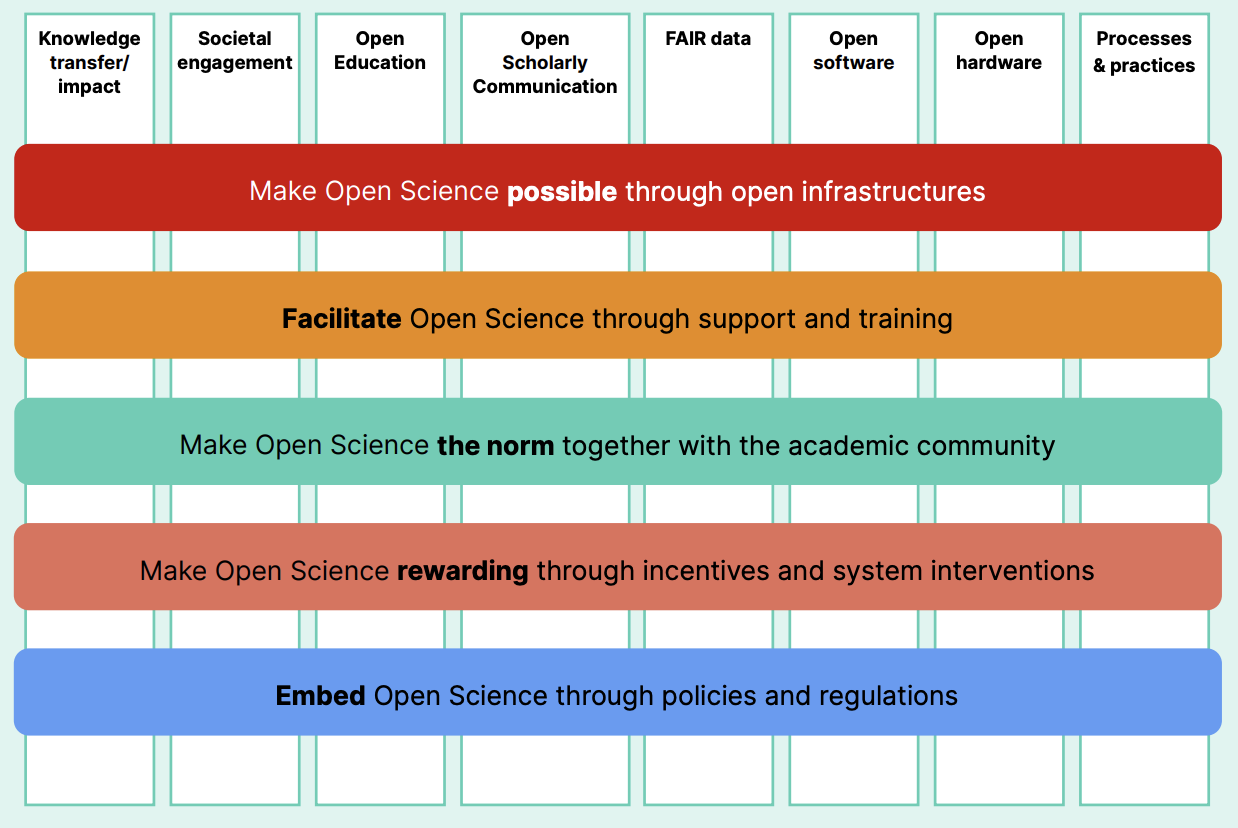
Dutch universities have committed to making Open Science (OS) the norm by 2031. Nationally, this transition is coordinated through the Open Science Steering Group of the Universities of the Netherlands (UNL) and the Chiefs of Open Science. Together they developed the UNL Open Science Agenda, which sets a shared direction for change across areas such as knowledge transfer and impact, societal engagement, open education, open scholarly communication, FAIR data, open software, open hardware, and research processes and practices. The Agenda outlines five levels of change:
-
Make Open Science possible through open infrastructures
-
Facilitate Open Science through support and training.
-
Make Open Science the norm together with the academic community.
-
Make Open Science rewarding through incentives and system interventions.
-
Embed Open Science through policies and regulations.
In addition to the UNL Open Science Agenda, there are several other key strategic documents which support the transition to Open Science, such as the UNL Vision on Publication Culture, the Netherlands Code of Conduct for Research Integrity, and the Strategy Evaluation Protocol 2027-2033.
To help make this transition possible in practice, national funding is provided through NWO’s Open Science programme (OSNL), which supports shared priorities such as research infrastructure, services, and collaborative processes until 2031. At the same time, each university is taking responsibility for embedding Open Science in its own context and strategy.
At the UG, Open Science was a core ambition in the Strategic Plan Making Connections, and continues to be a strategic priority in the Institutional Plan 2026-2031 Creating Impact Together. To deliver this, the Open Science Programme (OSP) was launched in 2021. It is governed by a committee of deans, service directors, and academic representatives, implemented by a university-wide team and coordinated by the Chief of Open Science.
In line with the UNL Open Science Agenda, the OSP stimulates the transition across the five levels of culture change for its strategic Open Science priorities: open access, FAIR data and software, open education, public engagement, open research information, community, and communication.
“We are not just building a more open university - we are creating a more impactful institution that leads the way in shaping the future of science.”
UG’s Strategic Ambitions for Open Science
Building on the principles set out in the UG Open Science Vision and aligned with the national UNL Open Science Agenda, the Institutional Plan of the University of Groningen endorses the principle that scientific and educational knowledge should be publicly accessible and reusable. Open Science is understood as a key enabler of transparent, collaborative and impactful research and education, where knowledge sharing, reuse and engagement with society are central. This includes the careful and responsible sharing of research data, publications, methods and software, in line with ethical, legal and security considerations.
The current phase of the Open Science Programme focuses on further embedding Open Science into everyday research and education practices across the university. Following an initial phase in which awareness, momentum and foundational infrastructure were established, the emphasis has shifted to full implementation and cultural integration. This next stage is closely aligned with national and European developments and supports the university’s ambition to strengthen digital and academic autonomy, reduce dependency on commercial providers, and maximise the societal impact of research.
More information:
Open Access & Scholarly Communication
Open Access & Scholarly Communication
The UG aims to reduce its dependence on large commercial publishers and pay-to-publish open access models (gold and hybrid OA). The monopolistic position of these publishers threatens academic autonomy and the accessibility of science. We are committed to developing and supporting more sustainable and community-led publishing models, particularly given that the costs of existing Read & Publish agreements continue to increase, raising concerns about their long-term viability.
Governing documents:
-
UG Publication Strategy Framework (to be published in 2026)
FAIR Data & Software
FAIR Data & Software
At the UG, creating Findable, Accessible, Interoperable and Reusable (FAIR) research data and software is a precondition for more efficient, reproducible and trustworthy scientific research.
Governing documents:
-
National OS Programme 2030, point 4
-
Netherlands Code of Conduct for Research Integrity (new version to be added in 2026)
Open Education
Open Education
Open Educational Resources (OER) enable free access to, use and adaptation of educational materials, supporting inclusive, learner-centred and collaborative teaching and knowledge creation. Open Science principles will be applied in higher education, both within university curricula and in the development and delivery of education. In line with the University of Groningen’s Strategic Plan, this includes the use and reuse of openly available educational materials, as well as the co-creation of open learning resources and solutions with societal partners. This approach creates added value for the wider learning community, including teachers, students and external partners.
Governing documents:
-
UNL Open Science Agenda, Spearpoint 7 Higher Education
Public Engagement (including Citizen Science)
Public Engagement (including Citizen Science)
The UG aims to maximise societal impact through transparency in research and educational materials, and by enabling close collaboration between knowledge institutions, government, industry and citizens. This strengthens the international position of Dutch science and optimises how knowledge is created, shared and communicated for the benefit of society.
Governing documents:
-
National OS Programme 2030, point 1
-
UNL Open Science Agenda, Spearpoints 3, 6, 11
Open Research Information
Open Research Information
The University of Groningen is committed to advancing Open Science and responsible research assessment also through the transition to open research information. In April 2024, the university signed the Barcelona Declaration on Open Research Information, joining an international movement of universities, funders, and research organisations working towards a more transparent, interoperable, and community-governed research information ecosystem. Our ambition supports a shift away from closed and proprietary systems towards research information that is openly accessible, reusable, and transparent. It covers key metadata on publications, researchers, affiliations, grants, and other scholarly outputs that inform evaluation, discovery, and strategic decision-making.
Governing documents:
Community
Community
The mission of the Open Science Community Groningen (OSCG) is to make it easier for everyone at the University of Groningen and the University Medical Center to facilitate large-scale adoption of open, reproducible, and responsible scientific methods.
The OSCG aims to make research more accessible and reproducible by: 1) providing workshops, lectures, and materials on the OSCG website to help people understand and use open science practices, 2) bringing together people who are interested in open science and supporting existing open science initiatives, and 3) promoting responsible research practices and policies that encourage open science.
More information: