
PhD defence F. (Fengzhi) Suo
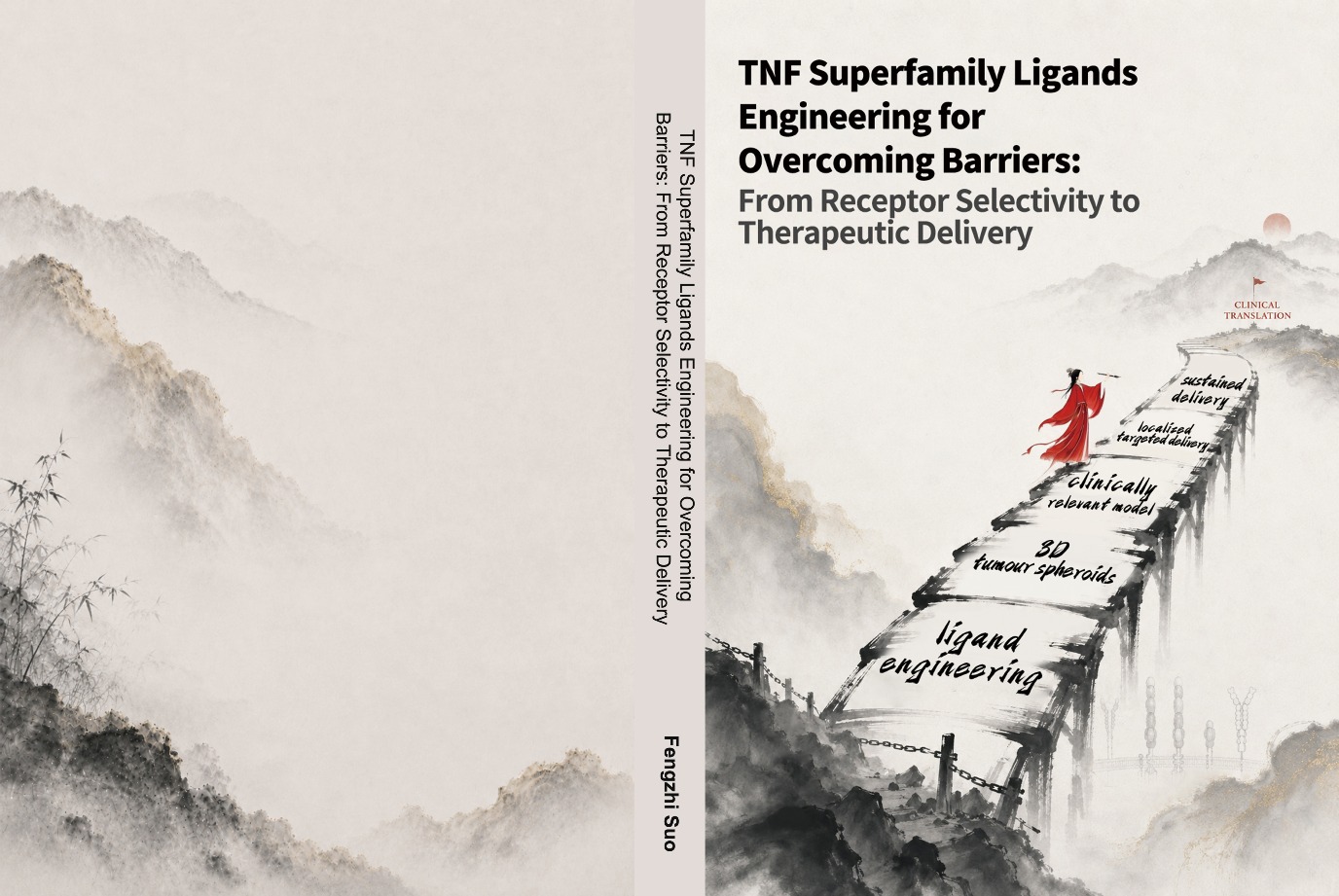
TNF superfamily ligands engineering for overcoming barriers: from receptor selectivity to therapeutic delivery
The tumour necrosis factor (TNF) superfamily regulates essential biological processes, including apoptosis, immune activation, inflammation, and bone homeostasis. Many TNF superfamily ligands interact with multiple receptors, their therapeutic application is frequently limited by receptor promiscuity, decoy receptor interference, model-dependent efficacy, and short half-life. This thesis investigates how ligand engineering, translational model selection, and optimal delivery can improve the therapeutic applicability of TNF superfamily ligands.
First, receptor specificity engineering is considered as a general strategy to redirect multi-receptor TNF ligands toward therapeutically relevant signalling pathways while reducing undesired receptor activation. Second, given the lack of a solved TRAIL–OPG crystal structure, this thesis constructed a predictive structural model to rationally design TRAIL variants that keep apoptosis-inducing capacity while reducing affinity for the soluble decoy receptor OPG in breast cancer cell models. Third, the thesis investigated how model complexity affects receptor-specific therapeutic responses. Using three-dimensional tumour spheroids, ionizing radiation was shown to enhance DR5-mediated TRAIL-induced cell death, but not DR4-mediated cell death, highlighting the importance of physiologically relevant models for evaluating combination therapies. Finally, replication-deficient adenovirus was used for intratracheal delivery of engineered OPG-resistant RANKL-Q236D in silica-induced pulmonary fibrosis mice. Viral expression enables sustained local RANKL secretion, inhibits the profibrotic TGF-β/Smad2/3 pathway and decreases collagen deposition, and was proven to inhibit fibrotic progress in the mice lungs.
Together, these studies demonstrate that TNF superfamily ligand therapeutics require integrated optimization across receptor specificity, microenvironmental validation, and tissue-directed and sustained delivery.
Supervisors:prof. dr. W.J. (Wim) Quax, prof. dr. H.J. Haisma