
ESRIG promotes the development of the TidalKite 2.0 with high-fidelity 3D flow simulations through a European Just Transition Fund (JTF) project.
This collaboration strengthens the scientific and engineering foundation required to advance tidal energy systems towards large-scale applications. By enabling accurate predictions and optimizations of system performance under realistic conditions, the project contributes to reducing technical uncertainty and improving the robustness of future system designs.

From experimental validation to predictive modelling
Since 2015, the University of Groningen has been involved in the development of the TidalKite concept — an innovative system that generates electricity by moving a winged structure through tidal currents, converting hydrodynamic lift into usable power.
Earlier research within ESRIG’s Biomimetics Group (BMM) focused primarily on experimental validation of key components and system behavior. Within the current JTF TidalKite 2.0 project, this work is extended through advanced numerical modelling, enabling a deeper understanding of system performance across a wide range of operating conditions.
High-resolution simulations to accelerate system understanding
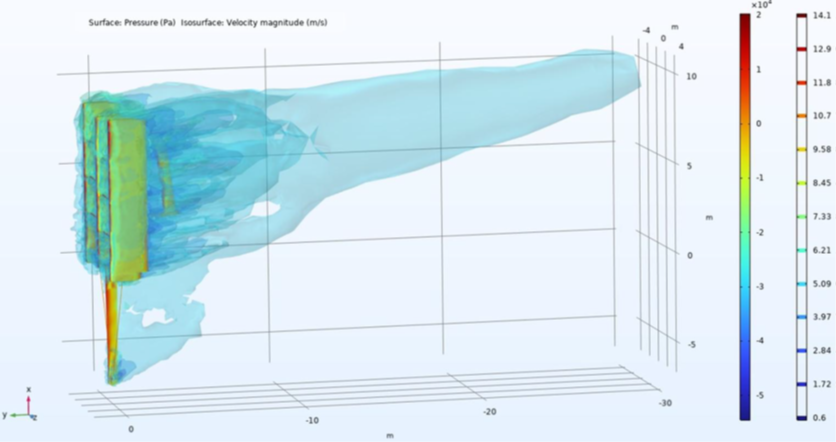
Using advanced Computational Fluid Dynamics (CFD), ESRIG performs detailed 3D flow simulations of the TidalKite during its operational trajectory in tidal currents. These simulations provide insight into power generation, hydrodynamic efficiency, and system behavior throughout the full operational cycle.
The 3D simulations consist of high-resolution computational meshes of up to 25 million cells, with local refinement near the kite to ensure accurate resolution of flow features. Two complementary turbulence modelling approaches are applied: the Shear Stress Transport (SST) model, which provides high-fidelity predictions of the flow in the immediate vicinity of the kite, and Large Eddy Simulation (LES), which captures primarily the development and structure of the wake. Together, these approaches enable detailed quantification of hydrodynamic forces, energy transfer mechanisms, and wake behaviour, supporting analysis at component, system, as well as energy parc scale.
The simulations are executed on the University’s high-performance computing cluster (Habrok), combined with a dedicated local workstation. This computational capability allows for rapid iteration of designs and scenarios, significantly enhancing the efficiency of the development process.
Reducing technical uncertainty and enabling future scaling
By complementing physical testing with high-fidelity simulations, the project contributes to reducing technical uncertainty and improving predictability of system behavior.
This approach enables: - faster evaluation of design variations and scaling effects
- improved prediction of energy yield and system efficiency
- deeper understanding of system interactions in array configurations
These insights form a critical knowledge base for the continued development of tidal energy systems and support future steps towards scaling and deployment.
Supporting the next phase: TidalKite 2.0
The ESRIG contribution is an integral part of the TidalKite 2.0 development program, which focuses on advancing the technology to higher levels of maturity.
By combining experimental validation with advanced simulation capabilities, the collaboration enhances the ability to design, analyze and optimize the system in a controlled and systematic way. This contributes to the development of reliable, efficient and scalable tidal energy concepts.
The project will run until summer 2026 and involves a dedicated team of researchers specialized in fluid mechanics and computational modelling.
Towards predictable and scalable tidal energy systems
The insights generated within this project contribute to the broader ambition of making tidal energy a predictable and scalable component of future renewable energy systems. By improving understanding of system behavior and performance, the work supports the development of technologies that can integrate effectively into future energy systems.
More news
-
19 October 2026
From research to business: RUG Ventures helps ideas move forward
-
-
03 September 2026
Ming Cao reappointed as scientific director of the Jantina Tammes School