

Combining complex data with creativity
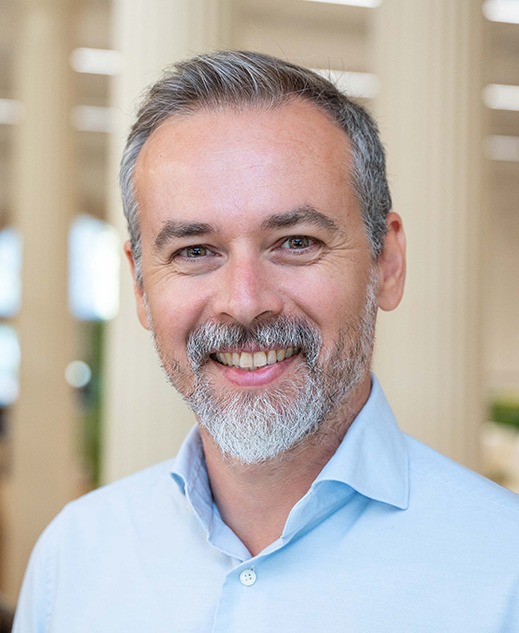
The scientific career of Dario Rodighiero, Assistant Professor of Science and Technology Studies at the University of Groningen, is difficult to confine to a single discipline. Combining computational techniques with design, he explores how complex information can be made visible. In this episode of the interview series JTS Scholars, Rodighiero discusses his work.
Text: Jelle Posthuma
About the JTS Scholars
A ‘JTS Scholar’ is a researcher (from postdoc to professor) affiliated with the University of Groningen who conducts research in fields related to the Jantina Tammes School: digitalization, digital technologies and artificial intelligence. In this series, we interview our Scholars about their expertise and future plans for interdisciplinary collaboration.
You can read the other interviews on our overview page.
Rodighiero began his career as a computer scientist. At an early stage, he developed a fascination for Gestalt psychology, the way people perceive and understand information. ‘I was always good at graphic design,’ he says, ‘and I decided to combine my two areas of expertise in the visualization of data.’ In doing so, he positioned himself at exactly the right moment within an emerging field, information design, which focuses on organizing and representing complex datasets in ways that make them accessible to a broader audience.
Networks
This combination of data and creativity has since become central to his work. For Rodighiero, visualizations are not illustrations added afterward, but tools for generating new knowledge. A key turning point in his career took place in Paris, where he collaborated with Bruno Latour, one of the founders of actor-network theory. Under Latour’s influence, Rodighiero shifted his focus to networks, systems of relationships between people, ideas, and institutions.
During his PhD research at the École polytechnique fédérale de Lausanne (EPFL), he used network visualization to map affinities of researchers at the EPFL. ‘I was mapping my colleagues, basically, and how they organize their research and education.’ He later continued this work as a researcher at institutions such as MIT and Harvard University, where he analyzed scientific communities, including those working on Covid-19 research.
Borders
These data visualizations not only show who collaborates with whom, but also how power structures emerge within networks. ‘If you are at the center, you are in a strong position; if you are at the margins, you become marginalized,’ Rodighiero explains. This principle applies not only to universities, but also to cities and other complex systems. Yet, according to him, the margins are precisely where things become interesting. ‘Research and education are divided into clusters, but the boundaries between them are the most interesting, especially when it comes to interdisciplinarity.’ His analyses showed that interdisciplinary education is relatively common, while research, particularly in technical disciplines, often remains more strictly bounded.
At Campus Fryslân, Rodighiero focuses on the field of Science and Technology Studies. In this domain, he examines the societal impact of digital technologies, with particular attention to artificial intelligence. He maintains a critical perspective, warning against reducing people to data points. ‘We must always pay attention to the sociological aspects.’ As a counterbalance, he introduces the concept of network literacy, the ability not only to read data but also to interpret it critically.
Living history of science
An important example of his work is the Grounding AI Map project. This interactive visualization transforms millions of scientific articles on AI into a navigable map. Visitors can effectively walk through the research landscape and see how different disciplines intersect with artificial intelligence. The map also reveals how trends evolve, showing when certain topics emerge, peak, and decline. A reduced version of the map was presented during the European Researchers’ Night in Groningen.
The map functions not only as an analytical tool, but also as a kind of living history of science. According to Rodighiero, this reflects a broader development within Science and Technology Studies. Whereas the field once mainly looked back at the history of science and technology, new digital methods now make it possible to follow developments in real time.
Engaging in interaction
As a Scholar of the Jantina Tammes School, Rodighiero expects that collaboration will mainly take place in the area of education. At the interdisciplinary faculty Campus Fryslân, he plays an important role in teaching. He coordinates the Data Wise minor, in which students are introduced to applied data science in relation to societal challenges, and he teaches in the Bachelor’s program in Data Science and Society.
He also considers making scientific knowledge accessible to a wider audience an important responsibility as a Scholar. ‘We live in a time when universities really need to give something back to society. That is why I enjoy working with museums and libraries, because they provide a physical space where you can communicate directly with the public and engage in interaction.’
More news
-
-
03 September 2026
Ming Cao reappointed as scientific director of the Jantina Tammes School
-
01 September 2026
Evrim Ursavas appointed scientific director Wubbo Ockels School