

What is real and what is fake, and does it even matter?
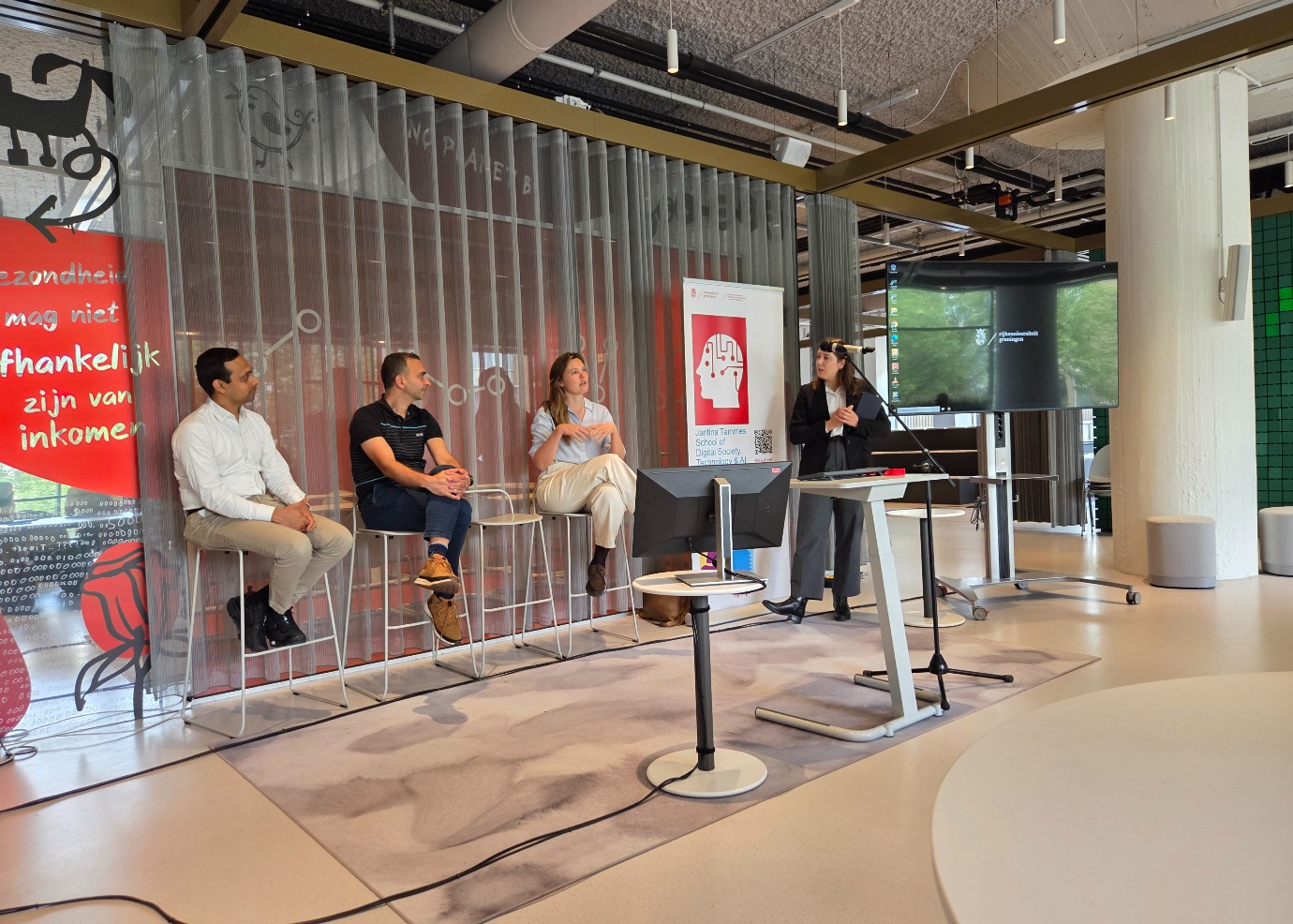
Deepfakes pose a growing threat to reputations and access to democracy and human rights, with women in public roles especially at risk. This pressing issue set the stage for the event ‘The Stereotypes and Mechanisms behind Deepfakes’ at House of Connections.
Guest speaker Eva Hofman, a journalist at Dutch weekly magazine De Groene Amsterdammer, highlighted the dangers of deepfakes: AI-generated fake images or videos. As an investigative journalist and technology reporter, she is interested in how the online world influences the physical world. In particular, she focuses on the rise of online conservatism. In her investigative work, she often collaborates closely with researchers from Utrecht University’s Data School.
Members of Parliament using fake images
During the event, Hofman spoke about her revealing report on AI-generated images on far-right Facebook fan pages. The generated images for example show young, blonde women being threatened by presumed groups of migrants, accompanied by propaganda texts about the PVV. She also showed AI images of the ‘ideal’ Dutch family, likewise threatened by migration, and a fake image depicting the arrest of Frans Timmermans, then leader of the GroenLinks-PvdA party.
Hofman and her fellow journalists and researchers found that at least two PVV MPs had generated fake images and subsequently posted them on PVV fan pages. Thanks to journalistic research, she discovered which account PVV MP Maikel Boon used on Sora, OpenAI’s image generator. Every prompt (command) that users enter on Sora gets saved and remains publicly accessible – unless the user specifies otherwise. This is how Boon’s 174 prompts became known to the journalists.
Using his account, Boon issued a series of commands to generate images, such as – roughly translated: 'Create a hyper-realistic photo of ‘an attractive blonde woman’. And then: ‘A group of young people with darker skin tones is walking behind her. They are calling her name, but she doesn’t respond…’ He then posted the generated images on popular Facebook pages with many thousands of followers. According to Hofman, Facebook users reacted to the published images as if they were real. Hofman asked the MP for a response, but none has been forthcoming so far. Boon is still an MP for the PVV.
In addition to her investigation into fake AI images, Hofman also referred to other investigative journalism work, such as her report on the accessibility of extreme videos about eating disorders on TikTok and the rise in hateful comments directed at the LGBTQIA+ community on various online platforms. Prime Minister Rob Jetten was also mentioned; in particular, since becoming Prime Minister, he has been receiving an increasing number of homophobic comments on his personal social media accounts. Increasingly, this too involves AI-generated content.
Prove what is real
Hofman’s account of AI-generated images was sobering: generative AI is being used destructively, and the consequences for its creators and distributors are minimal. Following Hofman’s presentation, it was up to UG researchers George Azzopardi and Guru Swaroop Bennabhaktula to offer some perspective: how can we improve the detection of deepfakes? According to Azzopardi, it has so far been a game of cat and mouse, with regulatory bodies often failing to respond in time. He cited the danger of manipulated passport photos as an example, which criminals can use to obtain a fake passport to cross borders. The researcher was approached by the Dutch Vehicle Authority (RDW) to help devise solutions.
In their project, the researchers developed an algorithm that can link a camera to a photograph. Each photograph contains, as it were, a unique ‘fingerprint’ of the camera that captured it. If every photograph can be linked to a camera, it becomes possible to filter out manipulated images: after all, they no longer bear the hallmarks of the original camera. Azzopardi and Bennabhaktula have since founded the spinoff ForensifAI, through which they aim to apply the technology on a broad scale. As examples, the researchers cited the use of the technology in identification, the insurance industry, online marketplaces and journalism.
The audience responded enthusiastically to this promising technology, particularly for applications with clear rules such as identification. At the same time, as comments from various attendees showed, technology alone cannot solve everything. Above all, deepfakes are a societal problem that calls for regulatory measures and greater digital literacy.
Sad reality
Hofman emphasised the complexity of the issue. The deepfakes used by PVV MPs are not particularly high-tech: they are, in fact, blatantly fake, but that seems to matter little to those who engage with them. Many users, for example, are well aware that the images are fake, but argue that the images do reflect and reinforce their feelings about issues such as migration. Fact-checking or labelling something as ‘fake’ makes little sense in such cases, the journalist argued. ‘That is the sad reality,’ she concluded.
It therefore remains a key question as to what we can do to protect public figures. After all, the ease with which anyone can generate and disseminate fake images is here to stay. Plenty of food for thought, in short, for the next meeting of the Young Arts Network (YARN), entitled ‘Targeting public voices: how scholars can protect themselves in times of generative AI’, which will take place in mid-September 2026.
The meeting in May was organized by the Young Arts Network (YARN) and Jantina Tammes School of Digital Society, Technology, and Artificial Intelligence.
More news
-
-
03 September 2026
Ming Cao reappointed as scientific director of the Jantina Tammes School
-
01 September 2026
Evrim Ursavas appointed scientific director Wubbo Ockels School