
IP & Business Development
We facilitate researchers in the field of intellectual property.
Patents are often essential to enable further development of promising research of the University of Groningen. We have a joint UG/UMCG patent policy and provide support in patent applications, commercialization of research of the university (IP-licensing or IP-transfer) and offer advice in the creation of start-up companies.
Intellectual Property
Policy
Based on the VSNU/NFU guidelines, as well as Dutch law and the University’s employment contract, the joint UG/UMCG Intellectual Property policy focuses on two main issues:
-
Public recognition. UG/UMCG wish to be visible on patent publications as (one of the) applicant(s) in those cases where the invention was (partly) the work of UG/UMCG inventors. This is highly relevant for our reputation, PR, and rankings.
-
Reasonable financial compensation. If a patent is transferred or out-licensed to a third party, UG/UMCG request a competitive compensation, negotiable on a case-by-case basis
All research, license, and patent transfer agreements are assessed accordingly by the legal department, before being submitted to the UG/UMCG Boards for signing.
The IP & Business Development team implements the joint UG/UMCG IP policy in close collaboration with the legal department of the University (ABJZ), the UMCG Innovation Center and the legal/contract support desk of the UMCG.
For more information please contact ip-info rug.nl or one of the members of the IP & Business Development team.
Guidelines Dealing with Intellectual Property Rights (IPR)
The Association of universities in the Netherlands (VSNU) and Netherlands Federation of University Medical Centres (NFU) have published guidelines for academic start-ups about dealing with intellectual property rights and the position of students wrt. IPR.
IPR Guidelines for academic start-ups
The utilisation of knowledge from research at knowledge institutions is important for society, in view of the social challenges and economic opportunities. Intellectual property plays a relevant role in the utilisation of knowledge. The guideline can help to remove obstacles in the handling of intellectual property rights (IPR) for academic start-ups.
IPR Guidelines for students
During your studies, you may encounter intellectual property rights (IPR). Make agreements about this before you start an internship, study activity or research project. This way, you know where you stand if an invention, design or idea turns out to be an economic or social gap in the market.
The IPR guidelines for university start-ups are in the abovementioned 'IPR Guidelines'. In addition, the rules for students are now also clarified in the 'Addendum IPR Guidelines and Students'.
Industry Cooperation
Principles for cooperation with industry
For research collaboration with industry and other private parties, the University of Groningen (UG) and the University Medical Centre Groningen (UMCG) follow the guidelines for public-private partnerships (PPP) and other types of technology transfer as formulated by The Association of Universities in the Netherlands (VSNU) and the Netherlands Federation of University Medical Centres (NFU).
In summary, these guidelines are:
-
Freedom to publish one’s own results
-
Freedom to do follow-up research
-
Freedom to do follow-up research with third parties
-
Freedom to use the foreground for educational purposes
-
Ownership of the foreground follows upon inventorship/creatorship
-
No obligatory assignment of the foreground
-
Market conditions for access to the foreground for commercial use
-
Access conditions include an anti-shelving clause
-
No obligation to grant access to the background for use outside the project
-
No automatic access to future results/IPR (which are not the foreground)
Inventions made by University’s employees are internally assessed for patentability and commercial value. When both are positive, a patent application will be filed and commercial parties will be approached for a license or patent transfer.
The IP & Business Development team focuses on strengthening the societal impact of the research of the University of Groningen and on stimulating entrepreneurship.
Contact information
|
Visitors/postal address
| |
|
Contact details
|
ip-info rug.nl |
We work in close collaboration with Funding Team, the Faculty Funding Officers, the legal department AJZ of the University of Groningen and the Center for Development and Innovation and the legal/contract support desk of the UMCG.
The IP & Business Development team is a merger of the IP-Team of the University of Groningen and the Business Generator Groningen
The Stories
Knowledge protection helps to find commercial and social partners to apply knowledge and thus create social impact. In addition, as a researcher at RUG and UMCG, you can spend a quarter of the revenues from the commercial application of knowledge for new research at your own discretion. Prof. dr. Erik Frijlink as well as prof. dr. Francesco Picchioni for example are partly funding their research from royalties. Their story.
Rubber for Eternity
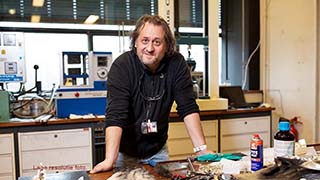
In 2016, prof. dr. Francesco Picchioni, Chemical Technology, University of Groningen, filed a patent application based on his research 'Recycling of Rubber'. A real gap in the market: ‘Recycling rubber is a social problem. The surplus of used rubber is now burned and that is bad for the environment. Our invention gives new applications to rubber from discarded car tires.’
About 7 million car tyres are discarded in the Netherlands each year. The total weight of these tyres is over 110,000 tons. Recently, a rule has been applied that 20% of these end-of-life tyres must be re-used. Picchioni: ‘We have developed a patented application in the lab that makes new and elastic base material out of recycled rubber tyres that is suitable for re-use and new applications. The new base material is durable and suitable for large industrial use at a competitive price.’
The proof-of-principle works!
Picchioni's research into the revaluation of rubber stems from the observation, after a literature search, that worldwide it is all too easily assumed that rubber is not recyclable. This is a matter of honour for the Groningen-based researcher and his team: ‘An incomprehensible point of view, of course, in a time of a circular society and advancing science.’ Time for action. The Groningen team located at Nijenborgh 4 at Zernike Campus, spent months in the lab to develop a proof-of-principle that enables the revaluation of rubber. A proof-of-principle is a test or experiment aimed to determine whether the technology or principle you have devised actually functions and is feasible. A moment of euphoria, which the Groningen researcher vividly recalls in his office two years later: ‘A student knocked on the door here and shouted: '’Francesco, the PoP works!’’ And then you suddenly realise that as a researcher you may have a commercial product on your hands and knowledge that you need to protect!’
Screening & Scouting
For the feasibility study into the filing of a possible patent, Picchioni approached the IP & Business Development team, part of Northern Knowledge, at Kadijk, Zernike Campus. Picchioni: ‘An important step to avoid wasting any energy, because not all knowledge is patentable. For example, an invention must meet the criteria of inventiveness, and knowledge about the invention may not have been publicly disclosed anywhere in the world prior to the date of filing the patent application.’ After a few weeks, Picchioni received the green light that his knowledge from the lab was indeed appeared to be novel and the process of obtaining a patent application was to be started for the invention of revaluing rubber. Knowledge valorisation leading to surprising new applications. To reduce health costs, for instance: ‘One of my students wants to reduce the consequences of falling off a bike by applying an elastic rubber patch on the sleeve of a jacket, whereby the rubber patch softens any contact with the ground after a fall.’ A creative application for which the re-use of rubber car tyres is perfectly suited: ‘And fewer fractures after falling off a bike also means lower healthcare costs. Knowledge protection pays off on all levels,’ says the Groningen researcher, revealing his social drive.
Patenting and publishing reinforcing each other
Knowledge valorisation by patenting is now in his genes. Besides a request for a patent into 'Revaluing Rubber', a patent application was also filed for Francesco Picchioni's research into carbohydrate-based linear polyesters. The innovative method provides new applications including water-based glue. A stepping stone to new challenges in Green Chemistry that will eventually lead to new research, patents and publications as well. A golden route to valorisation that only has winners says Francesco: ‘Before filing a patent application, you have to be patient as a researcher with publishing, because it has to be investigated whether an invention is also an invention according to the (international) patent law.’ But patience pays off here, concludes the flamboyant Italian born Groningen-based professor: ‘For the researcher: protecting knowledge on an invention gives you the recognition that you have invented something new. And publishing on this knowledge strengthens your reputation as a scientist. For the university: it strengthens the university's reputation in its value as a socially relevant knowledge institute. Everybody happy!’
IP-Méé with University of Groningen and UMCG! Contact us for support: ip-info@rug.nl
Professor Erik Frijlink's research freedom
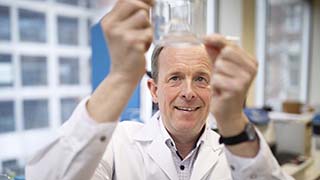
In the Netherlands, almost all research is directed by grant providers . These funding organizations in a way limit the freedom of researchers, who must adhere to the approved research proposals. Prof. dr. Erik Frijlink, Pharmaceutical Technology and Biopharmacy, University of Groningen (UG) , finances a part of his research from the royalties of his inventions Genuair and Twincer. A sense of freedom.
A few years ago, the University of Groningen sold the rights of Frijlink’s patented Genuair, a powder inhaler against asthma and COPD, to a biopharmaceutical giant. Recently, UG licensed out the rights of the Twincer, a disposable inhaler, as well. And on 1 April 2019, Circassia Pharmaceuticals, a world-class specialty pharmaceutical business focused on respiratory disease, received market approval for the breath-actuated inhaler Pressair® in the United States. Pressair is an innovative variant of the Genuair inhaler. Frijlink: ‘Licensing our powder inhaler invention is really taking off. Worldwide.’
Millions of euros in royalties
The license agreements have provided the University of Groningen with tens of millions of euros in royalties and ensures a constant flow of income in the coming years. Frijlink: ‘The exclusivity rights of a patent are valid for 20 years. You need 10 years to develop and market a medicine, and the next 10 years you can recoup the costs with a nice profit margin.’
The income from royalties for researchers from the University of Groningen and the UMCG is distributed via a fixed ratio: one quarter is placed in the patent fund of the University of Groningen and the UMCG, one quarter goes to the faculty, a part of the royalties goes to the inventors, and finally a part goes to the department of the researcher, free to spend at its own liberty as an incentive for the work carried out. The IP & Business Development team, part of Northern Knowledge, monitors the royalties and supports researchers in the entire process.
Fighting tuberculosis
The income from Genuair and the Twincer royalties allow Frijlink to initiate innovative research on tuberculosis (TB) and other respiratory tract infections. TB is one of the most deadly infectious disease worldwide claiming 1.8 million lives each year. In Frijlink’s lab in Groningen, new antibiotics are being developed which treat people against TB by way of inhalation. Further, every year worldwide around 115,000 children die of the Respiratory Syncytial Virus (RSV). ‘Mortality rates that are preventable,’ believes Frijlink: ‘What is often lacking is funding for new research into stable vaccines. The income from royalties, however, provides me this opportunity.’
Parkinson's disease
The successful professor realistically dreams on: ‘Our patented inhaler techniques are also ideally suited for vaccinations against diseases such as influenza or whooping cough and for administering medication to people suffering from Parkinson's disease.’
Frijlink has great expectations of the clinical trials with a new inhalation technique, the Cyclops, which could also be used to replace the EpiPen. The EpiPen (adrenaline) auto-injectors are intended for the emergency treatment of severe allergic reactions (anaphylaxis) caused by allergens in, for example, food, medicines, insect stings or bites. Frijlink: ‘People are often reluctant to inject themselves. This fear of injection sometimes makes them inject too late, which means that the medicine has no longer the desired effect. The Cyclops inhaler can in this case replace administration through injections.’
Besides having a therapeutic advantage, this invention also has a logistic advantage. Frijlink: ‘The medicine is offered as a dry powder, which keeps the drug stable, it is much cheaper, and it is easier for the patient to carry the Cyclops in his pocket. The EpiPen is a big and inconvenient thing to carry with you.’
Helping mothers in Africa
The money from royalties is also used for new research on drug delivery, for example regarding the controlled delivery of vaccines. ‘That means that you only have to inject once for two administrations," says the professor and director of the Groningen Research Institute of Pharmacy (GRIP).
Technologies which are efficient and cost-saving, but above all they are patient-friendly. ‘In Africa, mothers sometimes have to walk for hours with their babies from home to the clinic to receive their vaccinations against infectious diseases. With the new administration technique they have to go to the medical post less frequent and the product is even more stable than a normal liquid injection.’
Gives you a good feeling
Ground breaking research with social impact funded by royalties from University of Groningen patents. Protection of knowledge leading to new research and innovation. A way of life that must be in the genes of every researcher, says Frijlink: ‘As a researcher at a university, you want to innovate. Inherent to that mission is that you protect the value of your knowledge. Patenting is not a means to an end. Knowledge protection is a result of the work you do.’ In whatever form. ‘Patenting your invention ensures that you have control over your knowledge and that as a researcher you can improve the quality of life and the health of people. That gives you a good feeling.’
IP-Méé with University of Groningen and UMCG! Contact us for support: ip-info@rug.nl
The IP & Business Development team focusses on strengthening the societal impact of the research of the university (UG) and medical center (UMCG).
The team provides support with:
-
Intellectual Property (IP) protection
-
Patenting
-
Business Development
-
Technology licensing and transfer