

Where You Live, When You Lived: Place, Time, and Health Inequalities in Japan
Japan is widely recognised as one of the world's longest-lived societies, yet place-based socioeconomic inequalities in health persist and have widened since the "lost decades" of the 1990s, with area deprivation closely linked to these disparities. More deprived neighbourhoods consistently show lower life expectancy and a higher burden of unhealthy behaviours. This talk further explores these inequalities through two contrasting stories.
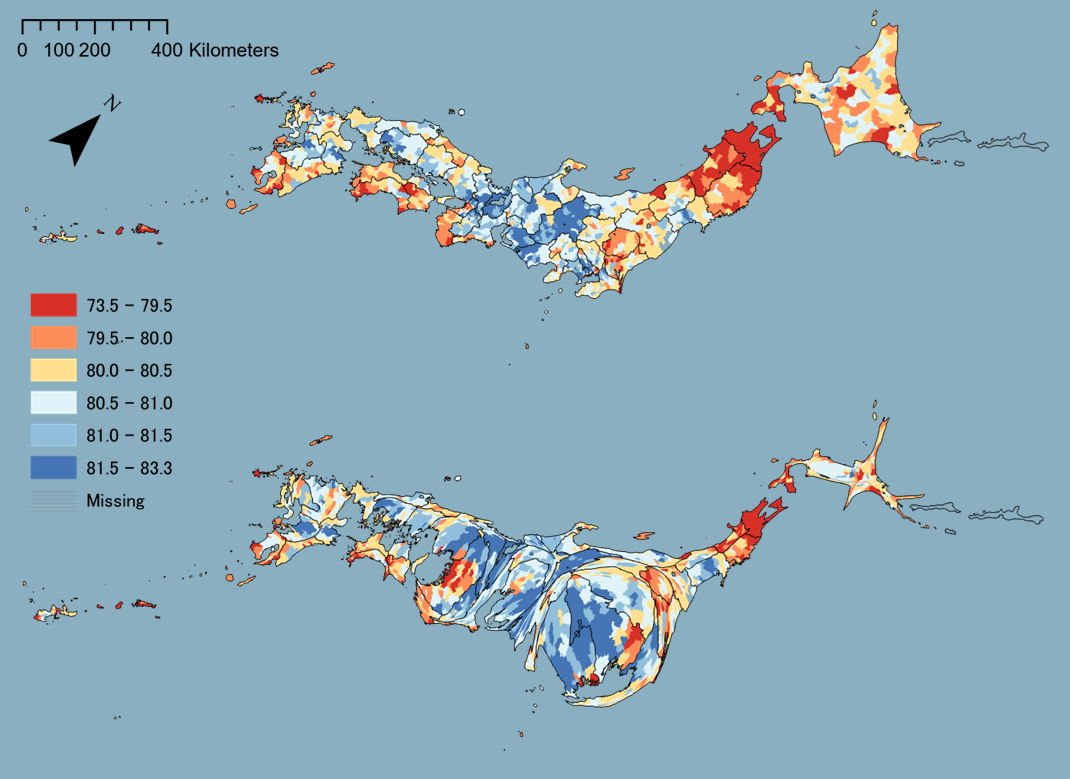
In Tokyo, one of the most affluent metropolitan regions, a retrospective lifecourse survey analysed through sequence analysis shows that residents of more deprived neighbourhoods are disproportionately likely to have accumulated unhealthy behaviours from early life stages, pointing to inequality rooted not just in place, but in time. Okinawa tells a different story. Long celebrated for exceptional longevity despite high socioeconomic deprivation, it appears to confound the expected relationship between disadvantage and poor health. Yet cohort-specific analysis reveals this paradox is unravelling: among younger generations, the expected gradient has reasserted itself as everyday protective practices eroded with postwar socioeconomic transformation. Together, these two stories suggest that health inequality is produced through the intersection of place and time, shaped by where people live, but also by when and how they lived there.
Kewords: area deprivation, sequence analysis, neighbourhood effects, lifecourse, generational change

Tomoki Nakaya is Professor of Environmental Geography at the Graduate School of Environmental Studies, Tohoku University, Japan, a position he has held since 2018. He received his PhD in geography from Tokyo Metropolitan University in 1997. His research focuses on GIScience, quantitative geography, and geovisualisation, with applications to geographical inequalities, crime analysis, and urban health. Among his major publications is the edited volume the Atlas of Health Inequalities in Japan (Springer, 2019).