
Testimonial Dr Abu Saleh Md Rafi
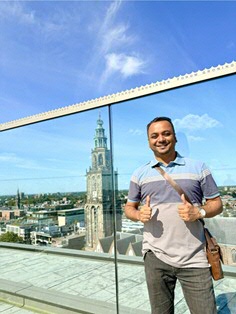
My time as a Research Fellow under the Faculty of Arts Research Fellowship Programme at the University of Groningen was intellectually enriching, professionally transformative, and deeply human. Groningen itself is a beautiful city, calm yet vibrant, historically rich yet intellectually alive. Walking through the city, from the Martinitoren to Noorderplantsoen and along Folkingestraat, sharing conversations over lovely food and long afternoon walks, became an inseparable part of my scholarly journey. The city invites thinking, and the university sustains it.
I was honoured to be selected as one of four successful applicants from a highly competitive international pool and to undertake a one-semester research residency as a guest researcher at the Faculty of Arts. During this fellowship, I collaborated with Dr Josh Prada, my academic host, to replicate my 2022 study, Linguistic Ecology of Bangladeshi Higher Education: A Translanguaging Perspective , within the Dutch higher education context. As part of the project, I conducted interviews ranging from senior professors to early-career lecturers, an experience that was both humbling and intellectually expansive. I learned immensely from colleagues at the Centre for Language and Cognition, particularly Prof Janet Fuller, Dr Aurélie Joubert, Dr Seyed Hadi Mirvahedi, Dr Seonok Lee, Dr Gerdientje Oggel, and Nadia Gerritsen, whose generosity, rigour, intellectual curiosity, and openness shaped my thinking in lasting ways. I also had the opportunity to observe classes and collect classroom-based data, which allowed me to see the interdisciplinarity that the University of Groningen fosters within its curricula in action. The generous support of this fellowship made this work possible.
Beyond his role as my academic host, Dr Josh Prada was an exceptional collaborator and mentor. He gave time generously, almost every day, for discussions about the project, future collaborations, and wider questions of life, philosophy, and academia, often while roaming the city together. He also facilitated crucial institutional connections, introduced me to colleagues, and ensured that my data collection progressed smoothly. Josh also introduced me to his PhD students, and we spent a memorable morning discussing their projects. The conversations reflected not only the originality of the research being undertaken, but also the brilliance and intellectual generosity of the students, an experience I thoroughly enjoyed. I am equally grateful to Jaap Nieuwstraten, Faculty Research Policy Officer, whose consistent support, despite our not meeting in person, ensured I was never without guidance. We remain in touch to this day.
The fellowship also opened valuable international academic spaces. I was invited to speak at LANSPAN Colloquia, University of Groningen, and Dr Prada kindly nominated me as a session speaker at the DAAD International Winter School on Inclusive Language Teaching, where I delivered invited talks in November 2025. Particularly meaningful was the committee’s decision to allow my students from the University of Liberal Arts Bangladesh to join the sessions, extending the fellowship’s impact beyond borders. The fellowship extended beyond Groningen. As part of data collection and networking, I visited Amsterdam and Hamburg, which opened further avenues for collaboration and helped situate the project within a broader European research landscape.
Overall, this fellowship has been profoundly fruitful, intellectually, professionally, and personally. I left Groningen not only with data and publications in progress, but with enduring collaborations, friendships, and a renewed commitment to this line of research. I am deeply excited to build on this work and very much look forward to continuing my engagement with the University of Groningen.
Dr Abu Saleh Md Rafi, Associate Professor of Applied Linguistics and Critical AI Studies