
Guest Seminar by Lei Zhang: Impurity-Activated Corrosion Mechanisms in Molten Halide Salts from Foundation Model Molecular Dynamics
We are pleased to announce a Guest Seminar by Dr Lei Zhang on 29 June organized by Prof. Francesco Maresca, Principal Investigator of the Mechanics of Materials research unit of ENTEG.
Abstract: Molten salt reactors (MSRs) have re-emerged as a promising source of carbon-free nuclear energy. Their inherent safety features, including passive cooling and low operating pressure, together with high thermal efficiency and reduced nuclear waste, offer important advantages over conventional light-water reactors. However, MSRs are designed to operate at high temperatures above 650 °C in molten-salt environments, where direct contact between the salt and structural alloys can cause severe corrosion. Experiments have shown that impurity levels in molten salts strongly influence corrosion rates [1]. Atomistic understanding has so far been developed mainly for pure salt systems, while the mechanisms by which impurities regulate interfacial reactions and transport remain poorly understood [2,3].
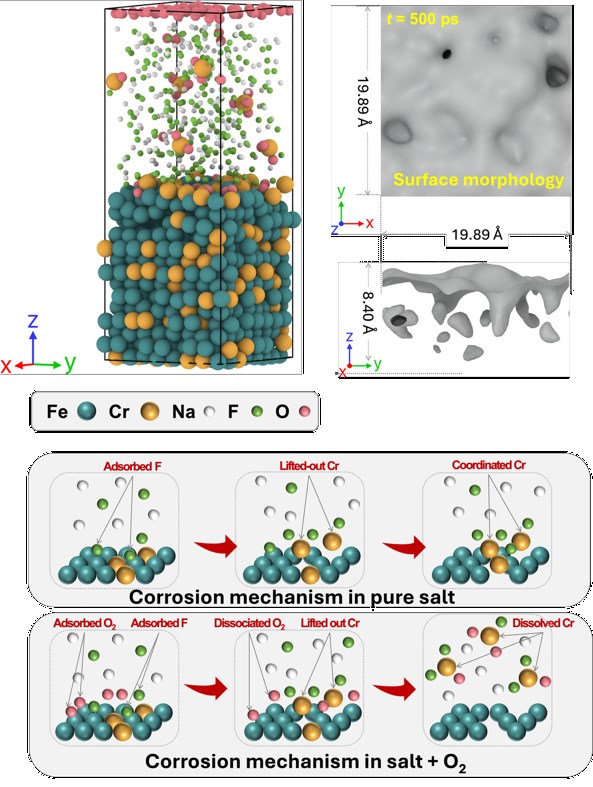
In this talk, I will present an atomistic investigation of how impurities influence the early-stage corrosion of FeCr alloys in molten halides. We employ a universal machine-learning interatomic potential, rigorously validated against density functional theory (DFT) reference calculations. Molecular dynamics simulations are performed for impurity-free salts and salts containing different concentrations of H2O or O2. In pure salts, Cr atoms are lifted from the alloy surface while remaining partially coordinated to the substrate, whereas O2 drives complete Cr dissolution into the melt. Charge transfer analysis reveals the critical role of O2 in activating net material loss, consistent with experimentally observed impurity-accelerated corrosion. The results also show that the corrosion resistance of different surface orientations changes under oxidizing conditions compared with pure salt environments. Finally, I will briefly introduce an open-source Python package we recently developed for atomistic simulations and analysis of complex salts [4].
[1] Raiman, Stephen S., and Sangkeun Lee. " Journal of Nuclear Materials 511 (2018): 523-535.
[2] Wang, Ximeng, et al. Corrosion Science 254 (2025): 113060.
[3] Arkoub Hamdy, et al. Corrosion Science 269 (2026): 113960
[4] https://github.com/leiapple/MoltenSaltCalc

Lei Zhang is a junior assistant professor at Eindhoven University of Technology. He obtained his PhD from the University of Groningen in 2024, where his research connected atomistic mechanisms with microscale behaviour through bottom-up multiscale modelling, with a particular focus on fracture and plasticity in body-centred cubic metals. Lei developed machine-learning interatomic potentials to bridge quantum calculations and classical molecular dynamics, and employed discrete dislocation dynamics to link atomistic mechanisms to microscale behaviour. His PhD thesis was nominated for the Biezeno Award. After his PhD, Lei conducted postdoctoral research at the University of Twente and DIFFER, where he worked on atomistic modelling of structural materials for molten salt environments. He has presented his work at international conferences including EMMC, EuroMat, EFC, and MMM, and has published in journals such as Acta Mater., npj Comp. Mater., and Int. Journal of Fracture. He also serves as a reviewer for Int. Journal of Plasticity, npj Comp. Mater., European Journal of Mechanics - A/Solids etc. His current research aims to translate fundamental atomistic insights into industrially relevant solutions, including iron- and nickel-based alloys under irradiation and corrosion, defect energetics governing the growth and failure of low-dimensional semiconductor materials, and the development of machine-learning interatomic potentials for these applications.