
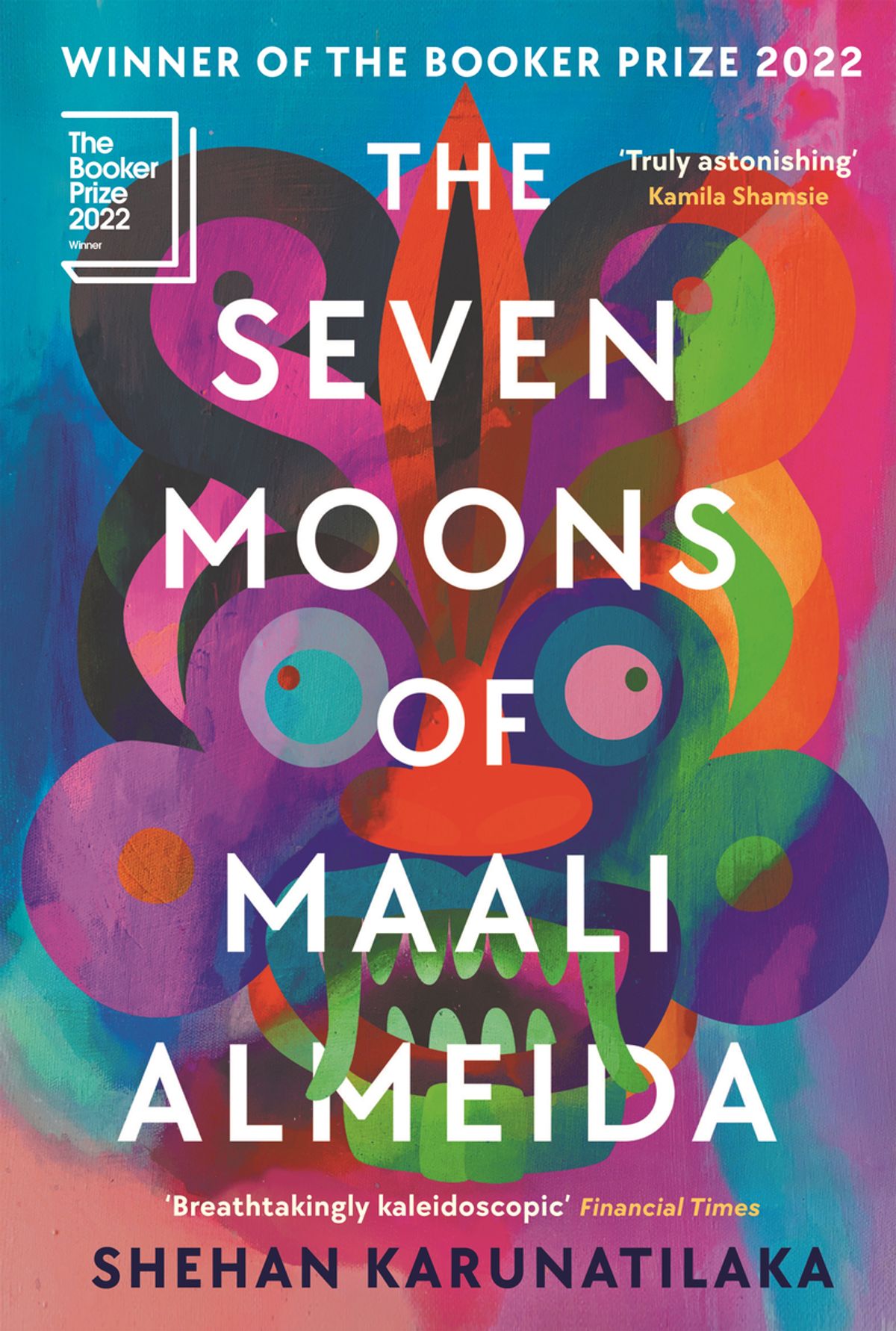
Book 2: The Seven Moons of Maali Almeida (2022) - Shehan Karunatilaka
Thursday March 12
What is the book about?
Maali Almeida, war photographer, gambler and closet queen, has woken up dead in what seems like a celestial visa office. His dismembered body is sinking in the Beira Lake and he has no idea who killed him. At a time when scores are settled by death squads, suicide bombers and hired goons, the list of suspects is depressingly long. But even in the afterlife, time is running out for Maali. He has seven moons to try and contact the man and woman he loves most and lead them to a hidden cache of photos that will rock Sri Lanka.
Fragment (to get an idea of the style)
“The memories come to you with pain. The pain has many shades. Sometimes, it arrives with sweat and itches and rashes. At other times, it comes with nausea and headaches. Perhaps like amputees feeling absent limbs, you still hold the illusion of your decaying corpse. One minute you are retching, the next you are reeling, the next you are remembering.
You met Jaki five years ago in the Casino at Hotel Leo. She was twenty, just out of school, and losing pathetically at baccarat. You were back from a torrid tour of the Vanni, unhinged by the slaughter, breaking bread with shady people, seeing the bad wherever you looked, and wearing your notorious red bandanna. You had sold the photos to Jonny at the Associated Press and cashed a welcome six-figure cheque. Even in Lankan rupees, six figures are better than five.”
First sentence
“You wake up with the answer to the question that everyone asks.”
The Seven Moons of Maali Almeida is also available at University's Library.
Looking back on Day 2 of the challenge
Even more students entered the challenge on Day 2! We welcome all international students who could not yet participate in Dutch on Day 1, but took their changes in English. It is not so easy to be creative and subtile in a language that is not your mothertongue. So respect to everyone who tried in a well-known, but not your first language. It is an important step to have the courage and try! Spread the word and encourage your friends to take part too. Begin a Book is like the Olympic Games: The important thing... is not to win but to take part. Let's take a closer look at yesterdays challenge and your entries. See what we can learn from each other.
A question and an answer
“You wake up with the answer to the question that everyone asks.” That was the sentence Shehan Karunatilaka gave you to start with. You immediately wonder which question that might be and what the answer is. So, a great opening! But we challenged you to write the second and third sentence. Some of you explicitely mentioned a big question like: "What happens, after you die?" Others left it more implicite, counting on the reader to figure out which question it probably was. What to do with the answer then? We enjoyed the funny: "But there’s one small problem: you can’t remember what the question was." and "It is a simple question, really. Why bother answering it (...)".
The main character
Most of you spotted that this book has a special form of narrating. There is a 'you' in stead of a the more common 'I' or 'he/she'. Well done if you continued in that form! You might wondered why Karunatilaka chose to use this form. I don't know either ;) But you can feel the effect, you feel addressed as a reader and at the same time it is a bit weird: you are not this photographer in Sri Lanka. So the writer needs to connect the reader to this character by introducing him a bit more. Always a good idea anyway. Some of you started doing that in the second or third sentence. "Alive, you would have described this as a definitive victory, like the last card in a rigged deck—one Jaki undoubtedly laid—turning in your favor." was one of our favorites. This one sentence shows someone who likes to win, fair or unfair, and tell the world the truth. You call this technique: Show, don't tell. (decribe what the person does to show what he is like)
A bit of irony
And then the style of the book. We gave you a fragment in which you see fairly short sentences. Karunatilaka is not afaid to describe horrific scenes, but does so with a bit of irony and a sense of relativity. The winning entry is subtile and ironic, but succeeds to touch on something important too.
The winning start of Begin a Book, Day 2:
“You wake up with the answer to the question that everyone asks. Yes, every religion got it wrong, even the NBC show "The Good Place." Its a pity you can't pass on the information to the mortal world, it could have helped stop wars, or maybe not."
Archie Deepa Srikumar, Student of Physics
Congrats, Archie!
Nice to know
-
An earlier version of the book was published in 2020 under a different title, Chats with the Dead, before being revised and released internationally.