

What is needed to make serious games more scalable?
In collaboration with the Jantina Tammes School of Digital Society, Technology & AI (University of Groningen), DASH: Data Science Center in Health (UMCG), and EVRgreen Studio, 8D is launching a public-private research project. Co-funded by the ‘PPS’ allowance from CLICKNL, the project aims to discover which design and organizational choices are crucial for scaling up locally successful innovations more effectively.
Many innovations naturally start small, designed for the specific context of a single department or hospital. However, once a pilot proves successful, scaling up often becomes a major hurdle. Project leader Job Lanting, associated with the Jantina Tammes School, explains: “At that stage, the product is often technically or organizationally unprepared for external demand. Through this project, we want to provide designers, researchers, and clients with the tools to better facilitate that growth spurt right from the start.”
Johan van der Meulen, who is responsible for bridging research and design at 8D, plays a leading role in engaging the industry. “We want to prevent building a theoretical framework that ends up gathering dust in a drawer,” he says. “That is why we are mapping out the sector’s pain points through interviews and co-creation sessions with fellow designers and game studios. My role is to connect that practical input with the scientific research of the University of Groningen.”
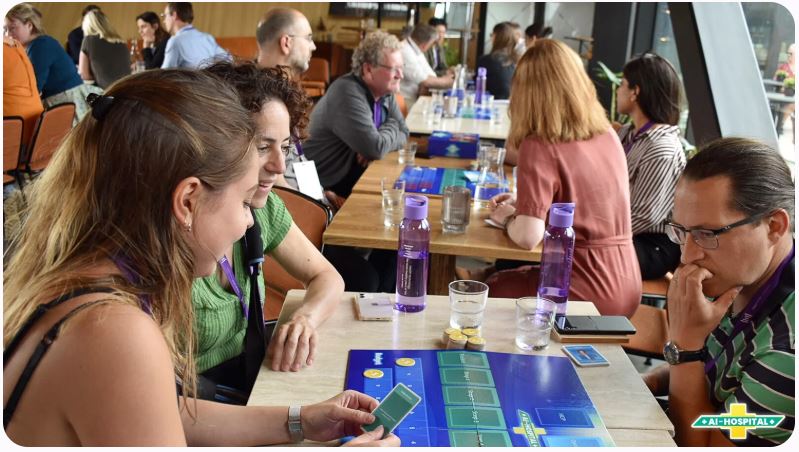
AI+Hospital as a practical test case
The research extends far beyond theory. The case study AI+Hospital—an educational game about artificial intelligence in healthcare—serves as the ultimate practical test. Originally developed as a board game by DASH and 8D, its success was so overwhelming that external demand quickly exceeded logistical capabilities.
Van der Meulen: “Developing AI+Hospital into a digital variant is the perfect opportunity to directly apply and evaluate the new framework. Our ambition is to design the digital version so that it is inherently ready for national or even international rollout. It is a win-win situation: we validate the new framework while simultaneously elevating a successful innovation to the next level.”
Transdisciplinary collaboration
The project is made possible by the PPP allowance for ‘Research and Innovation’ from CLICKNL, in collaboration with RVO (Netherlands Enterprise Agency), which aims to stimulate public-private partnerships. The Jantina Tammes School (University of Groningen) manages the project and safeguards its scientific relevance, DASH (UMCG) provides clinical expertise and the testing environment, and EVRgreen Studio and 8D bridge the gap to the creative market.
|
This news article was originally publishedon 19 May 2026 on the 8D website.
|
More news
-
-
03 September 2026
Ming Cao reappointed as scientific director of the Jantina Tammes School
-
01 September 2026
Evrim Ursavas appointed scientific director Wubbo Ockels School