

Event Recap: Voicing Sustainability - Achievements, Progress and Prospects
Text: Zacharoula Mouzouri
What does several years of work on sustainability look like when you bring it together in one room? On 2 October, around 75 members and partners of the Rudolf Agricola School community gathered at the House of Connections for Voicing Sustainability: Achievements, Progress and Prospects. The idea behind this event was simple but timely: to look at what has grown around RAS over the past years, make some of those connections visible, and ask what should be carried into the School’s next phase.
The question came at a moment of transition. The four Schools for Science & Society are being reshaped, with more connections between the 4 Schools. Part of RAS, the Sustainable Landscape & Region part, will become part of the Wubbo Ockels School. The event was therefore both a look back and a look ahead: at research areas, groups and activities that have developed within RAS, but also what will continue in a renewed RAS and what will find a place elsewhere.
Democracy and trust, (inter)national elections, migration, security, cascading disasters, biodiversity loss, plastics, food systems, and the transition to a circular economy all entered the room over the course of the morning. Yet what stayed with me was how often urgency was followed by something else, an example of collaboration, an experiment, a next step, or simply a conviction that something could still be done.
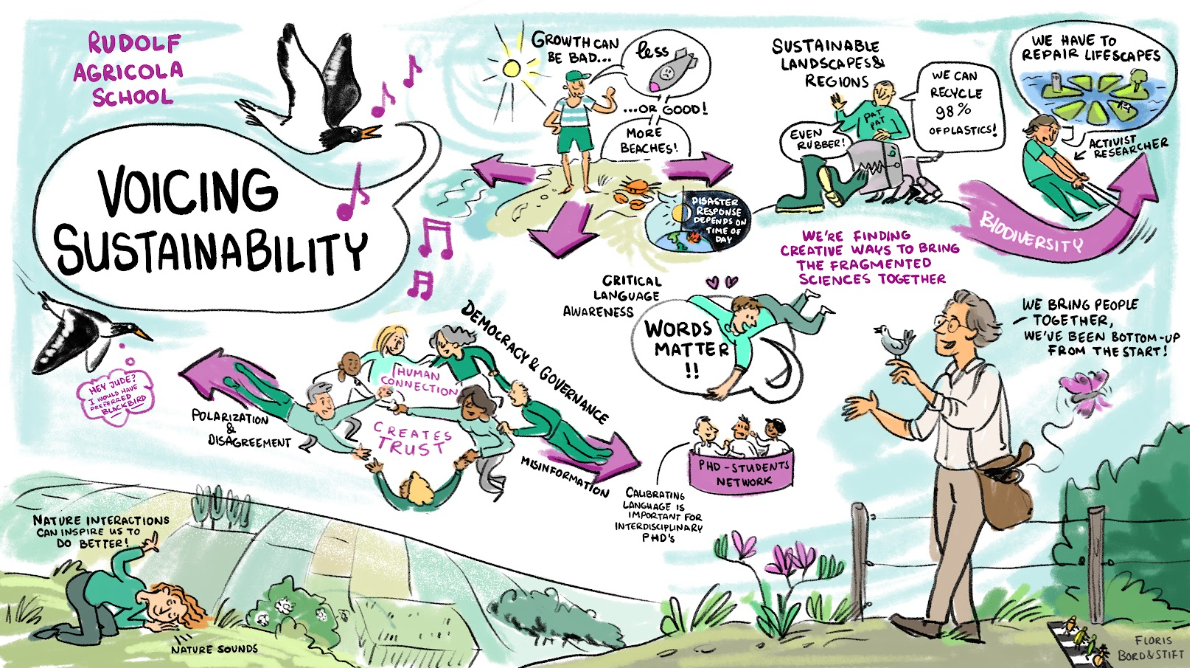
At the same time, a live drawing by Floris van Elteren of Bord & Stift was taking shape alongside the presentations. Each new contribution added another element. What began as separate fragments gradually became one picture of important elements within RAS.
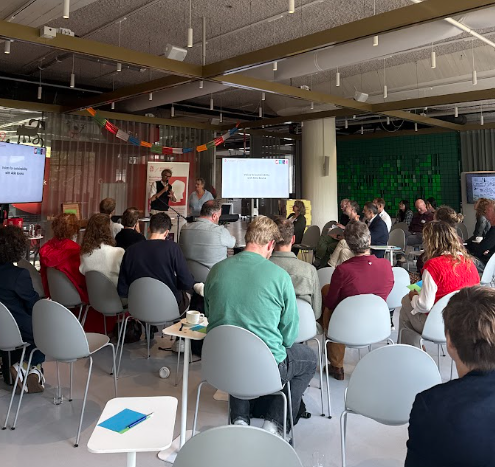
A round through the themes:
The first part of the programme was a rondje langs de velden: a quick journey through the School’s research themes, groups and projects.
Under Democracy & Governance, Piero Tortola, theme director, spoke about Elections, Leah Henderson about Social Trust, Davide Grossi about Democratic Innovations, and Jeanette den Toonder and Raymond Adema about Human Mobility & Migration. The focus then shifted to Development, Security & Justice, with Francesco Giumelli as the theme director being replaced by Malcom Campbell-Verduyn on Security and Justice, and Malcolm on his own subject post-growth infrastructure. Under Risk, Crises & Resilience, Francesca Giardini, theme director, presented Cascading Disasters, turning attention to crises that do not stay neatly within a sector or system. The range became particularly visible within Sustainable Landscapes & Regions. Michiel Daams, theme director, spoke about Sustainable Urbanisation, Francesco Picchioni about the project plesTIC Ready in collaboration with Greenwise Campus Emmen and organisations, knowledge institutes and companies, Emma Folmer and Bart Volkers about circularity, Han Olff about the CurveBend project, and Kees van Veen about Sustainable Food Systems.
The pace was quick, but that was part of what made the overview work. One subject changed how the next one looked. A presentation on cascading disasters sharpened the stakes for the one that followed on circularity, and a project on urban sustainability read differently once placed next to the one on migration. Seen side by side, the themes stopped looking like separate research lines and started looking like facets of the same question. That has always been part of the logic behind RAS as a network organisation: it does not gather research under one roof so much as connect it, bringing researchers at every career stage and lecturers from across the University together with each other, and with societal organisations and citizens, on many different pathways towards greater sustainability.
What grows around research:
The morning then moved beyond research themes and projects to something that can be less immediately visible, that has grown around them.
Jorien Zevenberg presented the Future Planet Innovation minor, bringing students into the story. Erika Darics, followed with RESPONSUS. As Darics explained, the name combines response and responsibility, a fitting name description for work that shows how language, communication and critical awareness are vital parts of social change. Attention then turned to what the programme called ‘’supporting deep digging research for sustainability.’’ Wanli Zheng reflected on the RAS PhD programme, followed by Irene Maltagliati, Jesper Beverdam and Jannick Scheepsta on the RAS PhD Community.
The next cluster was ‘’creative ways of bringing fragmented science together.’’ Jelle Posthuma and Leah Henderson spoke about the RAS podcast Wijze Raad, Koen de Koning and Douwe-Jan Schrale presented the RAS SDG Booth, and Kim Poldner reflected on regenerative leadership. These were followed by examples of developing the art of high-impact events. Astrid Bakker and Sita Dijkstra, eventmanagers of RAS, on high-impact event themselves, Ineke de Jonge and Thijs de Zee on the Noordelijke Bestuursconferentie, Bart Volkers on the yearly events together with Circular Groningen and Drenthe.
By this point, it was becoming difficult to describe RAS simply in terms of research groups. Students, PhD candidates, podcasts, public events, societal organisations and regional partnerships were all part of the picture, and taken together they pointed to the same underlying question what happens to knowledge once it leaves the researcher’s desk, how it travels into organisations, policy, communities and collaborations, and what happens when those actors become part of the process themselves.
Creating space:
That thinking was also present in Frans Sijtsma’s farewell interview on RAS. Looking back on his directorship, he described the School’s work as creating an environment in which different groups could develop and grow, rather than deciding in advance which initiatives would succeed. In his words, a people-centred approach is essential: ‘’So we are all about fueling enthusiasm, initiative, and motivation within people.’’
At around noon, the programme turned that same idea into something people could do, rather than only hear about. After the reflection on achievements and progress, the next part was titled ‘’Travelling into the future - with two suitcases.’’ Participants were given two differently coloured cards - green for the Rudolf Agricola School, blue for the Wubbo Ockels School - and were invited to write down wishes, ideas, or advice for what they wanted to see in each School’s future, before placing them into the corresponding suitcase.
The exercise fit Sijtsma’s description of the School rather precisely. The decision to move part of RAS into the Wubbo Ockels School was made at an organisational level. The cards offered a different kind of input and a concrete way to say what has mattered enough over the past years that it needs to travel with the School regardless of where exactly it lands. Creating space, in other words, held even for the move itself. Nobody in the room was asked to approve or object to the reorganisation; they were simply given room to put, in writing, what should not get lost in it.
So we are all about fueling enthusiasm, initiative, and motivation within people.
Finding a common rhythm:
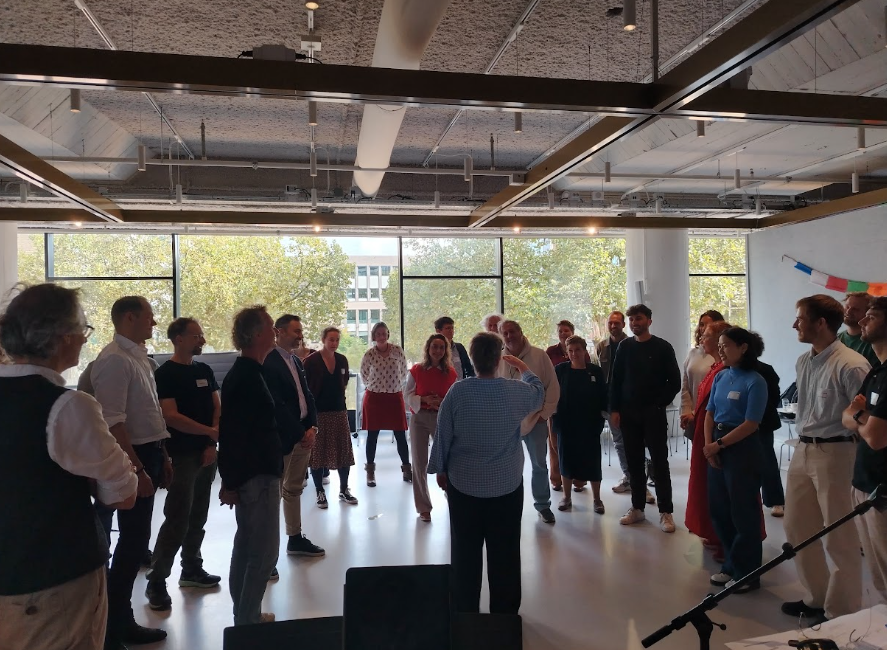
The formal part of the morning ended with Voices for Sustainability and the room singing together, led by Akke Bosma, conductor of several choirs.
After a morning filled with different disciples, methods, projects and ideas about sustainability, it was a fitting ending. Singing together does not require every voice to sound the same. It requires listening to the voices around you, adjusting, and finding a shared rhythm.
The challenges presented at Voicing Sustainability were urgent, and the event did not make them smaller. But neither did urgency become resignation. Again and again, the response was to bring people together: researchers and students, PhDs and societal partners, different disciplines and different forms of knowledge. Perhaps the live drawing captured it best. No single contribution was the whole picture, but the end result appeared through the connections between them.
The shape of the Schools is changing, and that kind of change rarely runs in one direction only. Research groups and projects are moving into new combinations, something the morning’s rondje langs de velden had already made visible before anyone used the word ‘transition.’ But the day’s official hand over made a more personal shift explicit too. 2 October was also Frans Sijtsma’s last event as director of RAS, after three and a half years in the role. It felt fitting, then, that the event closed with a room singing together, and a poem. A reminder that what RAS has built over the past years was never a matter of structures, but for the people willing to keep building them.
At the end of the event, Douwe-Jan Schrale also shared a poem for Frans Sijtsma, bringing together images of landscape, care, roots, and collective action.
|
Gedicht voor Frans afscheid
Show us your love.
Your love of the land.
Crystalize realize,
manifest the earth broken open
Fierce to stand up.
Fire in their eyes, |
|
- Douwe-Jan Schrale
|
More news
-
19 October 2026
From research to business: RUG Ventures helps ideas move forward
-
-
03 September 2026
Ming Cao reappointed as scientific director of the Jantina Tammes School