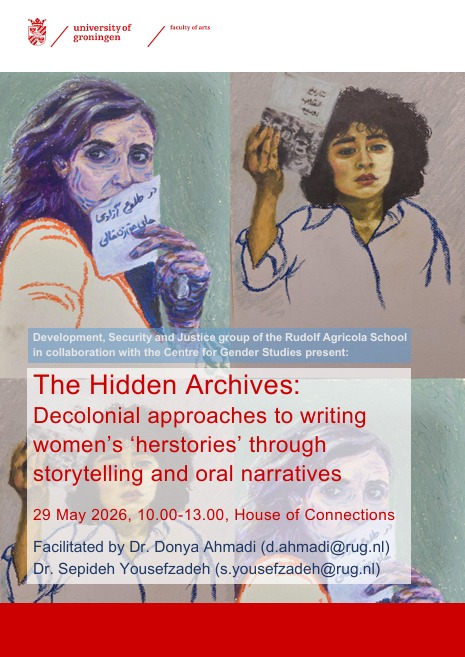
Women’s everyday and oral histories in the Middle-East
Over the past decades, feminist historiography has increasingly shed light on the masculinism inherent in traditional approaches to archival collection and use, underscoring how women’s lives and contributions have historically been inadequately documented in traditional repositories. Women’s archives remain scattered and patch-work especially in highly patriarchal and authoritarian contexts where little institutionalized effort and resources are afforded to the collection and preservation of women’s intergenerational stories. This is particularly the case in the Middle-East, where women’s lots and narratives have continuously (re-)emerged as battlegrounds of political ideology, national identity, and militaristic conquest since the turn of the century, rendering the cause of ‘women’s liberation’ particularly susceptible to cooptation and instrumentalization.
In light of this, the symposium invites contributions that utilize oral history narratives and alternative archives to weave together women’s bottom-up and everyday histories in the Middle-East. We use the category “women” in its heterogeneity, referring to trans women, queer women, women living with disabilities, migrants and refugees, incarcerated women, women who are currently living under war or occupation and working-class women. By alternative archives we mean anything that can be used as tools for the intergenerational transmission of wisdom, including memoirs, autoethnography, folkloric tales passed down through word of mouth, artefacts: from family heirlooms to archeologically excavated objects, poetry and art, women’s publications and periodicals, voice and video recordings, etc.
Our aim is not to present a comprehensive or monolithic history of Middle-Eastern women. Rather, we borrow from and build on decolonial feminist traditions of historiography and storytelling to carve out necessary space for the untold or oft overlooked everyday aspects of women’s lives. The ultimate aim is to uncover similarities and interconnections between Middle-Eastern women’s ‘herstories’ of struggle, strategies for survival, modes of socialization and political organization, cultural and knowledge productions and ways of joy-making beyond made-up borders and patriarchal nationalisms.
Programme
Programme Day 1
|
09:00 - 09:30
|
Walk-in
|
|
09:30 - 10:00
|
Opening
|
|
10:00 - 12:00
|
Panel I
|
|
12:00 - 13:00
|
Lunch
|
|
13.00-17.00!!
13:00 - 15:00 |
!!!Location: Room 1315.0042 (Harmony Building), Oude Kijk in Het Jatstraat 26, Groningen
Panel II
|
|
15:00 - 17:00
|
Panel III
|
|
17:30 – 19:00
|
Dinner
|
Programme Day 2
|
9:30 - 10:00
|
Walk-in
|
|
10:00 - 12:00
|
Workshop: The hidden archives: Decolonial approaches to writing women’s ‘herstories’ through storytelling and oral narratives Donya Ahmadi & Sepideh Yousefzadeh |
|
12:00 - 13:00
|
Lunch
|
*This day requires registration
Speakers
Donya Ahmadi
Donya Ahmadi is assistant professor of international relations at the University of Groningen, The Netherlands. Her areas of expertise include intersectional feminism, gendered racism, embodiement, and othering, among others. Her current research concerns an intersectional feminist critique of Iranian nationalism, and its historical and contemporary manifestations through gendered processes and embodied practices of assimilation. Her broader research addresses transnational modes of feminist activism in the Middle-east with a particular focus on Iran and Afghanistan.
Sepideh Yousefzadeh
Sepideh Yousefzadeh: I am a global South researcher and educator and an associate professor in Intersectional Wellbeing and Decoloniality, at the University of Groningen, Campus Fryslan. I am a midwife by training and continued my post graduate studies in Public Administration and my PhD on Governance and Policy Analysis. Before joining academia, I worked in international “development” first as a midwife, and then working with multidimensional wellbeing of migrants and displaced people, and finally with child rights. My current research focuses on family archives and women’s everyday history.
Reeda Alji
Reeda Alji is a PhD candidate in Law at Sciences Po Paris. She holds an LLM from the University of Exeter and an MA in Transitional Justice and Human Rights Law from the Graduate Institute of International and Development Studies in Geneva. Her research focuses on the colonial conception of time within the apartheid framework in international law in Palestine. She previously worked at the Office of the United Nations High Commissioner for Human Rights (OHCHR) in Geneva and as a researcher at the International Centre for Transitional Justice.
Arman Eslambolchi
Arman Eslambolchi is pursuing his PhD at the University of Groningen, where he studies the lives and struggles of communist women in modern Iranian history. His dissertation traces the intertwined biographies of several Marxist-Leninist women activists of the twentieth century, including Maryam Firuz, whose story forms a vital thread in his larger project. In addition to his research, as a university teacher (Docent), he teaches courses particularly on archival research, guiding students in navigating both traditional archives and alternative sources in the age of new media and the internet.
Bilge Duruturk
Bilge Duruturk earned a Ph.D. in Political Science from Hacettepe University in 2018 with a field research at University of Paris 8 Vincennes-Saint Denis. Her thesis focused on intersectionality, politics of identity and gender issues of civil society organizations in France. Her research offers a critical analysis of intersectionality, examining how race, gender, and class intersect with issues of religion, migration, and veiling practices in France. She is currently an Associate Professor in the International Relations Department at Adana Alparslan Türkeş Science and Technology University.
Ertugrul Cevheri
Ertugrul Cevheri is assistant professor at the Adana Alparslan Türkeş Science and Technology University in Adana, Turkey. He has a PhD degree in International Relations from Ankara University. His area of research includes democracy promotion, democratization, authoritarianism and European Integration.
Artemis Akchoti Shahbazi
Artemis Akchoti Shahbazi is an artist and writer exploring exile as a condition of perception—how displacement, colonial gaze, and inherited doctrine shape the ways we see, love, and remember. Born in Iran and raised between Iran, France, and Switzerland, she now lives in the United States. Her practice moves across geographies, languages, and cultural frameworks, creating works that hold fracture, intimacy, and history together in new forms. Drawing on Persian miniatures, Sufi cosmology, and embodied memory, Shahbazi
approaches art as an act of perception rather than representation, privileging immediacy, relationality, and the intimate alongside the political. Her work has been exhibited internationally, including at the Museum of Fine Arts, Boston, and Aaran Gallery in Tehran, and featured on BBC Persian program Tamashah.
Pilar Milagros
Pilar Milagros has a PhD in Rhetoric with a focus on Cultural Studies. She is a Serra Húnter Assistant Professor at the Faculty of Education at the Universitat de Lleida (Spain). She is currently a co-investigator in a project funded by the Scientific Research Projects Coordination Unit (BAP) of Ege University, Izmir, Turkey (Project No: 32054), titled “Graphic Novels in the English Literature Classroom as Potential Actors in Raising Gender Equality Awareness.
Şirin Fulya Erensoy
Şirin Fulya Erensoy is a film and media scholar, curator, and lecturer whose work examines the intersections of documentary cinema, activism, and political aesthetics. Her research combines feminist and ethnographic approaches to explore how moving images engage with questions of witnessing, resistance, and collective memory. She has taught Film and Television at various institutions in Turkey and completed a Marie Skłodowska-Curie Individual Fellowship at the Film University Babelsberg Konrad Wolf (2021–2023). Since September 2024, she has been Lecturer in Film Studies at the University of Groningen.
Perihan Taş Öz
Perihan Taş Öz completed her undergraduate, graduate, and doctoral studies in Cinema and Television at Marmara University. Her academic research focuses on film narratives, gender, and identity. She is currently the Head of the Department of Radio, Television, and Cinema at Istanbul Kültür University, where she also continues to work in film production and screenwriting.
Mayed Sahibzada
Mayed Sahibzada: I call myself a creative alchemist, one who cultivates tools of liberation. For me, creativity isn’t just about invention but remembrance — listening to the echoes of what's been buried yet still lingers within me, and finding my way back to my roots. As a queer, diasporic being shaped by histories of colonization, displacement, and migration, I am learning what it means to (un)belong to many places, or sometimes none at all. My work across design, fashion, research, and storytelling is how I practice reclamation and imagine futures that can truly witness us in our collective be(com)ing.
The two-day symposium is organized in line with the forthcoming edited volume (University of Groningen Press) titled “Lest we forget: Women’s everyday and oral histories in the Middle-East”, edited by Donya Ahmadi and Sepideh Yousefzadeh, and in collaboration with the Centre for Gender Studies at the University of Groningen, NOG (Netherlands Research School for Gender Studies), and ICOG (The Groningen Research Institute for the Study of Culture), and Rudolf Agricola School for Sustainable Development (Development, Security and Justice Research Theme).
Under Agricola’s Development, Security and Justice Theme, this symposium will be coordinated by two research groups and their members: Decolonizing Knowledge Research Group and Digital Archives (Donya Ahmadi and Sepideh Yousefzadeh) and Digital Collections Research Group (Renata Figueiredo Summa). The symposium is at the heart of both research groups. On the one hand, it is rooted in women’s embodied knowledge and oral histories, foregrounding lived experience, memory, and forms of knowing that are often transmitted outside formal institutions. On the other, it engages directly with the core concerns of archives and collections, prompting reflection on how such knowledge is preserved, interpreted, and given space within institutional frameworks.
|
For questions, don’t hesitate to reach out to us!
|
|