

Stories of This Abled City: Shaping inclusive places through research, lived experience and creativity
Text: Zacharoula Mouzouri
How do we experience the city when we move through it differently? What changes when the knowledge and experiences of people with disabilities become central to how we think about urban life? From 10 to 12 June, the House of Connections in Groningen became a space for exploring exactly these questions, during Stories of This Abled City: Experiential Dialogues on Disability in Urban Life.
The three-day exhibition brought together research, lived experience and creative practice, inviting visitors to explore accessibility and inclusion from new perspectives. Organised by the This Abled City team and the Aletta Jacobs Chair, Prof. dr. Bettina van Hoven (University College Groningen and the Faculty of Spatial Sciences), in collaboration with the Rudolf Agricola School for Sustainable Development, the event was made possible through the Impact Explorer programme of the Dutch Research Council (NWO).
A decade in the making
Stories of This Abled City grew out of roughly ten years of collaboration between researchers at the University of Groningen and ‘s Heeren Loo / Noorderbrug, a care organisation supporting people with disabilities. ‘’We began with participatory and arts-based projects involving students from UG and Minerva, such as our Break Out and Show Yourself projects,’’ says Van Hoven. ‘’But this gradually developed into research on accessibility, disability, inclusion and everyday urban life.’’
Over the years, the co-researchers took on an increasingly central role, shaping the research questions, the methods, and the way findings were shared. ‘’Working with them emphasised the importance of being addressed, being taken seriously, being able to participate, and being recognised as someone with knowledge of the city,’’ Van Hoven explains.
The exhibition became a way to bring these strands together and open them up to a wider public. Instead of approaching disability only through the lens of barriers or deficits, the organisers wanted visitors to encounter it through stories, maps, games, film, design, sport, humour, frustration, expertise and imagination. Collaborations with students, Minerva, the Creative Media and Game Technologies programme at the Hanzehogeschool, and Alfa-college supplied much of the material that made this possible. Above all, the hope was to shift perspective: to challenge dominant representations of people with disabilities by showing them instead as co-researchers, designers, players, city users and citizens.
Working across disciplines, and beyond them
Multi-, trans- and interdisciplinary work sits at the heart of the project. Academically, it draws on human geography, disability studies, participatory research, ethics of care, urban studies and arts-based methods. But just as important is knowledge that falls outside conventional academic disciplines: above all, the experiential knowledge of the co-researchers, alongside the expertise of designers who translate research into image and space, and the technical and creative skills of game developers.
‘’I always say that I am ‘incomplete’, and that is actually a great place to be in,’’ Van Hoven reflects, ‘’because it means I am always open to finding out what and who we need to make our project better.’’ Academic research helped frame the questions around disability, urban space and participation; the co-researchers brought knowledge of what accessibility actually feels like in everyday life; designers created images and translated research into characters and embodied, spatial experiences; Hanze students turned insights into playable games; and school activities invited children to explore accessibility through making, interviewing, designing and mapping.
‘’I always say that I am 'incomplete', and that is actually a great place to be in - it means I am always open to finding out what and who we need to make our project better.’’
Making that kind of collaboration work meant building relationships over years, staying in touch, visiting people in person, and leaving room for the serendipitous. ‘’That means we often engage in collaborations or pursue ideas without really knowing what will come out of it, or if it will be a success. It also means we have to let go of some control, to allow other people to do ‘their thing’ in their own way and at their own pace.’’ Not every avenue led somewhere, but the ones that did, new methods for working with people who communicate through a tablet or letter card, for instance, or ways of making characters with multiple disabilities compelling to children as game heroes, became some of the project’s most distinctive contributions.
Concrete materials such as maps, photographs, drawings, and game prototypes, proved essential to this way of working and also served as conversation starters between people with very different backgrounds. So did slowing down, adjusting the pace of meetings, using visual material, adapting how people communicated, and making sure wheelchair users had the support they needed to participate fully. ‘’We accepted that combining different forms of knowledge is not always smooth, sometimes even chaotic but we also realised that friction can be productive if there is enough trust, time and willingness to change.’’
An exhibition built room by room
The collaboration with the Rudolf Agricola School gave the project something it needed to move from academic dissemination to public dialogue: space, quite literally, and the support to fill it. As Van Hoven notes, ‘’accessibility is sometimes treated as a specialist or technical issue but it is central to how cities become liveable, just and sustainable for different people. Everybody plays a role in making spaces accessible and inclusive.’’
That space, the House of Connections on the Grote Markt, let the team tell its stories through a series of rooms, each one its own chapter. The green room, developed with the Creative Media & Game Technologies programme at the Hanze, showed how people with a disability can be game characters and heroes, and connected to a film studio where primary school children built their own short stories about accessibility. The ‘overwhelm room’ took the opposite tack, filling the space with images of the everyday obstacles that make moving through the city discouraging such as ill-parked bikes, cars on the sidewalk, construction sites, and loose tiles. Outdoors, the exhibition’s opening day doubled as the National Buitenspeeldag, the national initiative run by Jantje Beton, the programme on the Grote Markt, with the Wheelchair Skills Team, Skatepark Colosseum, FC Groningen and House of Sports Groningen, was Stories of This Abled City’s contribution to that wider day of play.
I spent an afternoon walking through the rooms myself, and what stayed with me was how differently the same idea could land depending on the medium carrying it. A stop-motion film made by schoolchildren, a game that puts you in a wheelchair racing across a reimagined Vismarkt, a wall of photographs documenting loose tiles and blocked curbs: none of these explain accessibility so much as let you feel your way into it for a few minutes. That is a different kind of understanding than the one a report or a journal article produces, and it is one this project treats as knowledge in its own right, not just an accessible add-on to the ‘’real’’ research. For a school built around the idea that sustainable, inclusive places take more than one kind of expertise to design, that felt like the exhibition’s clearest argument for itself. As Van Hoven puts it: ‘’Sometimes we need to change who is involved in knowledge-making, what forms knowledge can take, and where conversations about research happen.’’
What comes next
Looking back, Van Hoven points to two insights that run through the whole project. The first is that accessibility is about far more than whether a place can technically be entered, it is also about energy, time, communication, being addressed directly, feeling welcome, and being able to participate without constantly negotiating exceptions. The second is that people with disabilities should not be consulted about accessibility only after decisions have already been made; their lived experience is planning knowledge, design knowledge and research knowledge from the start.
Since then, it has become clear that the exhibition’s reach went well beyond its own walls. It brought together co-researchers, students, professionals, schoolchildren, designers, researchers and members of the public, offering concrete ways to engage with accessibility. For the students involved, it showed that research can be collaborative, creative and geared towards a broader public. For visitors, the organisers hope it opened up new ways of seeing disability and the different ways it is produced through environments, routines, assumptions and relations.
Looking ahead, the team wants to deepen its collaboration with co-researchers and societal partners, extend its work on accessibility in everyday urban and work environments, and develop methods that take care, time and interdependence seriously. The games, maps, stories, school activities and design tools developed for the exhibition will also be shared more widely, to support teaching, public engagement, planning conversations and future research and the project’s website is currently being updated to make this material available.
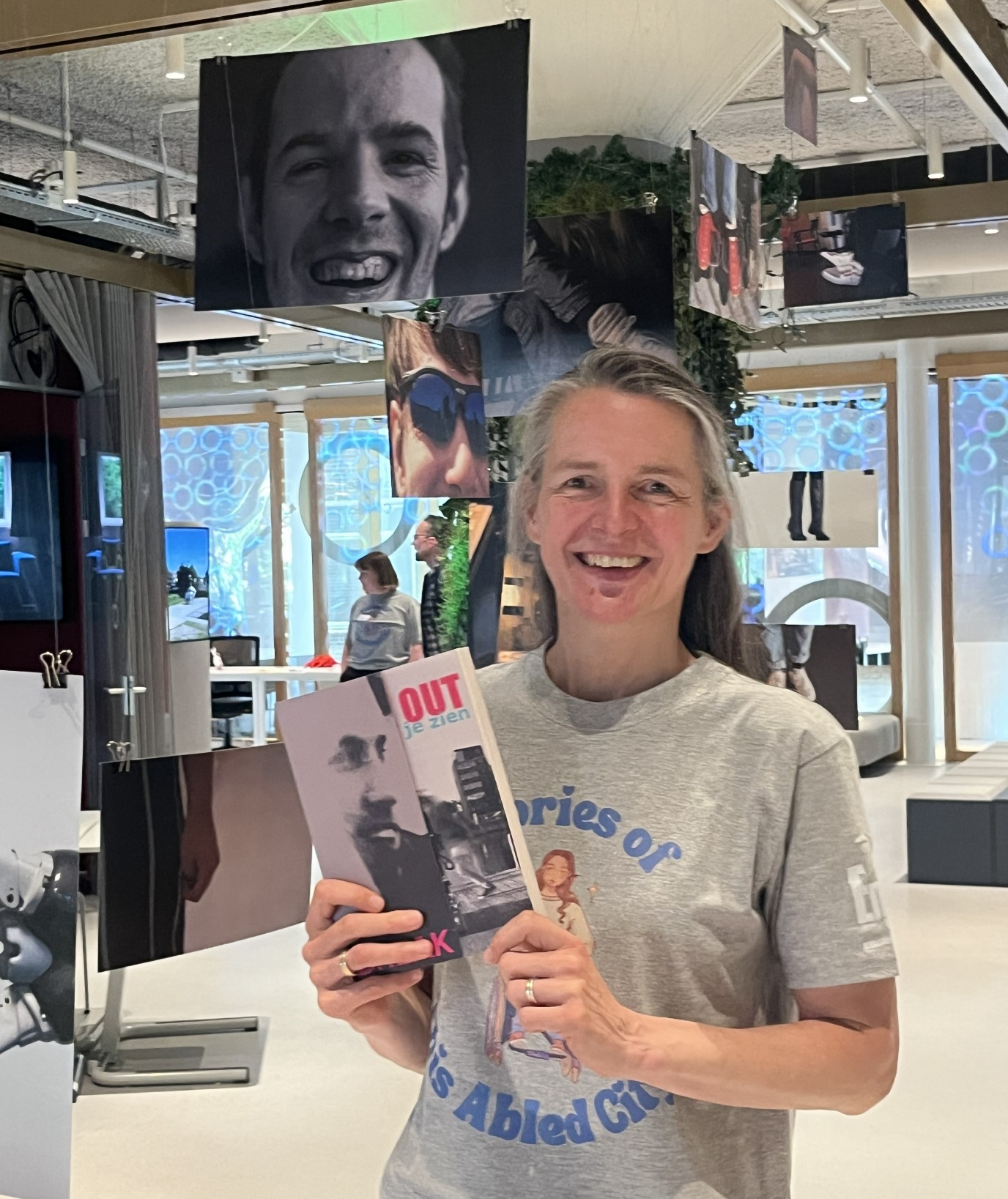
Two of the project’s earlier outputs, the Break Out book and the This Abled city book are also available on request, free of charge. Copies can be picked up, or posted for the cost of the postage. The game is not yet printed, but anyone interested can register that interest now and will be contacted as soon as it is ready.
None of this would have come together without the exhibition’s partners and funders: the Nederlandse Organisatie voor Wetenschappelijk Onderzoek (NWO), Wheelchair Skills Team, Skatepark Colosseum, Huis van de Sport, FC Groningen, Kids United, Gemeente Groningen, Univé, Accessible Gaming, Jantje Beton, So Yes, Vale Design and Babbage. A full overview of the partners behind Stories of This Abled City is available on the Rudolf Agricola website.
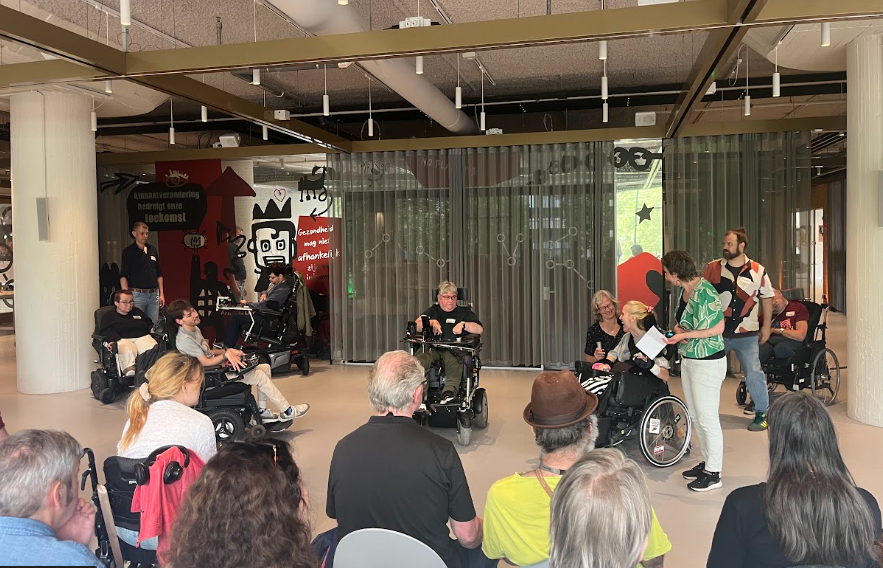
Groningen's city poet Jaimy Hindriks wrote a poem inspired by Stories of This Abled City, bringing her distinct voice to the exhibition's exploration of accessibility, disability, and urban life. Hindriks, the 12th city poet of Groningen, was selected for the role in January 2026 for a two-year term, and is known for blending poetry with stand-up comedy, using sharp and absurdist humour to capture daily life in the city. As part of her term, she connects with the community through short work placements with local organisations, which inspire the six official poems she is required to write each year, and this exhibition became one such source of inspiration.
Beperkte openingstijden
Je noemt me een superheld,
Jij bent dat ook niet omdat
je zonder wielen boodschappen doet.
Mijn beperking is geen cape,
jouw twee benen ook niet.
Hij draagt zijn beperking als een medaille zeggen ze.
Ik draag vooral slijtplekken in mijn jas,
versleten mouwen,
bandensporen op mijn handen,
en soms de boodschappentas
die nét niet handig hing.
De winkelruit toont een bordje
met koeienletters
Maar OPEN gaat verder
dan een deur van het slot halen.
Open is een pashokje waar je kan draaien.
Een stoep zonder losse tegels.
Een fiets die niet midden op de route geparkeerd staat.
Een straat die niet elke honderd meter vraagt Hoe graag wil je hier eigenlijk zijn?
Het leven is een grote drempel
zeggen ze.
Dat klinkt poëtisch.
Tot je beseft dat drempels
meestal gewoon blijven liggen.
Ik ben geen held omdat ik leef.
Wie van ons wil er nou applaus
voor het halen van de supermarkt?
Je leert obstakels temmen
als een drakentemmer.
Sommige draken zijn van beton.
Sommige draken zijn van staal.
Als Groningen echt wil winnen,
laat de prijs dan geen medaille zijn,
maar een stad die open is.
Poem written by Jaimy Hindriks
Curious to learn more?
Visit the This Abled City website to learn more about the project, the people involved, and the wide range of research and creative outputs developed throughout the collaboration. Or hear more about accessibility, inclusion and the collaboration behind the project in the RUG & Co. podcast episode featuring Bettina van Hoven and Leon Lodder. The exhibition was also featured by RTV Noord and OOG TV, who highlighted how Stories of This Abled City challenges assumptions about disability and invites visitors to see the city from different perspectives.
More news
-
19 October 2026
From research to business: RUG Ventures helps ideas move forward
-
-
03 September 2026
Ming Cao reappointed as scientific director of the Jantina Tammes School