

The Writing Centre is celebrating its first anniversary!
A year ago, the Writing Centre opened its doors as part of the University of Groningen Language Centre. With over 300 free coaching sessions for Bachelor’s, Master’s, and PhD students, as well as well-attended Writing Days, the team looks back on a successful first year full of valuable encounters and, above all, significant progress in writing skills!
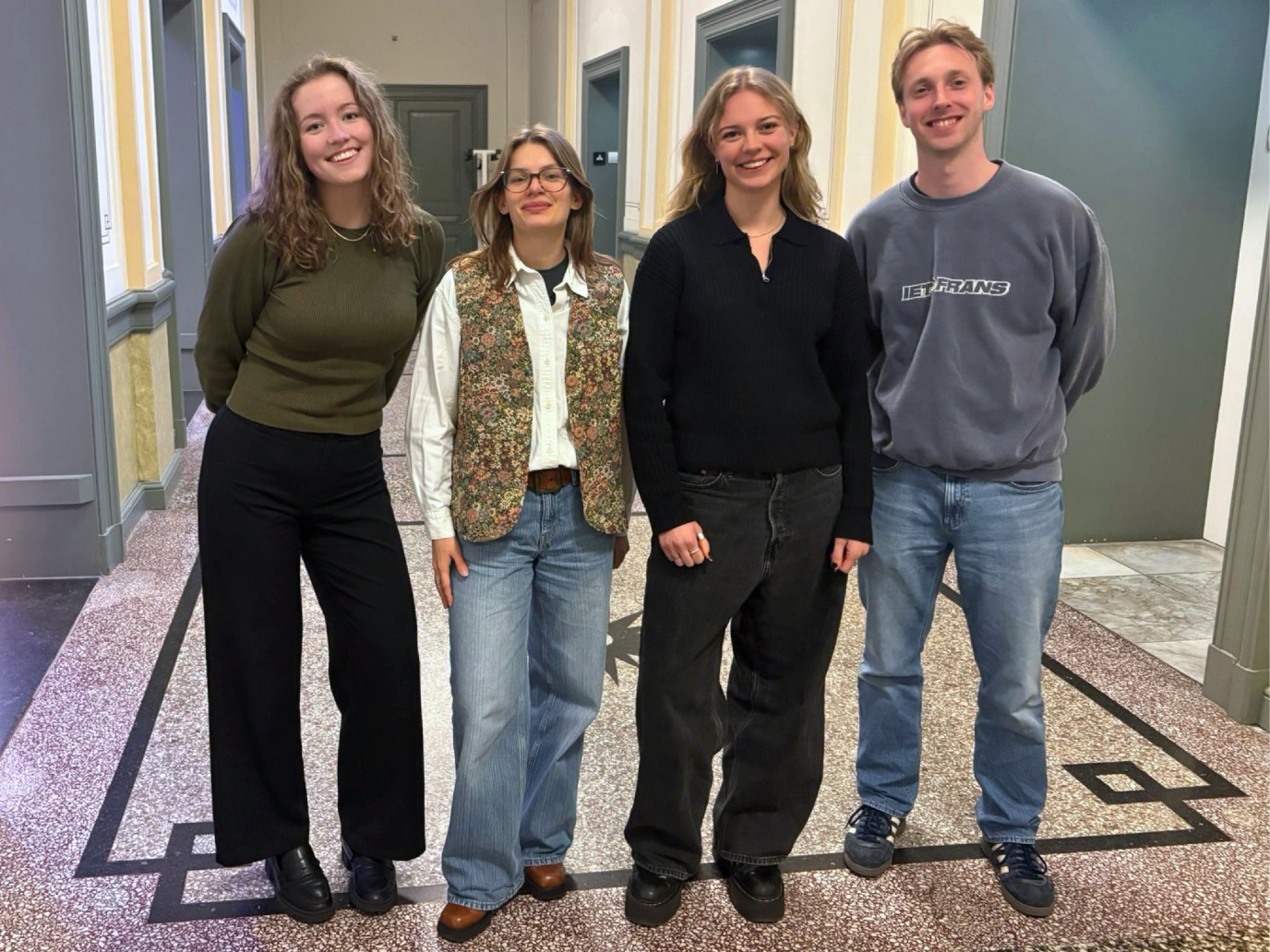
Over the past year, the team has grown from three to five coaches: University of Groningen students Sophie, Luna, Tess, Hannah, and Jesse, with a range of academic backgrounds, share a strong interest in academic writing and coaching. They are trained in coaching and supervised by professionals from the Language Centre. Writing coach Tess looks back on her first year with enthusiasm:
‘This first year has been particularly enjoyable and educational! It’s quite nerve-wracking at the start. You’ve practised a lot with fellow coaches, but now you really have to put it into practice. That took some getting used to, but you become increasingly confident and find a coaching style that suits you.’

Non-directive coaching: putting the writer first
The free individual coaching sessions form the core of the Writing Centre. In a 45-minute session, one of the writing coaches helps a student with a text of up to 1,500 words in Dutch, English, French, or Spanish. For these sessions, the coaches adopt a non-directive approach: they ask questions and help students to look at the text or their writing process in a different way. The student remains responsible for the text. The coaches are students themselves and deliberately do not take on the role of teachers. Tess explains:
‘We do not provide direct feedback or spelling and grammar checking, nor do we have subject-specific knowledge, but it is precisely because we lack this knowledge that students learn to articulate their ideas clearly. We ask questions and help students look at their text or writing process from a different angle. In this way, we help not only to improve the written piece, but above all the writer.’
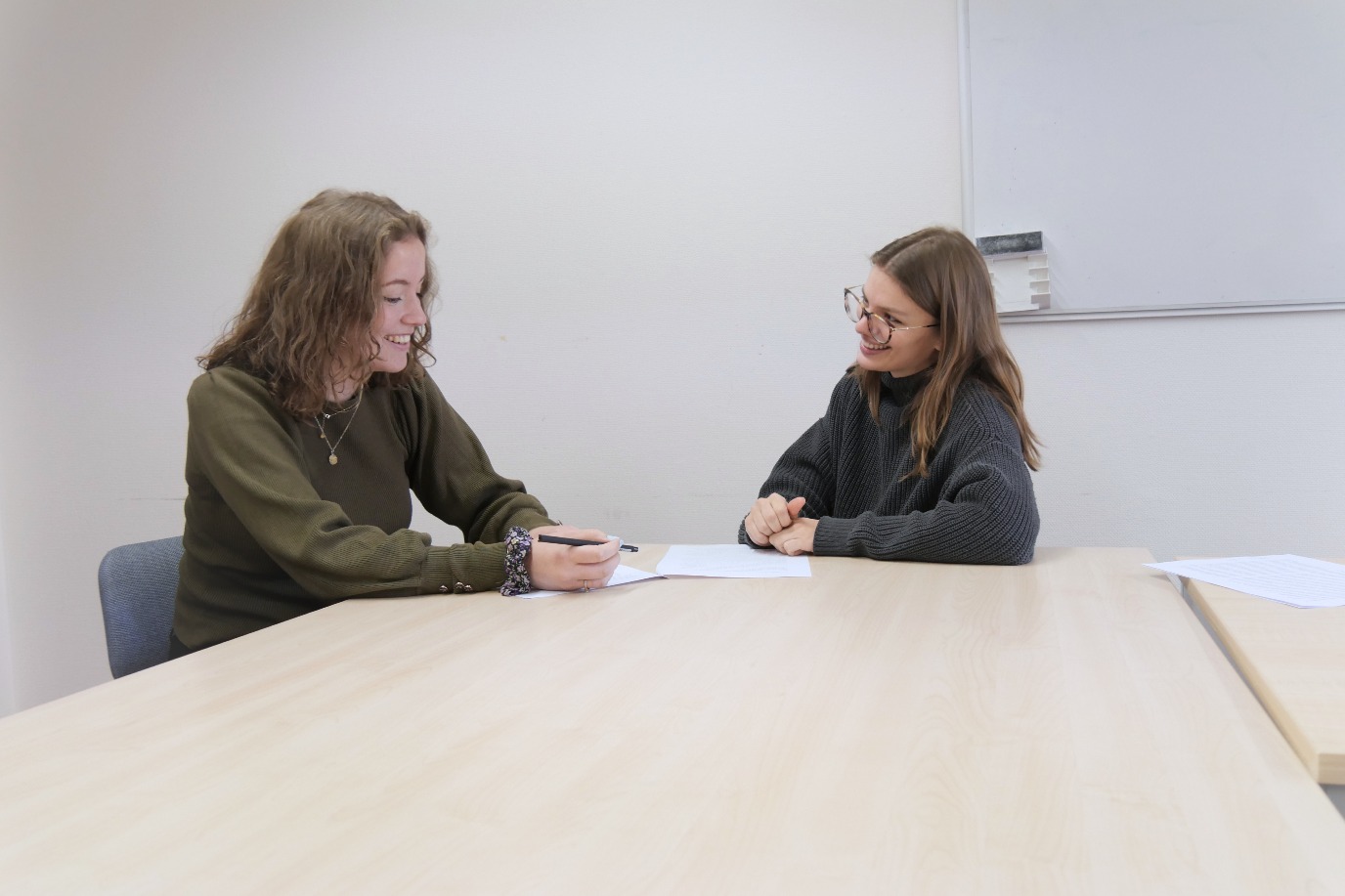
The fact that our writing coaches are students themselves creates a relaxed and equal atmosphere during the sessions. ‘We’re peers, not lecturers,’ says Tess. ‘Before a session starts, we always have a little chat so that the student can settle in.’ From that relaxed starting point, the coaches get to work.
So what exactly happens during the sessions?
Tess tells us about a student who was working on a resit for their thesis. At first, the problem seemed to be writing, but during the session it became clear that the challenge lay elsewhere: in processing the literature. Together, they drew up a plan to analyse articles systematically and flag them according to their relevance to the research question.
Another student, working on a master’s thesis, received feedback that their sentences were too long and complex, and their language too woolly. In the sessions, they explored together how sentence and paragraph structure could be simplified and phrased more directly. It was not about cutting content, but about clarity.
Sometimes, all that is needed is reassurance rather than correction, and students often realize this themselves during a session. For instance, one student had doubts about the structure of their thesis. By reading the text aloud during the session, the student discovered that the structure was, in fact, logical. The conversation brought peace of mind and confidence.
Up to five free sessions
Most students drop by once, often towards the end of their writing process to address feedback from a lecturer or discuss any doubts. For example, a PhD student who was nearly finished noticed that writing had suddenly become more difficult: organizing their thoughts took more effort than before. A single conversation with one of our writing coaches was enough to get them back on track, but for each piece of writing, it is possible to schedule up to five sessions with a coach. As a result, students who have yet to start or who are working on their thesis tend to return more often. Tess recalls a student who struggled with confidence in their writing:
‘We had several sessions, talked a lot, and drew up a weekly plan together. A few weeks after our last session, I received an email: the student had achieved an excellent mark. That made me so proud, especially of that student, but also a little bit of myself. It really confirmed just how enjoyable this work is!’
Writing Days to make real headway
In addition to individual coaching, the Writing Centre organizes Writing Days each semester. During a Writing Day, students work on their texts in small groups in a quiet environment, with the opportunity to receive personal coaching from one of our writing coaches. Peer feedback is also part of the programme. The strength of these days lies in the combination of a quiet workspace and shared motivation. Students work independently, but start and reflect together. The next Writing Days are scheduled for May and June, at a time when many students are working on their theses.
On to year two
To all University of Groningen students: whether you are already writing, putting the finishing touches, or have not started yet, you are always welcome at the Writing Centre. We can coach you through every step of the writing process and help you improve not only your written work but also your skills as a writer. Please read the website carefully before your first appointment so you are well prepared.
Thank you all for the past year. We looking forward to the next one with enthusiasm!

More news
-
19 October 2026
From research to business: RUG Ventures helps ideas move forward
-
-
03 September 2026
Ming Cao reappointed as scientific director of the Jantina Tammes School