

Behind the DCC Scenes: Burcu Beygu
Would you like to know more about the people who work at the UG Digital Competence Centre? In our behind-the-scenes series, our data stewards, IT consultants, and data protection professionals share their role and their perspectives on the research landscape of data and software. In this edition: Burcu Beygu.
Text: Dr. Burcu Beygu
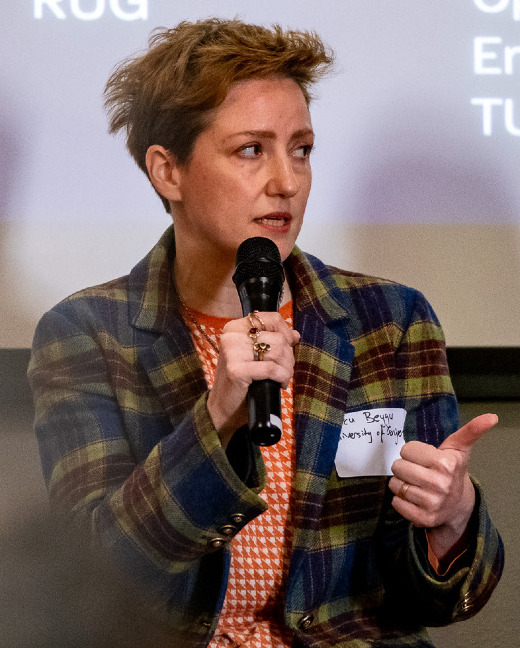
Research software has been part of science for decades. In disciplines such as astronomy, researchers have long developed their own tools to process observations, run simulations, and analyse data. As computing power, scientific instruments, and data volumes have grown, software development has become an integral part of research across many fields. Today, researchers routinely write code, develop analysis pipelines, create visualisations, and build software as part of their research.
Despite its importance, research software has only recently begun to receive recognition as a valuable scientific output. As a former astronomer, I spent years processing and analysing large volumes of data and developing my own analysis tools. At the time, I saw these tools primarily as a means to answer scientific questions rather than as research outputs in their own right. Looking back, I realise how much value was lost by not sharing, maintaining, and publishing them. Not only would this have improved reproducibility, but it would also have helped me develop skills that later proved valuable in my career. These experiences shaped my view that research software deserves far more attention within the research process.
Research software deserves far more attention within the research process.
Unlike research data, software is not static. It is continuously developed, maintained, improved, and adapted to new requirements. Making software reproducible, reusable, and sustainable, therefore, requires different skills and practices than managing research data. I believe it is important that we recognise and reward the researchers and support professionals whose work ensures that software continues to benefit scientific communities.
For the past five years, I have worked at the UG Digital Competence Centre (UG DCC) to support researchers in managing both research data and research software. I initially worked as a dedicated data engineer within the ENTEG institute while also being affiliated with the DCC. Today, alongside my role as Product Owner of the Research Drive and Management System (RDMS), I coordinate and further develop the university's research software management service.
My primary goal has always been to help researchers acquire transferable skills.
Nearly three and a half years ago, I established research software management as a dedicated service at the DCC. With the support of colleagues, I created a webpage and organised workshops, consultations, online resources, and community activities focused on Git and GitHub, reproducible coding practices, collaborative software development, and publishing research software. My primary goal has always been to help researchers acquire transferable skills. Whether they continue in academia or pursue opportunities elsewhere, these competencies help them develop more reusable and maintainable software while providing valuable professional skills that extend far beyond research.
One of the most enjoyable aspects of my work is meeting researchers and PhD candidates from different institutes and disciplines. Each workshop provides an opportunity to learn how they use software to address their own research challenges. It is especially rewarding when participants tell me that they learned something useful and can immediately apply it in their work.
I hope that, in the future, software will become an integral part of the University's broader data management policies, ensuring that the software, the researchers and the research support professionals who create and maintain it receive the recognition they deserve.
Over the last three and a half years, I believe we have come a long way. Research software is now explicitly recognised alongside research data (as special consideration for data) in the Faculty of Science and Engineering's data management policy. Together with colleagues from the Data Science Team, we have developed a Reproducible Research Software Learning Line, offering seven workshops throughout the year and certificates for participants who complete the programme. We also organise Code Cafés with the UMCG and maintain strong connections with the national research software community through TDCC-NES, the eScience Center, and the ADORE.software initiative. I hope that, in the future, software will become an integral part of the University's broader data management policies, ensuring that both the software and the researchers and the research support professionals who create and maintain it receive the recognition they deserve.
More news
-
-
12 October 2026
Farewell to Big Tech: ‘It requires a different mindset’
-
08 October 2026
Exam period: extra opening hours UB - UG-only