

Open access publication in the spotlight - 'Disappointment is coming: rules of engagement in Bill Drummond’s rock memoirs and HBO’s Game of Thrones'
Each month, the open access team of the University of Groningen Library (UB) puts a recent open access article by UG authors in the spotlight. This publication is highlighted via social media and the library’s newsletter and website.
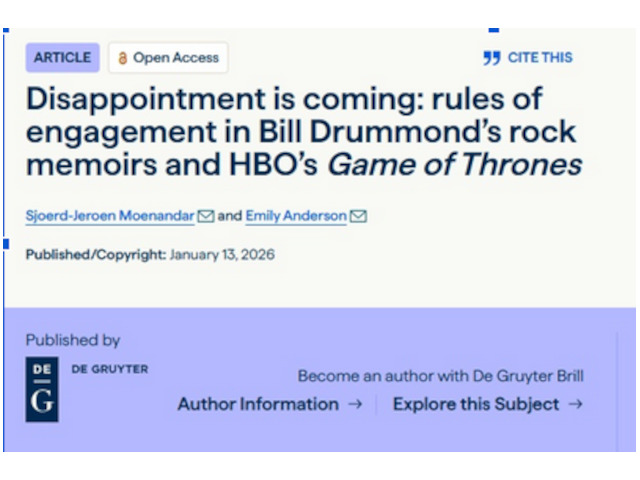
The article in the spotlight for the month of May 2026 is titled 'Disappointment is coming: rules of engagement in Bill Drummond’s rock memoirs and HBO’s Game of Thrones’, written by Sjoerd-Jeroen Moenandar (Faculty of Arts) and Emily Anderson (Knox College, USA).
Abstract
In this study, we analyze two instances of highly mediatized relations between producers of popular culture and their fans. We argue that in such relations, there is a narrative push and pull between creator and audience around rules of engagement: explicitly or implicitly stated agreements about what audiences may expect and creators are expected to deliver. Breaking these rules can be experienced as deeply shocking. Our first case is Bill Drummond, one half of the KLF, a British rave duo from the early 1990s infamous for exiting the music industry in 1992 by shooting blanks at the audience of the BRIT Awards and burning £1 million. Since then, Drummond has written two memoirs in which he describes, often with relish, how he is a disappointment to his fans. Our second case is HBO’s Game of Thrones, which – like many big-budget television series – developed and capitalized on a massive fanbase, resulting in a strong aesthetic and value-driven investment among fans. These fans emphatically turned on the showrunners during the series’ final season, furiously disappointed by what they saw as the show’s failed storytelling, especially its finale. In the first case, fans are intentionally scandalized; in the second, certainly not.
We asked first and corresponding author Sjoerd-Jeroen Moenandar a few questions about the article:
Game of Thrones had a reputation for being surprising and breaking with storytelling conventions (for example with major characters suddenly dying, with The Red Wedding being especially shocking and memorable). Despite this reputation, the surprising (unconventional) final episode was received very negatively by fans. Can you explain why?
In the article, Emily Anderson and I describe how television shows like Game of Thrones shape the expectations of their audiences. So, by the end of the third season, when The Red Wedding happened, viewers had become accustomed to the surprises this show had to offer. That is not to say that viewers were not shocked by the massacre of Robb Stark and his bannermen, but it was the kind of shock that they were tuning in for. Yes, Game of Thrones had made a habit of breaking with storytelling conventions, but by then it had also established a certain way of breaking the rules. We call this the rules of engagement: an implicit contract between audiences and makers, about what a show should offer, and how its viewers should respond. From the perspective of a vocal number of its viewers, that contract was broken by the final episode, which did not shock in the way they had become used to being shocked, but instead broke with the show’s own conventions.
How do digital platforms intensify emotional investment in popular culture? And how does this influence the balance (the narrative push and pull) between creators and audiences?
One way in which digital platforms do this, is by offering a space for creative responses to your favourite show, or pop artist. You can post your fan art on Instagram, show off your cosplaying on TikTok, feature your canon theories on YouTube, and so forth. Of course, such creativity was already an important part of fan communities before the advent of digital platforms, but they make the contact between makers and fans more immediate. Often, the producers of a show try to tap into the creative energy of fan communities, for instance by liking or commenting on fan art, or organising competitions. Fans who see their work recognised in this way can gain status, and a fan community as a whole may feel quite validated by such recognition. This, however, also creates a sense of ownership among fans, who invest time, effort and energy and expect something in return. This creates a potential for fierce backlash if, for instance, a television show does not live up to fans’ expectations. In the paper, we describe how this can even lead to a kind of “anti-fandom”, where, instead of admiration, feelings of dislike, or even hate, become the driving force behind fan engagement. Again, the immediacy of online platforms can exacerbate such dynamics.
You are the journal manager of the European Journal of Life Writing, an open access journal. Why did you (and the editorial board) opt for University of Groningen Press as your publisher?
That decision was taken before I became the journal manager. It had to do with the fact that University of Groningen Press is dedicated to open access publishing, and offers a very user-friendly platform for journals like ours. The website makes it easy to navigate our archives, and the editorial manager offers a manageable workflow – and trust me, I know from experience as an author that this is not always the case!
We, as a journal, strongly believe in open access, but it is difficult to maintain a high-quality academic publication without the income from subscriptions. University of Groningen Press makes this possible. Their staff – in our case, the extraordinary Dorien van Rheenen – is extremely helpful. Without them, we could not do it, really.
Could you reflect on your experiences with open access and open science in general?
I started publishing as an academic when open access was not really an option, and have seen this grow over the years. It is so much nicer if your work is widely available! Fifteen years ago, your choice was, either publish with fully open-access web-based journals that were not so prestigious, or opt for the more prestigious journals, but have your work behind expensive paywalls. As an aspiring academic, I tended to prefer the latter.
Then, I worked for a few years for a Tunisian university, and this really changed my perspective. Institutions in the Global South, generally speaking, have less resources, and therefore lack the well-stocked libraries that we have at a university like ours. This often meant that I was dependent on open access publications – and of course, I was very happy if important work was available in that way. That made me realise that publishing open access is also a question of global justice: it means that no matter where you come from or work, you have access to current academic debates and important research.
When I returned to the Netherlands and started working for the University of Groningen, I was pleased to discover that because of arrangements that the university library has with numerous academic publishers, a lot of my publications are automatically available open access, even if they appear in journals that normally have their articles behind a paywall. That is an enormous privilege. To give an example, a 2024 paper of mine that was published open access in 2024 – “The Structured Narrative Interview” – in a journal that is not, by default, open access, has been the number one best read paper of that journal for more than 24 months by now. Of course, I like to think that has to do with the quality of the paper, but I also realise this would never have happened if it had not been available open access.
This is a great privilege, and not really fair if you think about it – if you don’t work for a university like ours that has the means to make this possible for its employees, you have less chance of being read. That is why it is so important to maintain organisations like the University of Groningen Press, where scholars and scientists from around the world can publish their work open access without having to pay enormous fees.
Useful links:
Open access journal browser: search engine that can be used to check if a discount on the article processing charge (APC) is available for a specific journal. UG corresponding authors can publish with an APC discount (mostly 100%, so for free) in more than 12,000 journals!
University of Groningen Press (UGP) is an open access publisher. UGP provides a publishing platform for journals, books and series, inaugural lectures and open textbooks by teachers and researchers working at or with the University of Groningen.
Citation:
Moenandar, S. & Anderson, E. (2025). Disappointment is coming: rules of engagement in Bill Drummond’s rock memoirs and HBO’s Game of Thrones. Frontiers of Narrative Studies, 11(2), 312-332. https://doi.org/10.1515/fns-2025-2029
If you would like us to highlight your open access publication here, please get in touch with us.