

Open access publication in the spotlight - 'The impact of mining-induced earthquakes on mental health: Evidence from the Dutch Lifelines Cohort Study and Biobank’
Each month, the open access team of the University of Groningen Library (UB) puts a recent open access article by UG authors in the spotlight. This publication is highlighted via social media and the library’s newsletter and website.
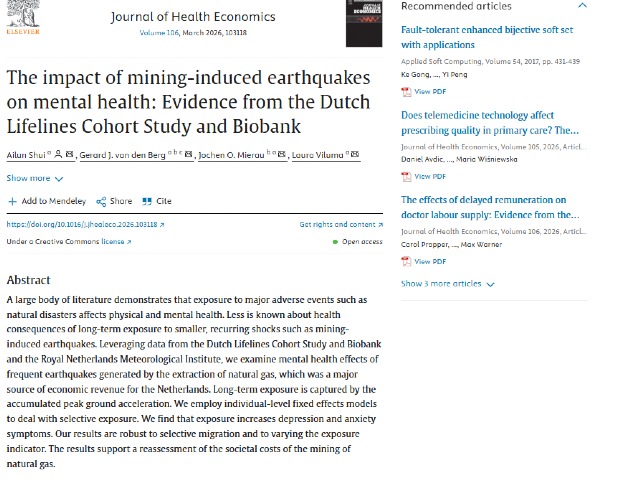
The article in the spotlight for the month of March 2026 is titled 'The impact of mining-induced earthquakes on mental health: Evidence from the Dutch Lifelines Cohort Study and Biobank’, written by Ailun Shui (Faculty of Economics and Business, FEB), Gerard van den Berg (University Medical Center Groningen, UMCG, and FEB), Jochen Mierau (UMCG) and Laura Viluma (FEB).
Abstract
A large body of literature demonstrates that exposure to major adverse events such as natural disasters affects physical and mental health. Less is known about health consequences of long-term exposure to smaller, recurring shocks such as mining-induced earthquakes. Leveraging data from the Dutch Lifelines Cohort Study and Biobank and the Royal Netherlands Meteorological Institute, we examine mental health effects of frequent earthquakes generated by the extraction of natural gas, which was a major source of economic revenue for the Netherlands. Long-term exposure is captured by the accumulated peak ground acceleration. We employ individual-level fixed effects models to deal with selective exposure. We find that exposure increases depression and anxiety symptoms. Our results are robust to selective migration and to varying the exposure indicator. The results support a reassessment of the societal costs of the mining of natural gas.
We asked first and corresponding author Ailun Shui a few questions about the article:
In what way are the mental health effects of natural (non-induced) earthquakes different from the mental health effects of mining-induced earthquakes?
I was born in the southwest of China, where natural earthquakes occur relatively frequently, and I personally experienced a major earthquake of magnitude 8. Events like this can be devastating: many people lose their homes and even family members, and the psychological consequences, such as trauma and post-traumatic stress disorder (PTSD), can persist for years. Large natural earthquakes are typically rare but extremely intense, often involving immediate threats to life, serious injury, or the loss of loved ones, which is why their mental health impacts tend to be both acute and long-lasting.
Mining-induced earthquakes are quite different. They are caused by human activities and are usually smaller in magnitude but occur much more frequently, creating a form of ongoing environmental stress rather than a single catastrophic shock. In our study, we find that repeated exposure is associated with higher levels of depression and anxiety symptoms. These effects are often more subtle and less likely to be clinically diagnosed, which means they can easily be overlooked. Rather than direct trauma, the impact unfolds through more indirect channels, such as damage to housing, declining property values, and a persistent sense of uncertainty, which gradually affects people’s well-being.
The mental health data that you analyzed come from the Lifelines database. What was the process for gaining access to the data?
The Dutch Lifelines Cohort Study and Biobank is particularly well suited for our research because it follows individuals in the northern Netherlands, where exposure to mining-induced earthquakes varies considerably across regions. This variation allows us to compare people living in heavily affected areas with those in less exposed areas, providing a strong basis for identifying the impact of these earthquakes on mental health.
Access to the data is granted through a structured application process. Researchers submit a proposal outlining their research question, motivation, and the variables they intend to use, after which the Lifelines team reviews the application and may provide feedback. Once approved, access is available for a fee, with discounts for students as well as occasional funding opportunities. The process is rigorous, but also transparent and designed to ensure responsible use of the data. More information can be found on the Lifelines website.
Could you reflect on your experiences with open access and open science in general?
I see open access and open science as an important and ongoing shift in how research is shared. Open access allows a much wider audience, not only academics, but also policymakers and the general public, to engage with research findings, which can significantly increase both visibility and impact. Institutional agreements, such as those at the University of Groningen, also make this option more accessible by lowering publication costs.
For this paper, I developed a detailed replication package that explains how to access the data and reproduce all results. Preparing it required a substantial investment of time, especially given the complexity of the project, but it was also a valuable experience in organizing code and documenting the research process clearly. More importantly, it strengthens transparency and makes it easier for others to build on our work, which is ultimately at the core of open science.
Useful links:
Lifelines aims to be a resource for the national and international scientific community. Researchers interested in using Lifelines can find information here: https://www.lifelines-biobank.com/
Open access journal browser: search engine that can be used to check if a discount on the article processing charge (APC) is available for a specific journal. UG corresponding authors can publish with an APC discount (mostly 100%, so for free) in more than 12,000 journals!
Citation:
Shui, A., van den Berg, G. J., Mierau, J. O., & Viluma, L. (2026). The impact of mining-induced earthquakes on mental health: Evidence from the Dutch Lifelines Cohort Study and Biobank. Journal of Health Economics, 106, 103118. https://doi.org/10.1016/j.jhealeco.2026.103118
If you would like us to highlight your open access publication here, please get in touch with us.