

Women in the Special Collections (part 4): Jantina Tammes, the first female professor
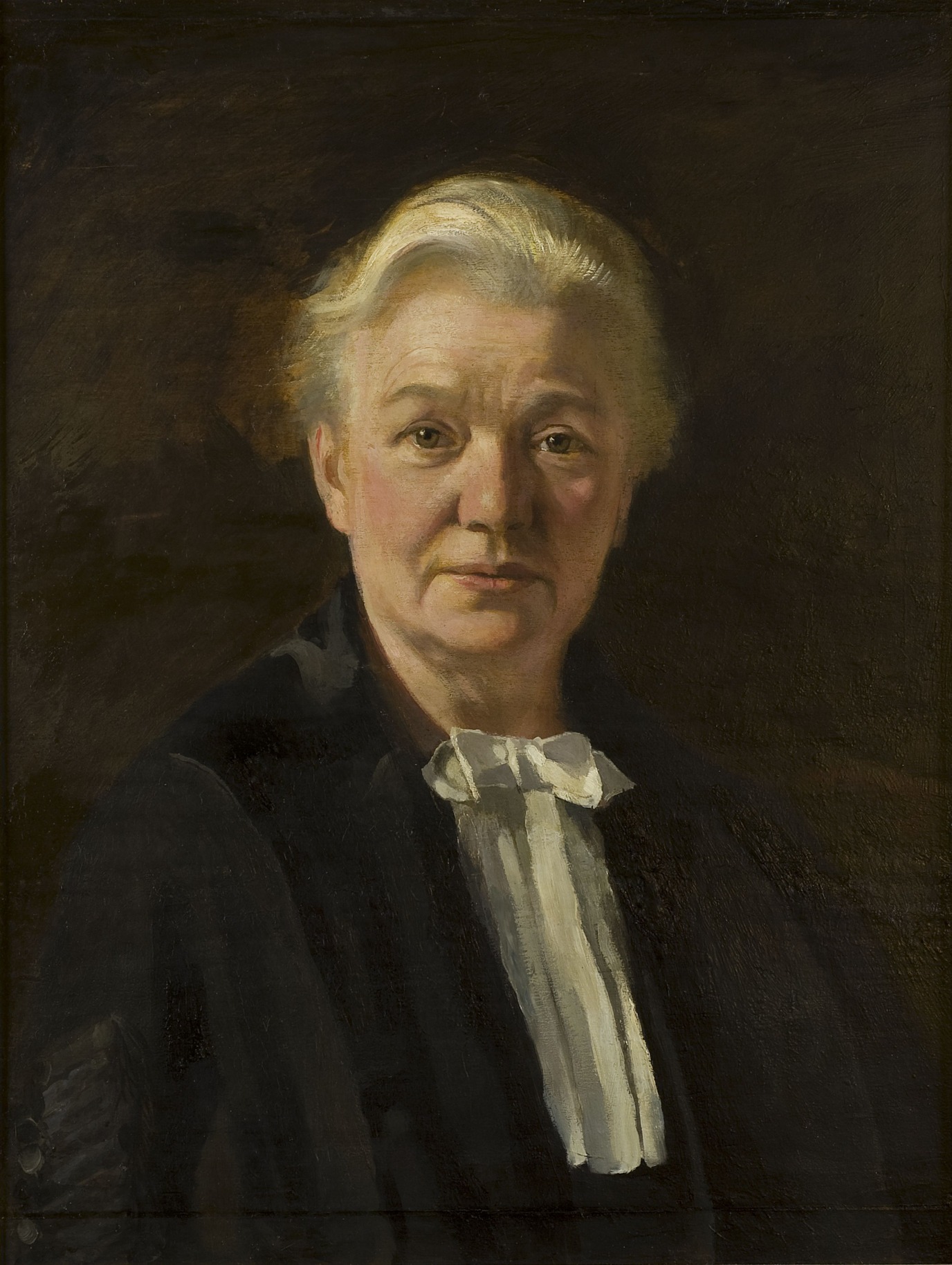
Another important woman in the history of the university who cannot be absent from this series is Jantina Tammes (1871-1947). She was the first female professor in Groningen (1919-1937) and the second female professor in the Netherlands. She was also the first professor of genetics. She features in an exhibition at the University Museum, entitled: ‘From Experiments to the Public: 225 Years of the Royal Natural Science Society in Groningen’. Tammes was a member of the society. This exhibition runs till the 8th of November 2026. It should be clear that Tammes was a pioneer; her path was unusual and demonstrates her perseverance.
Jantina Tammes was the daughter of a pastry chef, later chocolate manufacturer, and it was therefore not expected she would attend university. After her exams at the Secondary School for Girls in Groningen, she took private lessons in mathematics, physics and chemistry to be able to attend lectures at the university as an auditor. She did this to prepare for the secondary teaching certificates (MO-aktes), which would allow her to become a teacher, but not enable her to study further. She obtained several certificates, including in physics, chemistry, plant science and animal science. She taught at her old secondary school for a few years, but in 1897 she was appointed as the assistant of the professor of Botany at Groningen, Jan Willem Moll, who saw her talents. In 1900 she was appointed as teacher in plant and animal science at the Rijks-HBS (‘Higher Civic School’). She had to give up this position within a year, however, as she was struggling with her health. It turned out she had performance anxiety. Professor Moll then offered her an unpaid (!) position in his lab. She would stay there for almost twelve years and publish lots. In 1904 she published important research on flax, which brought her international recognition. Obtaining a doctorate was not possible for Tammes, as she had not completed a university degree, but on the 5th July 1911 she received an honorary doctorate in plant and animal science from the University of Groningen. She then took over Professor Moll’s lectures: his sight was deteriorating because of illness. In 1919 she was appointed as Professor of Genetics. She kept this position until 1937, when she withdrew to be able to do more research. Jantina Tammes was clearly a very talented person with a passion for research. She was known as modest and friendly, but what she did was groundbreaking.
The classroom on the fourth floor of the library is named after her. The Tammes Room is frequently used for events and for lectures that make use of materials from Special Collections. In 2024 the room was redecorated with new wallpaper: on it you can see items from the Special Collections against a background of decorative paper. These items naturally include materials from the Tammes Archive, created by Inge de Wilde, as well as the announcement of Tammes’ appointment as professor.
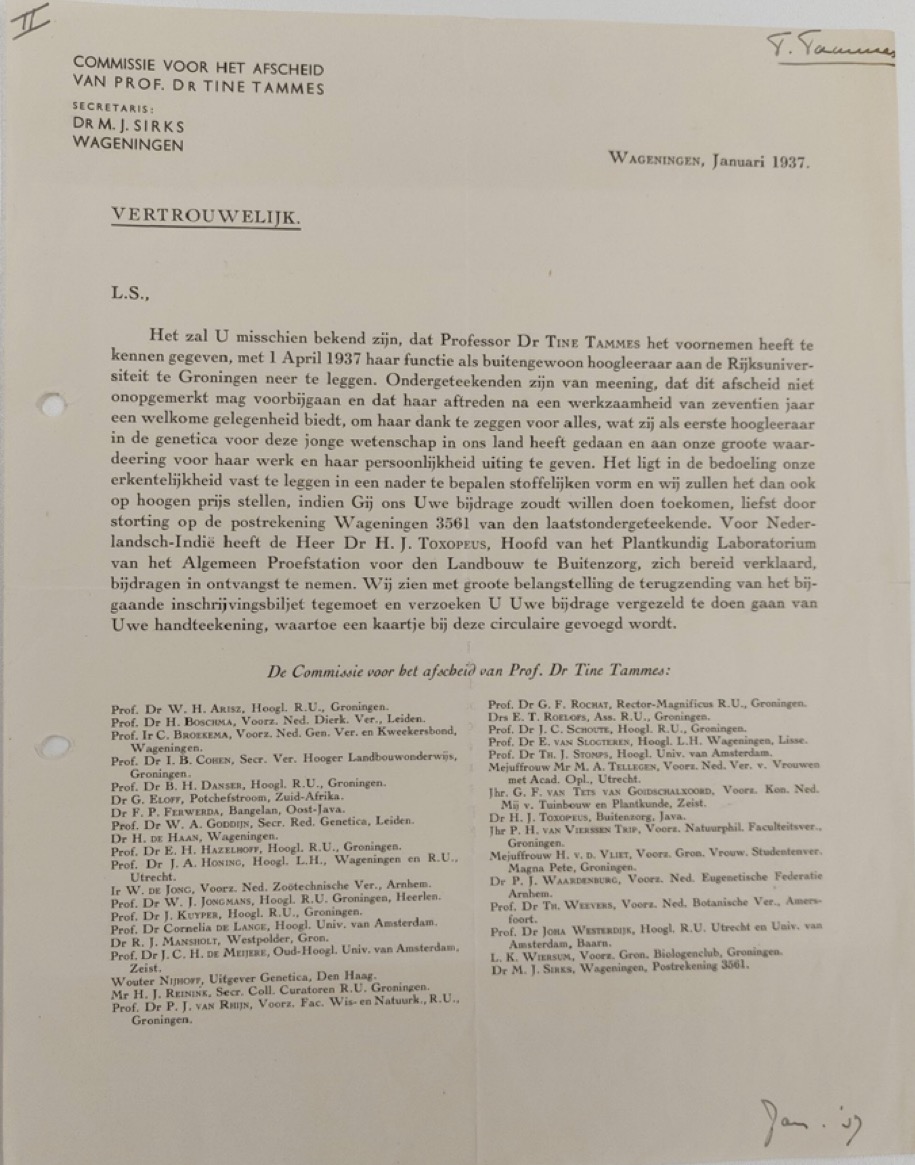
The Tammes Archive includes, amongst other things, this letter from the committee for the retirement of Professor Tammes, which shows how appreciated she was. Not every professor has such an extensive committee when they leave.

This small notebook is also striking. It is my favourite item in the archive. Not only because it is so small, but also because it is relatable to me. It still has quite a lot of empty pages and includes all sorts of notes ranging from a list of books Tammes wants to read to entries on the delivery of potatoes and charcoal. I also have notebooks I use for various purposes like that.
The following blog posts have been published so far in the “Women in the Special Collections” series: