

Women in the Special Collections (part 2): Anna van der Horst (1735-1785), a female poet
Recently I came across a work from 1772 about the Siege of Groningen written by Anna van der Horst, a woman! A good reason to investigate what I could discover about her.
Anna van der Horst was born in Enkhuizen in an orthodox reformed family. She was the daughter of merchant Albert van der Horst and Gerritje Pool. Without official education she became a self-made poet. She corresponded intensively with Betje Wolff, who would later – after the death of her husband – cohabit with Aagje Deken and write the famous epistolary novel Sara Burgerhart with her. In the spring of 1765, when van Der Horst was almost 30, her father discovered her relationship with Betje Wolff and prohibited it, because he believed Wolff was too liberal. But soon he discovered the correspondence had been resumed, because reverend Wolff, the husband of Betje, felt obliged to inform Anna’s father of this. It resulted in a conflict between Anna and her father. In July she asked Betje for money and moved to Groningen. Her youngest brother was a student there. In November she married Pieter Roelfzema, a clerk of the province of Groningen, who was ten years younger than her. The marriage remained childless and Anna continued to write.
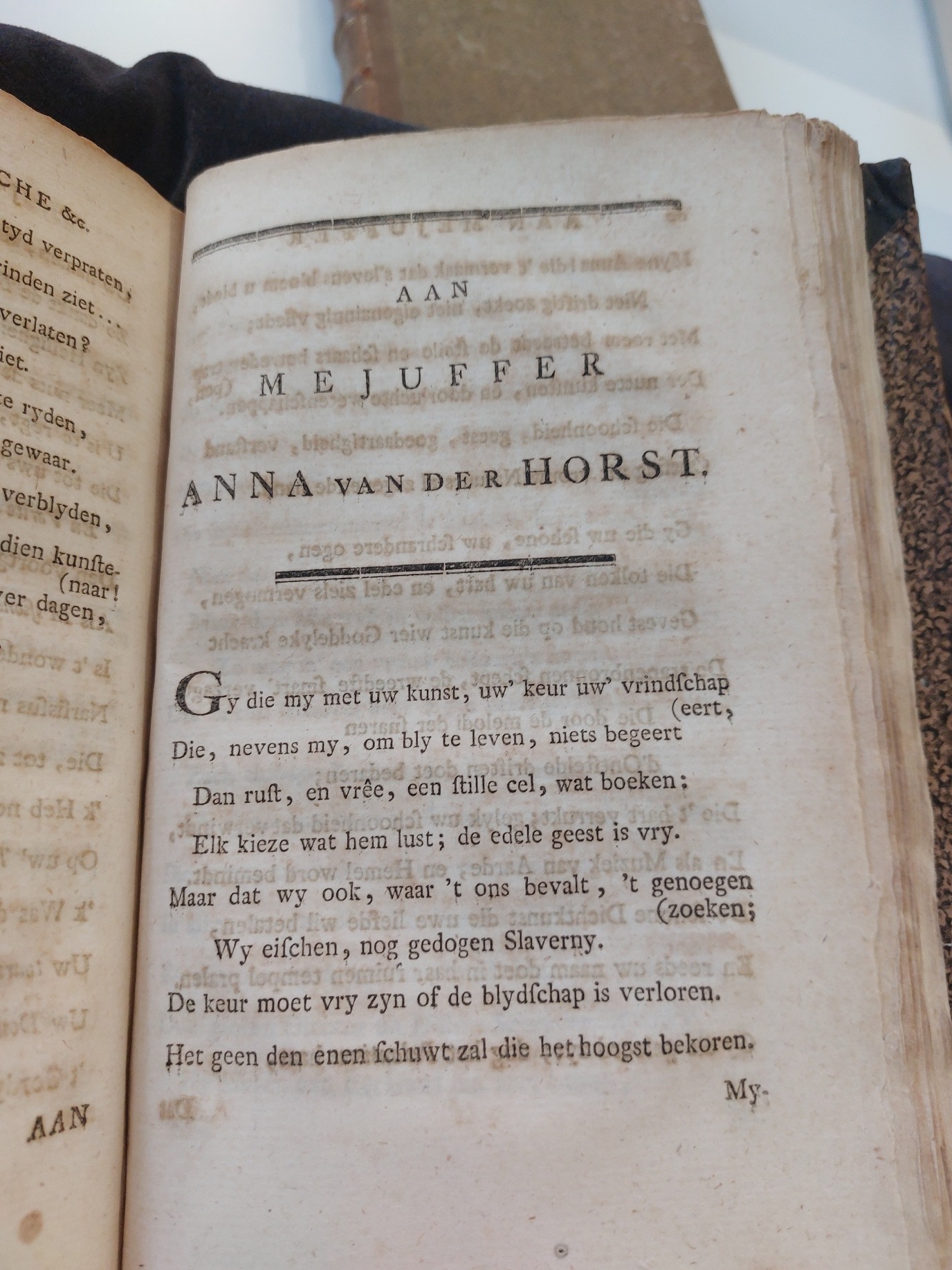
She wrote two epics; the epic was seen as the most prestigious genre for a poet, the epitome of their achievement. The main characters in her epics are women from the Bible, Ruth and Deborah. Her epic about Ruth, published in 1764, is the first in Dutch literature in which a woman has the lead role. In reaction to this work Betje Wolff wrote the poem ‘Aan Mejuffer Anna van der Horst’ (To Miss Anna van der Horst), in which she praises her friend and the work of her friend. Male critics were less positive. They believed an epic to be too ambitious for Van der Horst, and for the female sex as a whole. She did not let this hold her back and in 1769 her biblical epic about Deborah was published in Groningen. At the end of this work she added a ‘Nareden aan de wyzheidbeminnende Vrouwen’ (Epilogue to wisdom-loving women), in which she explains that women should have the opportunity to gain knowledge through self-study, as she has been able to do herself. She even takes the then dominant view that the mind of a woman is less developed than that of a man and more changeable, and uses it to argue that women should study as they can overcome these weaknesses through study. This was not a new tactic.
The famous humanist Anna Maria van Schuurman, the first female student in the Netherlands, did the same in her Dissertatio de ingenii muliebris ad doctrinam & meliores litteras aptitudine published in 1641 (it appeared in an English translation in 1659: The learned maid; or, Whether a maid may be a scholar : A logick exercise).
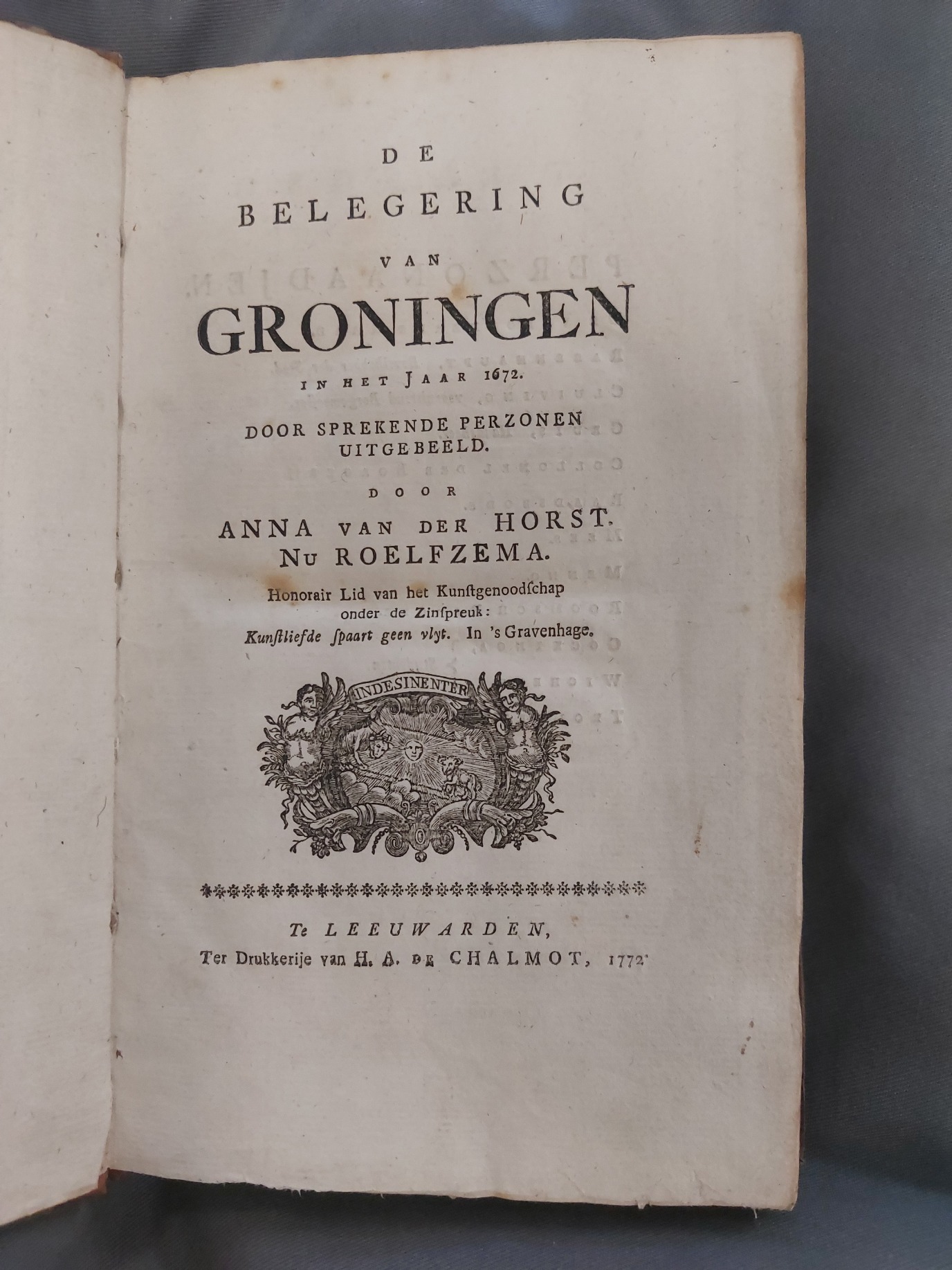
On the occasion of the 100th anniversary of the Siege of Groningen in 1772, Anna van der Horst wrote a play entitled: De Belegering van Groningen in Het Jaar 1672: Door Sprekende Perzonen Uitgebeeld (‘The Siege of Groningen in the Year 1672: Depicted by Speaking Persons’). This play was probably performed as part of the celebrations. Although all the characters are men, everyone plays a part in the siege and the role of women is described, for example in the first act (p. 9):
Ik zag hoogagtb're Vrouwen, | Hoe zwak die kunne ook zij, als Paarden de Kartouwen | Voorttrekken naar den Wal
‘I saw venerable women, weak though they may be, pull the cannons as horses towards the wall.’
Even more striking is a passage in which a woman loses her child and an arm in a tragic incident (second act, p. 17):
Terwijl deze arme Vrou, door zulk een slag verzet,
En schreeuwende om haar Kind, dat dood ligt op de stenen,
Haar' arm raapt van den grond, en vraagt in 't angstig wenen,
Aan wien behoort deze arm? vol bijsterzinnigheid
Merkt zij niet dat die Bomb hem van haar' Schouder scheidt.
Maar denk wat Heldenmoed, en wat wij mogen hopen!
Wanneer de buurte kwam met de Artzen toegelopen
Om hare wond te zien, sprak zij, hoe zeer gebrand:
Geen nood! ik gav mijn bloed voor 't dierbaar Vaderland!
Snij af 't geschroeide vleesch! mijn Arm ga vrij verloren!
Wierd maar der Stadstriums door dit verliez geboren!
Daar hier de Vrouw die taal in zulk een lijding voert,
Een taal, die 't edel hart der grootste Helden roert,
Zou dan de Jong'lingschap van Groningen bezwijken,
En dralen om zijn moed der Stad te laten blijken?
A summary of the passage: Screaming because her child has died, the woman picks up an arm from the ground asking whom it belongs to. She then realises it is her own. When neighbours rush towards her with doctors, to look at the wound, she tells them not to worry and to cut off the seared flesh. She gave her blood and her arm for her fatherland and wishes victory for the city will come from this loss. If a woman is showing such bravery in suffering, why would the young men of Groningen fail to show the courage of the city?
The answer to this last rhetorical question is of course ‘They wouldn’t!’ (‘Neen!). The assumed weakness of women is used to create pathos and encourage men, but also to show the great courage of women.
Anna van der Horst was a feminist avant la lettre, who pushed boundaries and encouraged women to develop themselves.
The following blog posts have been published so far in the “Women in the Special Collections” series: