

Women in the Special Collections (part 5): Adri Buning, initiator of ‘De Blauwe Schuit’
The last installment in this series is about Adriana (Adri) Jantine Buning (1896-1948). It is likely you have never heard of her. Some of you may be familiar with ‘De Blauwe Schuit’ (‘The Blue Barge’) the collective which published clandestine imprints in the second world war. Who thinks of ‘De Blauwe Schuit’ thinks of Hendrik Nicolaas Werkman (1882-1945), the famous artist and printer of ‘De Ploeg’ (the Groninger artist collective). He published all the works for De Blauwe Schuit and was arrested and executed in the forests near Bakkeveen just before the end of the war. Other members of the collective were Reverend August Henkels, chemist Ate Zuithoff and Adri Buning. All the members of De Blauwe Schuit can be seen in the picture below.
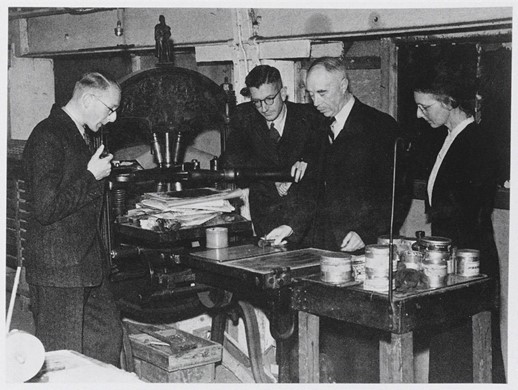
Buning is not mentioned often in relation to De Blauwe Schuit. Perhaps the reason for this is that we have less information about her than about the other members or perhaps it is because she passed away as early as 1948. Nevertheless, she can be considered the initiator of De Blauwe Schuit. She was living across the street from Reverend Henkels in Winschoten and taught Classics at the gymnasium (grammar school) there - or German as other sources say. Or was it geography? I thought it strange that the sources are so unclear about this. That’s why I did further research and I discovered in this book that Buning obtained a PhD in Slavic Languages from the University of Leiden in 1927. Her thesis was entitled: ‘De Indogermaansche athematische conjugatie in het Slavisch’ (‘The Indogermanic athematic conjugation in Slavic [languages]’). In his book on Hendrik Werkman, Hans van Straten states that Buning thought German, which would not be strange given her linguistic background. I thought there should be more information from the gymnasium though. I contacted Genealogie Groningen to get more clarity on Buning’s time in Winschoten. When did she move there? What subject did she teach and when? An answer came swiftly. Adriana Jantine Buning moved to Winschoten on the 11th January 1927; she came from The Hague where she was born on the 25th June 1896 (Bevolkingsregister 1921-1939 (‘Resident register’)). So she already moved to Winschoten in the year she was finishing her PhD. According to Gymnasium Winschotanum: gedenkboek bij het 125-jarig jubileum 1832-1957, Buning worked as a teacher of geography and history from 1927 until her death in 1948. The book lists teachers per subject, so it seems she did not teach Classics or German. From September 1936 she also served as deputy headteacher. This means that she was working as a teacher and deputy head while she was active for De Blauwe Schuit and continued to do so after the war; it seems the German occupier never noticed her activities for De Blauwe Schuit.
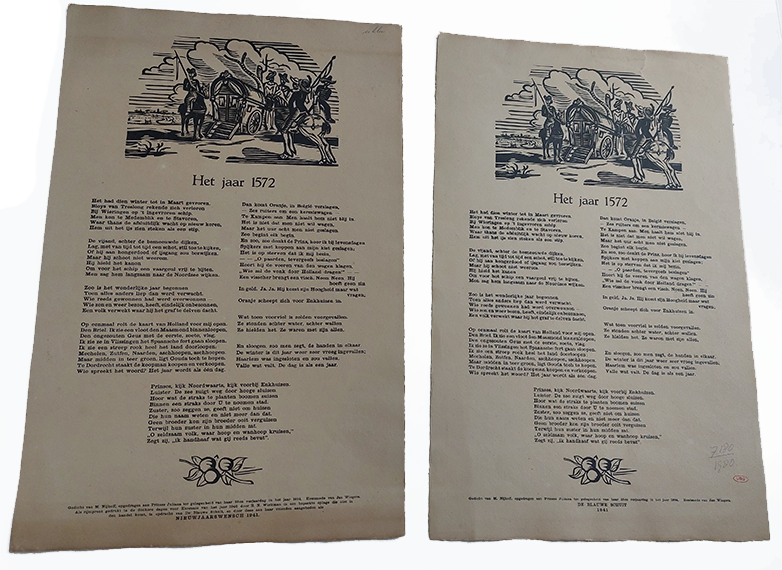
In the autumn of 1940 Henkels, Zuithoff and Buning gather for the first time at Adri Buning’s home. She proposes they publish the poem ‘Het jaar 1572’ (‘The year 1572’), a poem about the Netherlands during the Eighty Years’ War (1568-1648); it was written by Martinus Nijhoff and originally published on the occasion of the 25th birthday of Princess Juliana, in 1934. It therefore does not only refer to resistance against an occupation, but is also a royalist text. This made it the perfect choice for encouraging resistance/boosting morale. The first printrun was sent as a New Year’s wish and in the summer of 1941 a second printrun was made, which Buning distributed. We have a copy from each printrun at Special Collections.
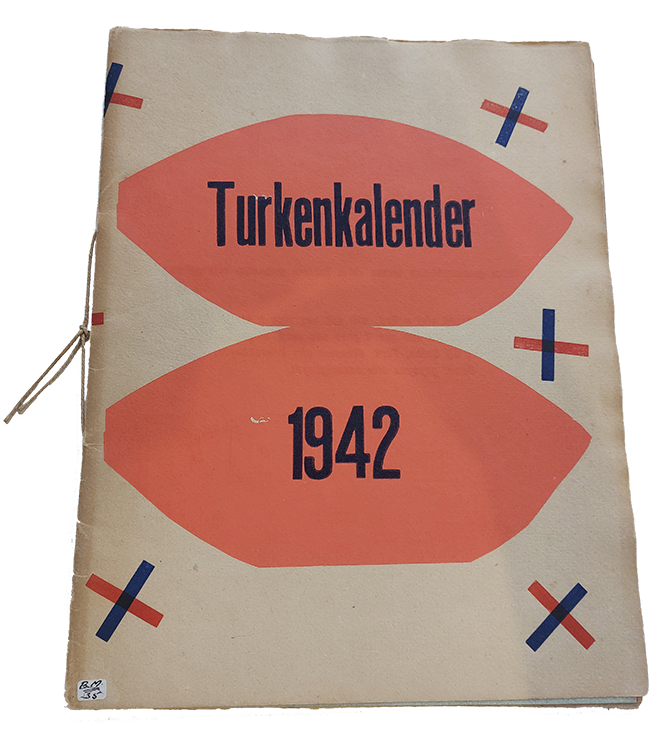
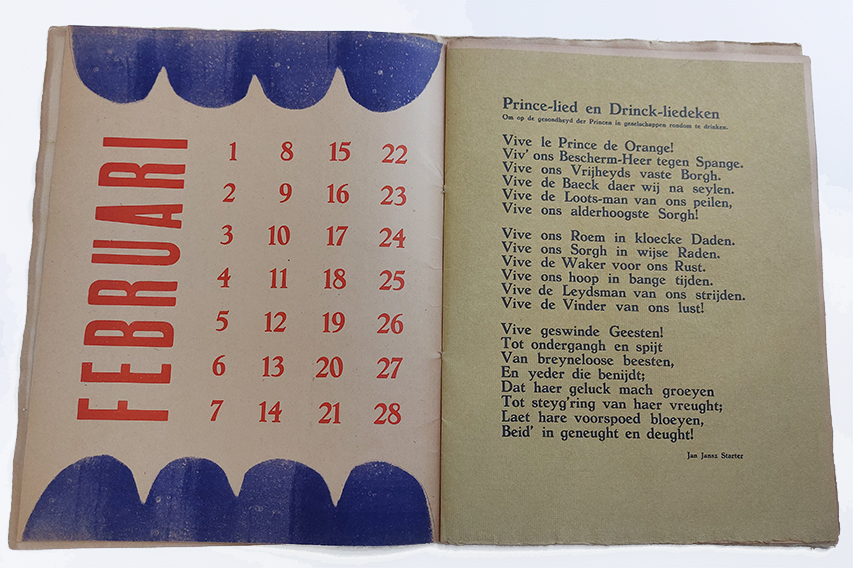
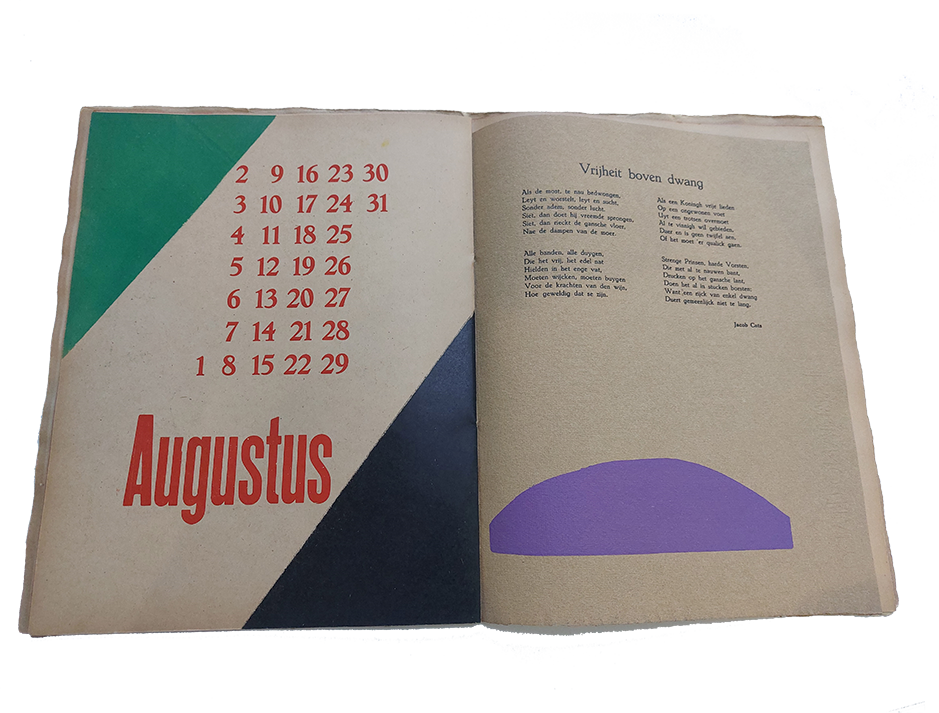
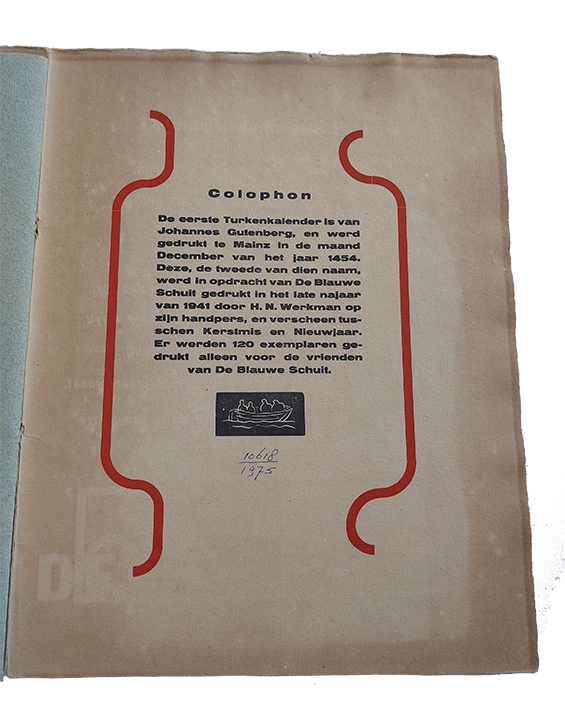
Buning also played an important role in later publications of De Blauwe Schuit. For instance, she chose the texts that were included in the Turkenkalender 1942, the most extensive publication of De Blauwe Schuit up to that point. The title of the publication refers to a work that was printed by Johannes Gutenberg in 1454. It was an appeal to stop the conquests of the Ottoman Empire. The texts in the Turkenkalender 1942 date from the 16th and 17th century; they are patriotic texts opposing the Spanish occupation. The calendar’s message is clear: revolt against the conquests and occupation of a new occupier. The work also contains an actual calendar. The illustrations and design are in the characteristic style of Werkman.
Adri Buning was an academic who obtained a PhD at a time when this was unusual for a woman. She took up an important position at the Gymnasium in Winschoten and acted just as bravely as the other members of De Blauwe Schuit by choosing fitting literary texts for their publications and distributing them. She has faded into the background, but deserves her own biography!
The following blog posts have been published so far in the “Women in the Special Collections” series: