

Turmoil at the University of Groningen
By Arwen Westerink
Between 1827 and 1828 the University of Groningen was turned upside down. Why? One of its students had written a mocking poem about his teacher. Why did he do so? And what was so terrible about that poem?
In 1816 Johan Jacob Antonie Goeverneur (1809-1889) moved to the Peperstraat in Groningen. In 1825 he began a degree in theology at the university in the city. He participated actively in student life. As a member of fraternity Vindicat he set up the Groninger Studenten-Almanak. He regularly contributed to this annual publication using the pseudonym Jan de Rijmer.
In his student days Goeverneur wrote two satires entitled Minerva’s vloek (‘The curse of Minerva’) and De Keesiade. The reason for writing htese poems was the fact that one of his professors, Cornelis (Kees) de Waal, had recently (in December 1827) been seen visiting a brothel. Cornelis de Waal was one of five professors in the faculty of philosophy and arts. He came from a well-to-do family and gave lectures in three subjects: history, philosophy and natural theology. His lectures on metaphysics were quite dark and hard to follow for most students. He was not that popular with his students and was also married.
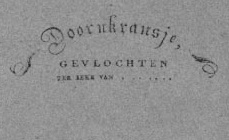
De Waal was awaited by a lecture hall full of students and mocked. Furthermore, a collection of poetry entitled Doornkransje gevlochten ter eere van… (1828) (‘A small garland of thorns in honour of...’) had been published, which included the satire Minerva’s vloek. De Waal could not teach anymore and filed a complaint with the academic Senate. In the poem Minerva’s vloek, Goeverneur describes how Minerva, the goddess of wisdom and science, became enraged because of the injustice which her servant – the not named Cornelis de Waal – had suffered in Groningen.
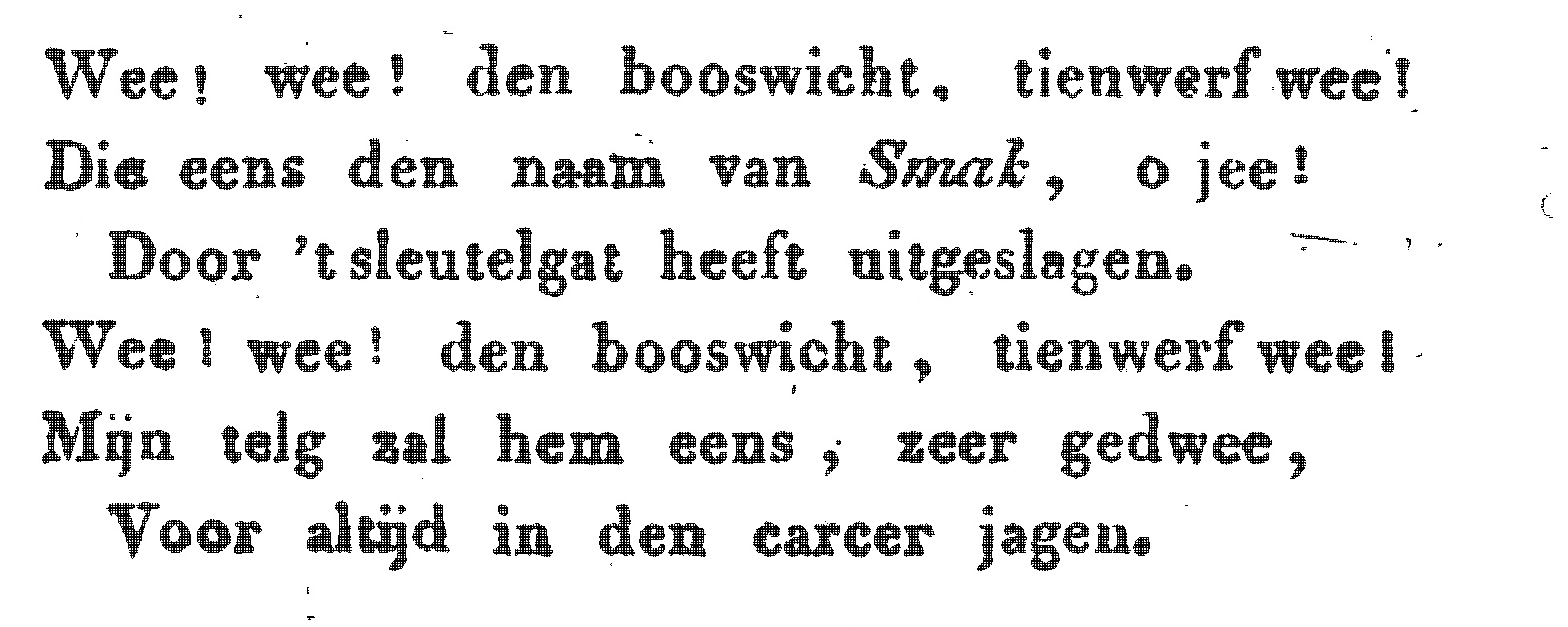
Funny details make evident whom it concerns. Gouverneur refers for instance to De Waals nickname ‘Smak’ (‘Smack’) chosen because he made smacking noises before his lectures. The prostitute ‘moeke Henzel’ (‘Mother Henzel’) is also mentioned, the prostitute who apparently was De Waal’s favourite.
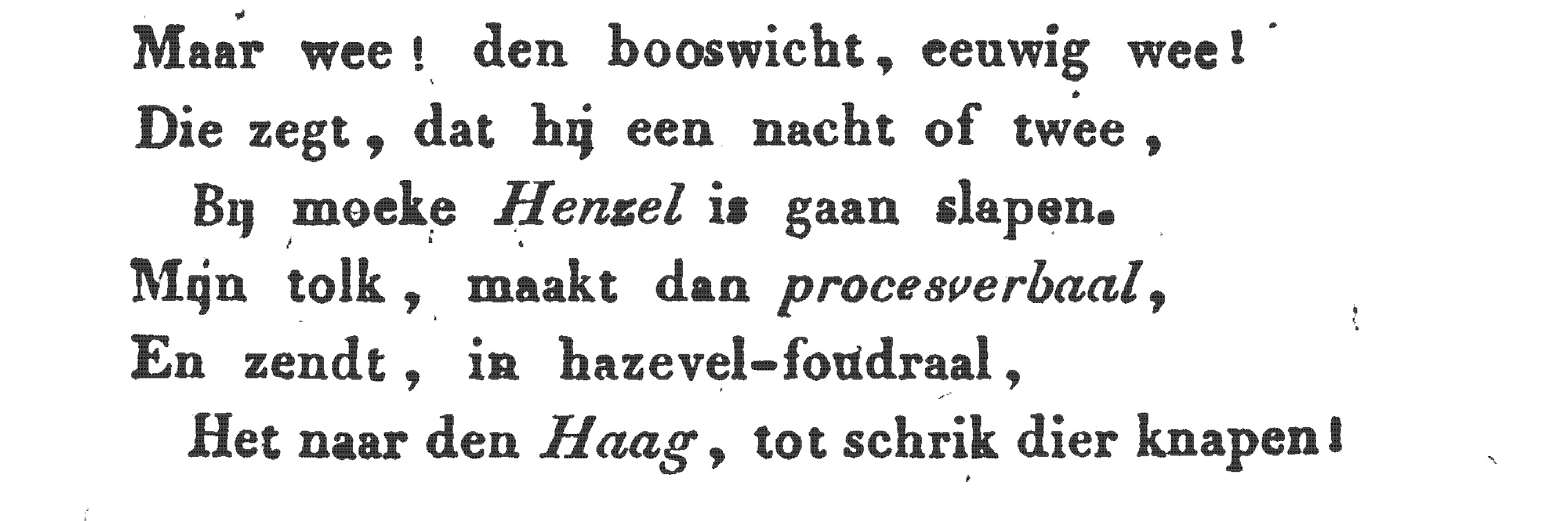
The narrator condemns someone for gossiping about Smak’s visits to the brothel. But the person visiting ‘moeke Henzel’ - Smak himself – is also condemned. The speaker asks his interpreter to draw up an official report and send it to The Hague, parodying legal procedure and inflating this personal scandal into a matter of state.
The board of the university discovered that Goeverneur wrote the poem and punished him on the 17th of March 1828 with two weeks’ house arrest. In these two weeks he wrote another satire about De Waal’s visits to brothels, entitled ‘De Keesiade’. The subtitle of the poem, ‘An epic by various poets’, indicates this poem is a cento. It is made up completely of lines from other poems in Dutch, German, English, French and Greek. He wrote the poem without consulting other books, demonstrating how well-read he was. Initially Goeverneur only let the poem circulate in manuscript. He eventually published the poem in 1878, forty years after the death of De Waal.
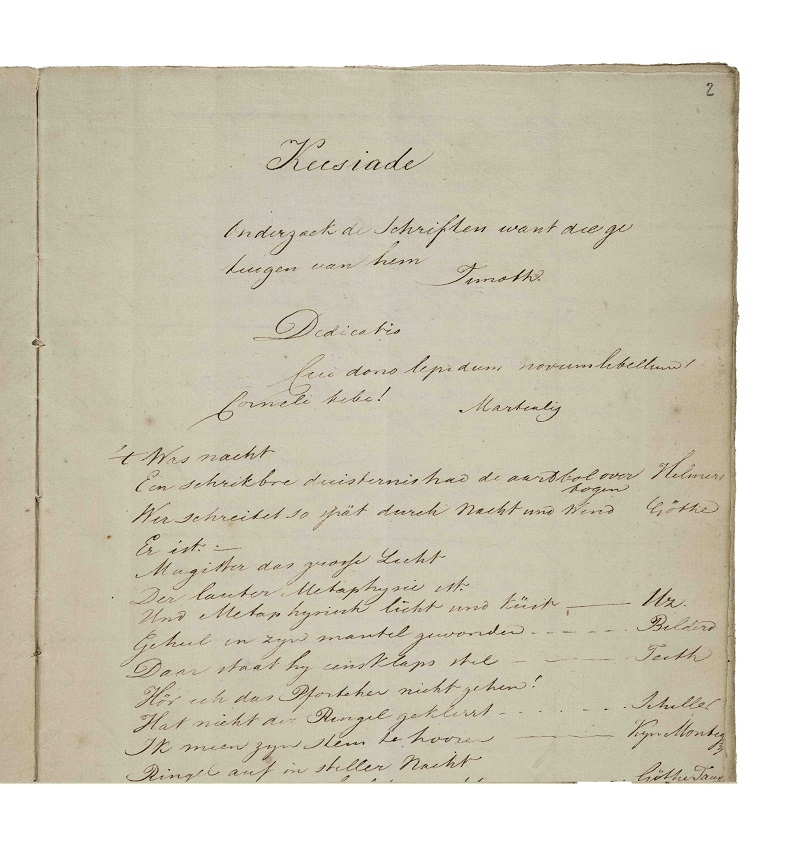
It is striking that research on the poem only discusses the printed poem from 1878. The manuscript is not mentioned once. What’s more, it is stated that there are no other sources for this poem. In June 1835 Goeverneur joined the University of Leiden. There is however no secundary literature which discusses why Goeverneur left Groningen to study in Leiden and returned to Groningen after graduating. This is explained in the manuscript which was written by a fellow-student of Goeverneur during the lectures on physics. He states that Goeverneur had to leave Groningen because of the Keesiade. This indicates that the poem had become well-known, in spite of it circulating only in manuscript. There are sentences in the printed version which do not appear in the manuscript and vice versa.
In 1830 Goeverneur chose to join the military to help suppress the Belgian Revolution. In 1831 he used this experience for a poem entitled Jan de Rijmer Soldaat (‘Jan de Rijmer Soldier’) for the Groninger Studenten-Almanak. It is a satirical poem about the miserable life of a soldier in which he cynically describes the horrible tasks of students and the circumstances of war. Whe his fellow-students returned home, he had to stay because of circumstances and had a tough time. In this period he also wrote the poem Napoleon, in which he condemns the war-mongering French emperor. It describes the downfall of Napoleon in a satirical way, and shows his aversion for people who seem to have forgotten Napoleon’s crimes.
After he graduated from the University of Leiden, Goeverneur made a living as an author. He became the editor of the family magazine De Huisvriend (‘The House Friend’) and wrote many children’s poems and fairytales. It was important to Goeverneur that children would be accepted for who they were: sometimes happy, sometimes naughty. He appreciated the bubbly personality of children and felt you should be understanding and patient towards them.
The Dutch poet Willem Wilmink (1936-2003) greatly admired Goeverneur. According to Wilmink he was the only children’s poet who truly put children at the heart of what he did and did not want to give pedagogical advice. The Belgian children’s author Jan van Collie (1957) considered Goeverneur to be the most important children’s poet of the 19th century. He believed Goeverneur mastered the art of being a child with children by speaking their language and making his characters believable. If there is a moral in his story, Goeverneur conveys it in a light-hearted way. For instance, in many of his poems he teaches children to treat animals well by writing them from the perspective of an animal. He also created Christian poems and prayers for children in a playful way. In addition to poems and fairytales, the publications of Goeverneur contain many vivid illustrations, amongst others by the Groninger artist Otto Erelman. His little books were very popular especially around Saint Nicholas; thousands were sold.
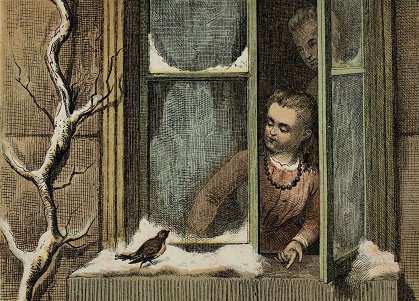
A famous poem by Goeverneur is Het Roodborstje aan het venster (‘The Robin by the Window’):
Het roodborstje pikt aan het venster: tin! tin!
En zegt: Ach, doe open en laat mij er in.
Doe open lief meisjen, ‘k weet anders geen raad,
Zoo sneeuwt en zoo waait het hier buiten op straat.
Ik sterf van de koude, toe, laat mij er binnen,
‘k zal zoet zijn en allerlei grapjes beginnen.
Het meisje deed open en gaf, op haar schoot,
Aan t’roodborstje suiker en kruimeltjes brood.
In translation (ChatGPT):
The little robin pecks at the window: tin! tin!
And says: “Ah, open up and let me come in.
Open up, dear girl, I know not what to do,
For it snows and it blows out here on the street too.
I’m freezing with cold—please, let me come inside,
I’ll be sweet and perform little tricks with pride.”
The girl opened up and, upon her lap so warm,
Gave the robin some sugar and crumbs of bread to charm.
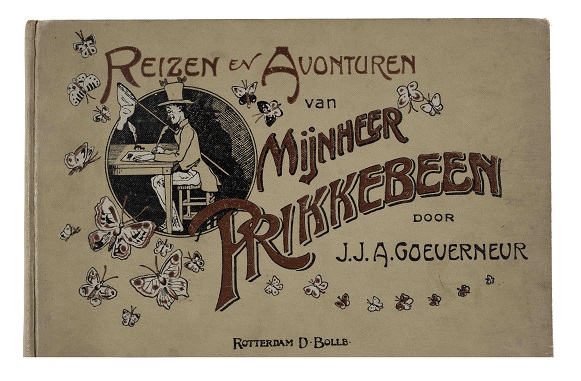
Goeverneur is known especially for his adaptations of the story of Mijnheer Prikkebeen (‘Mister Prikkebeen’) (1858) . The abovementioned stories are funny and sweet, but the stories about Prikkebeen can be cutting. These stories do not fit with modern mores. For instance, the friend of Prikkebeen is of a stocky build and is therefore referred to as Dikkie (‘Fatty’). Prikkebeen and Dikkie are swallowed by a whale, after which they are saved by whalers. At this time the Netherlands still partook actively in whaling. The stories are also rather stereotypical. In one of the scenes there is a fight with ‘the Turkish’ about which Goeverneur states: “Al wie hen maar durft weerstaan; Hunne sabels, scherp en goed, Druipen dra van Christenbloed” (“All who dare withstand them; their sables sharp and effective soon will drip with Christian blood”).
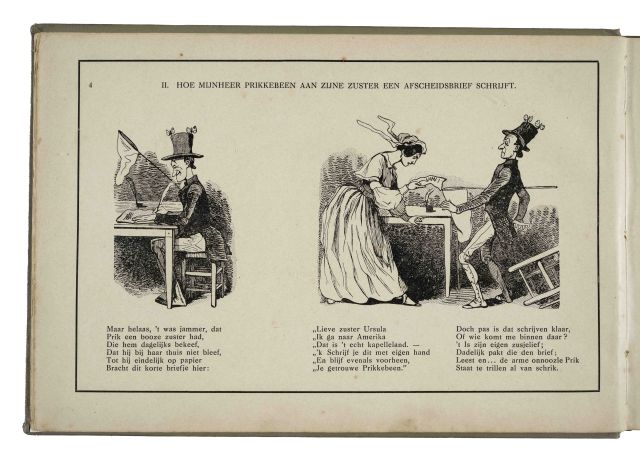
Goeverneur passed away on the 18th of March 1889. During his life he made an important contribution to Dutch literature for adults and children. It is evident from the poems he wrote during his youth, such as De Keesiade, Jan de Rijmer and Napoleon, that he was no saint. He enjoyed satirical jokes and was not afraid to be critical. Although many of his later children’s poems and fairytales are idyllic, the satirical Goeverneur of his student days can be found again in his stories about Prikkebeen. Nowadays some of his poems, such as ‘The Robin by the Window’ are still well-known. From funny stories to prayers before bed – the versatile Goeverneur wrote them all.