

Maria and her insect world
by Arwen Westerink
Maria Sibylla Merian (1647–1717) is a famous entomologist and artist from the 17th and 18th century. In her book Metamorphosis Insectorum Surinamensium ofte Verandering der Surinaamsche insecten (‘The Metamorphosis of the Insects of Suriname’) she made beautiful images of plants, insects and some other animals from Suriname. Her work is unique, not only because of its exceptional quality, but also because it was unusual in her day for a woman to work as a scientist, let alone travel without male company for her research. Furthermore, the work is significant for colonial history. In this blog you can read more about it.
Maria was born in 1647 in Frankfurt am Main. She was the daughter of the famous artist and publisher Matthäus Merian Senior, who passed away three years after she was born. Maria’s mother then married Jacob Marrel, who was an artist and art dealer. He taught Maria many artistic techniques. From a young age she was interested in insects and at the age of thirteen she was already researching the metamorphosis of the silkworm. In 1665 she married and moved to Neurenberg, a city with painters’ guilds, which only allowed men to use oil paint for their work. As a result, Merian mostly used watercolours. Whilst in Neurenburg she published her book on flowers and the first part of her caterpillar book. In 1683 she moved back to Frankfurt after the passing of her stepfather.
In 1686, Merian, her two daughters and her mother moved to Wieuwerd in the province of Friesland. They joined the Labadist community on the Waltha Estate. By moving here Maria also divorced her husband, as Labdists only recognise marriages within their own community. The labadists strive for a born-again life by leaving what is worldly and material behind. Art was not allowed in the community because it was seen as useless. Science, however, was allowed, as long as it served the faith, so Maria could continue her research. Moreover, the butterfly was seen as a symbol for the resurrection within the labadist community. The motivation for Maria’s research came from her faith. She wanted to honour God as creator with it, as she explains in poem on one of the first pages of the Metamorphosis Insectorum Surinamensium ofte Verandering der Surinaamsche insecten:
Zo opent zich een nieuwe Hóf
Van overoverzeesch geboomte en bloemen.
Wie leersaem is, vind hier weer stóf,
Om s’wyzen Scheppers maght te roemen,
En uyt het allerminste Kruydt
Te ontdekken, hoe ver zy verdwaelen,
Die goddeloos en dwaes verhaelen,
Dat alles uit zich zelven spruyt.
Elk Blad, elk Bloeissel toont Gods werking,
En wyst zyn onderhouding aen,
En leert, dat alles zonder die versterking
Hier alles zonder maet zou gaen.
Niet minder kan men dit beslissen
In dit geöpent Kabinet,
Door MERIAEN te faem gezet
Thus opens a new garden,
Of overseas trees and flowers.
Whoever is eager to learn finds here matter,
To praise the wise Creator’s power,
And from the humblest herb
To reveal how far astray they stray,
Who godlessly and foolishly claim
That all things spring from themselves.
Each leaf, each blossom shows God’s work,
And testifies to His care,
Teaching that without His strength,
All here would go without measure.
No less can this be seen
In this opened cabinet,
By Merian brought to fame.
(Translation of this passage - Mistral)
In Wieuwerd she studied the metamorphosis of frogs, also dissecting the animals. She also studied snails, as well as caterpillars and other insects. Furthermore, she benefitted from collections of tropical plants and animals which fellow members of the community brought with them from the Dutch colony of Suriname.
In 1691 Maria and her daughters (her mother had passed away at this point) had to leave, because the community was experiencing financial difficulties. They set up an art dealership in Amsterdam. Later, Maria travelled to Paramaribo with her youngest daughter to research the metamorphosis of insects and lizards. From her Labadistic brothers and sisters who had set up a plantation in Suriname, she had already heard a lot about this area. She stayed in the city of Paramaribo because it was the safest place. There was a risk the French could attack and a risk there would be anti-colonial uprisings of the native population.
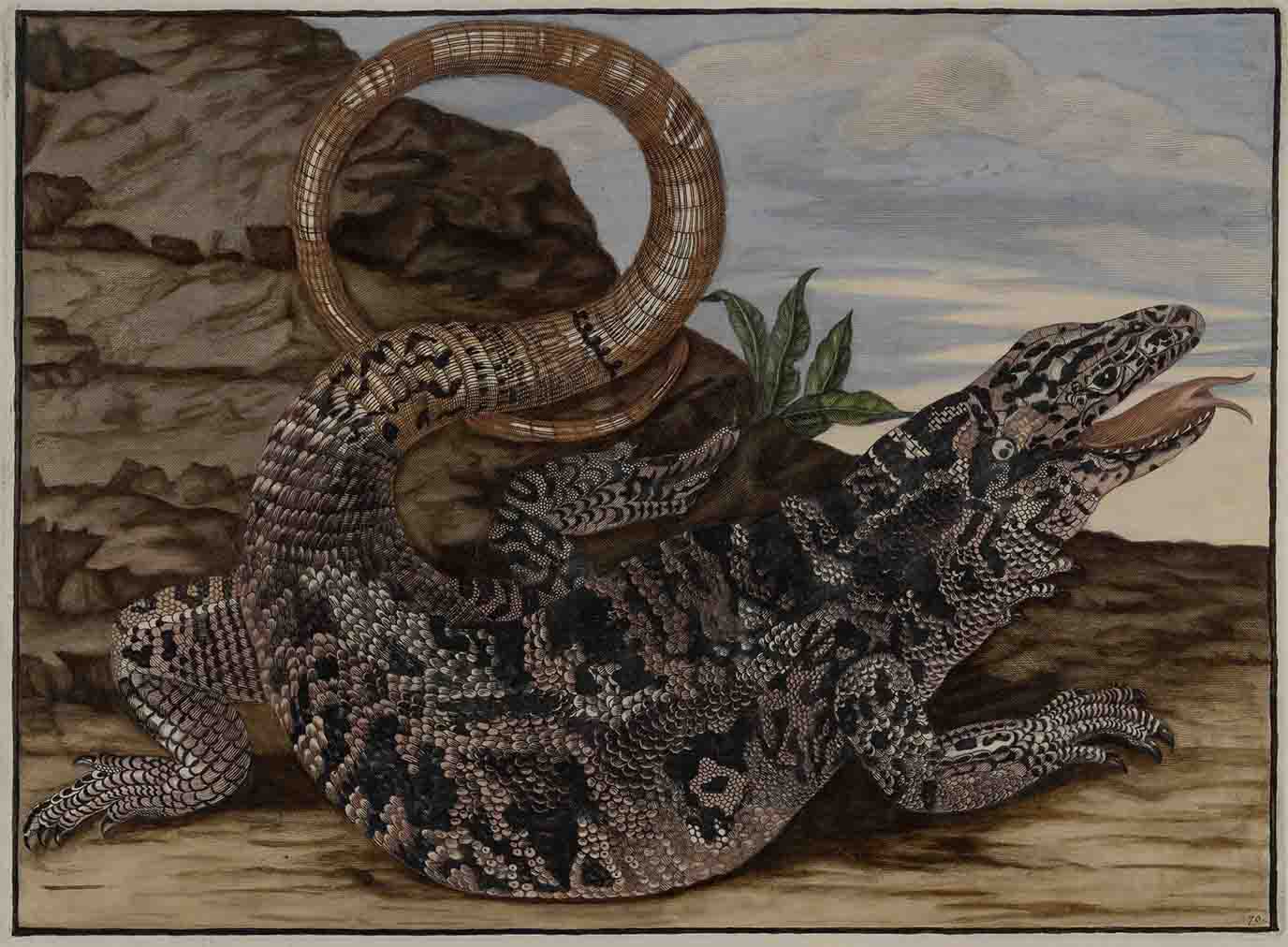
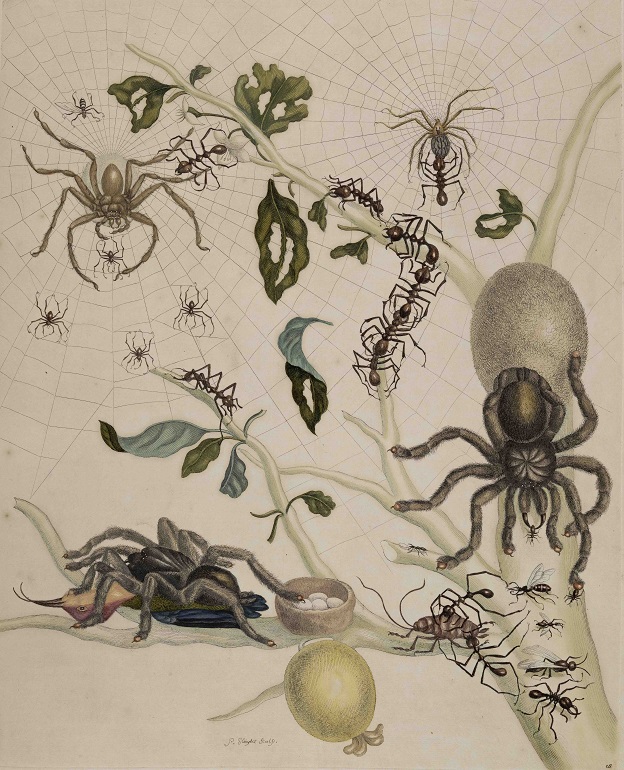
In 1691 Maria and her daughters (her mother had passed away at this point) had to leave, because the community was experiencing financial difficulties. They set up an art dealership in Amsterdam. Later, Maria travelled to Paramaribo with her youngest daughter to research the metamorphosis of insects and lizards. From her Labadistic brothers and sisters who had set up a plantation in Suriname, she had already heard a lot about this area. She stayed in the city of Paramaribo because it was the safest place. There was a risk the French could attack and a risk there would be anti-colonial uprisings of the native population. In the city she did research for her book Metamorphosis Insectorum Surinamensium ofte Verandering der Surinaamsche insecten (‘The Metamorphosis of the insects of Suriname’). What makes this book unique is that it depicts life size metamorphoses of species from Suriname which were unknown before then. Furthermore the animals were depicted in their natural environment as is evident from image 1 of the lizard. Not all caterpillars and butterflies have been matched correctly and the insects are occasionally not depicted with the right plant (food source). An explanation for this is that Merian’s notes got mixed up on the journey back from Suriname. Another could be that not all plants in the book were drawn in Suriname itself. Some grew in Dutch greenhouses where Maria could study them. Of a story on page 18, scientists still do not know whether it is true. Here Maria discusses large spiders she has seen. She states that the spiders usually eat ants, but when there is a shortage of these, they eat birds instead. She created a famous image of a spider eating a hummingbird (image 2). Four eggs are also depicted, which for some scientists is reason enough to assume the whole story is made up; a hummingbird only lays 3 eggs.
In Suriname Maria was assisted in her search for insects by Africans who had been made slaves and by native inhabitants. They also helped her with information about these plants and insects; for this reason Maria cites them several times in her book. She explains what plants and insects the African and native inhabitants eat, what medicinal purposes the plants serve and for what other purposes they can be used. She also uses the Suriname names of the plants, instead of the Latin ones. Although Maria benefited from the presence of slaves for her book, she criticises the monoculture of sugar in the colony.
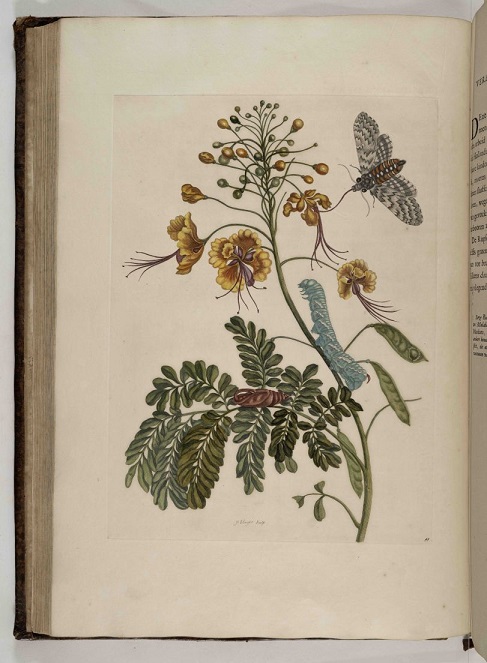
She also differs from other seventeenth-century European scientists because she acknowledges the help she received from slaves in her work, something other scientists never did. Maria also explains she has sympathy for women who committed an abortion by using the Flos pavinos on page 45 (image 3). This was exceptional, because abortion was - and sometimes still is - seen as a great sin. She describes that when Dutch people abuse women who have been made slaves, the slaves have an abortion so their child does not become a slave too. She explains that the Indian women believe the children will be reborn free in their own country after they pass away, and therefore let them go so they cannot be made slaves. By sharing this story with the reader Maria is giving the Idian women and female slaves a voice. The knowledge about the Flos pavinos was also important for many European women. According to Viktoria Schmidt-Linsenhoff this knowledge empowered them sexually at a time when men did not allow them access to means to control fertility. This knowledge there became a symbol for liberation and emancipation for European women.
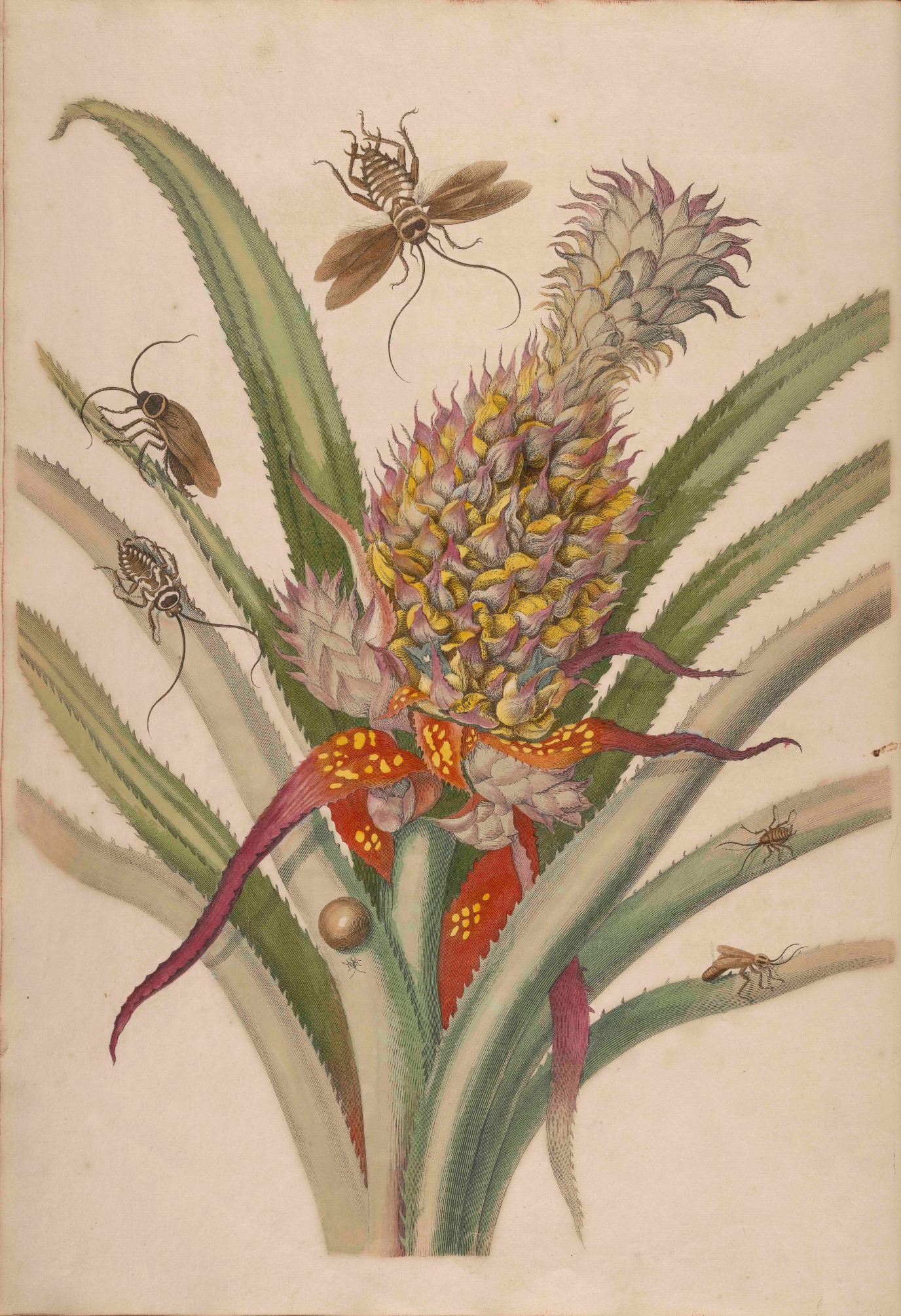
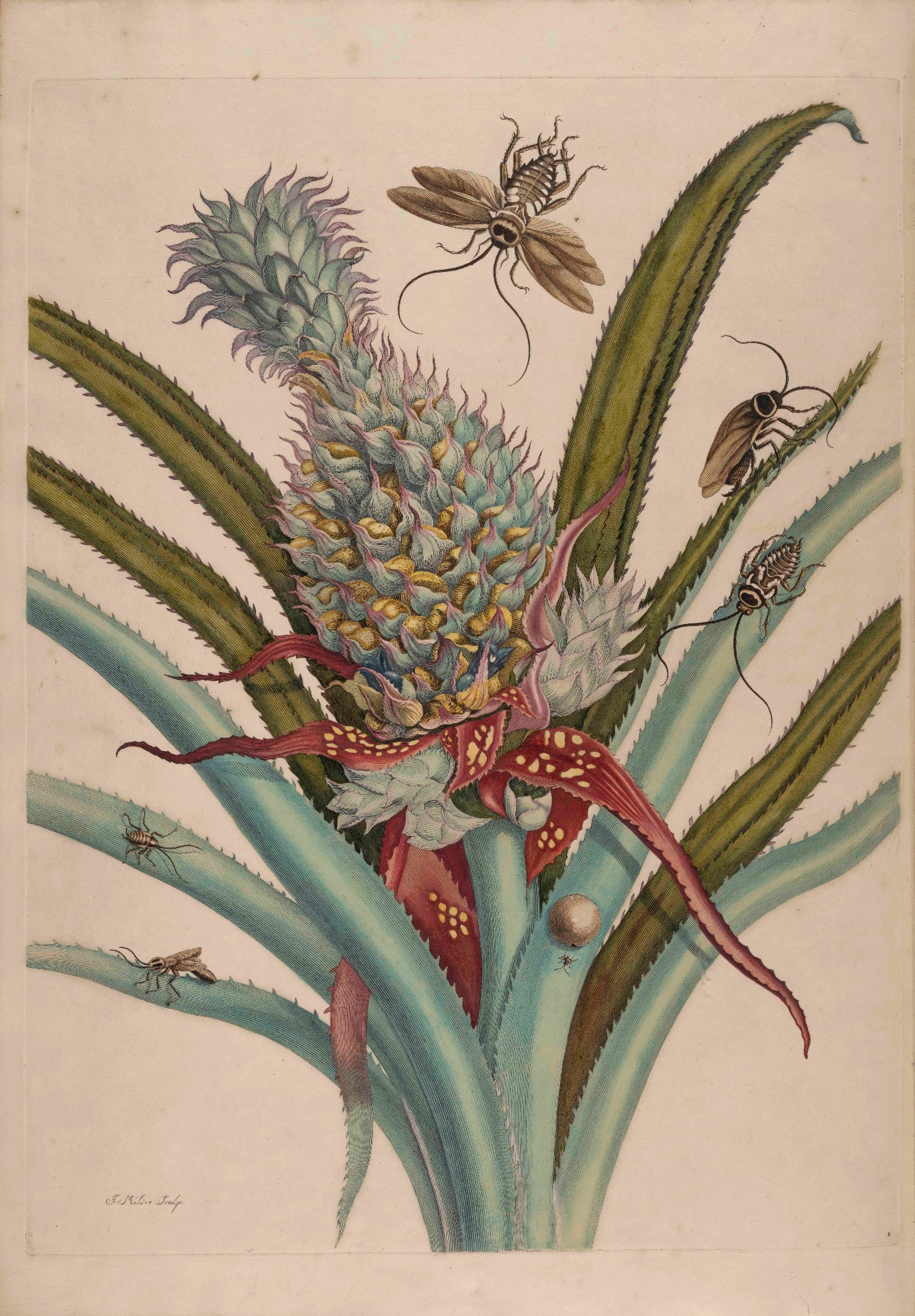
After two years Merian had to return to the Netherlands, because she became ill. According to her the hot and wet climate did not agree with her nature. In the Netherlands she had previously collected samples to grow insects in jars and boxes. She searched in the soil for worms and looked for moths at night. In this way she empirically studied the behaviour of insects, their food, and the stages of their development. She then showed the different stages of development of the insect in one image and depicted it with a plant. It therefore may seem you are looking at a plant with multiple insects, but it is in fact one insect at different stages of its development. This is evident from image 4, which shows the development of a cockroach.
Groningen University Library has three different copies of the Metamorphosis Insectorum Surinamensium ofte Verandering der Surinaamsche insecten. Two are coloured in and one is not. The two coloured in ones are different in several ways. Firstly, one copy (KW C 1377 - image 4) is a counterproof and the other (M1 O---- 2 - image 5) is not. When making a counterproof, the printer imprinted the wet new prints once more on a new piece of paper. The result is that you see no plate marks on the paper (as the name suggests plate marks are the indentations in the paper caused by the copper plate during the printing process). Because a counterproof is made with the original print on new paper, you get a mirror image of the original print. This is the reason the signature of the printer is not visible; it would be mirrored and unclear, so they cover it. An advantage of a counterproof is that the lines are lighter. When the prints are coloured in they look like a watercolour painting.
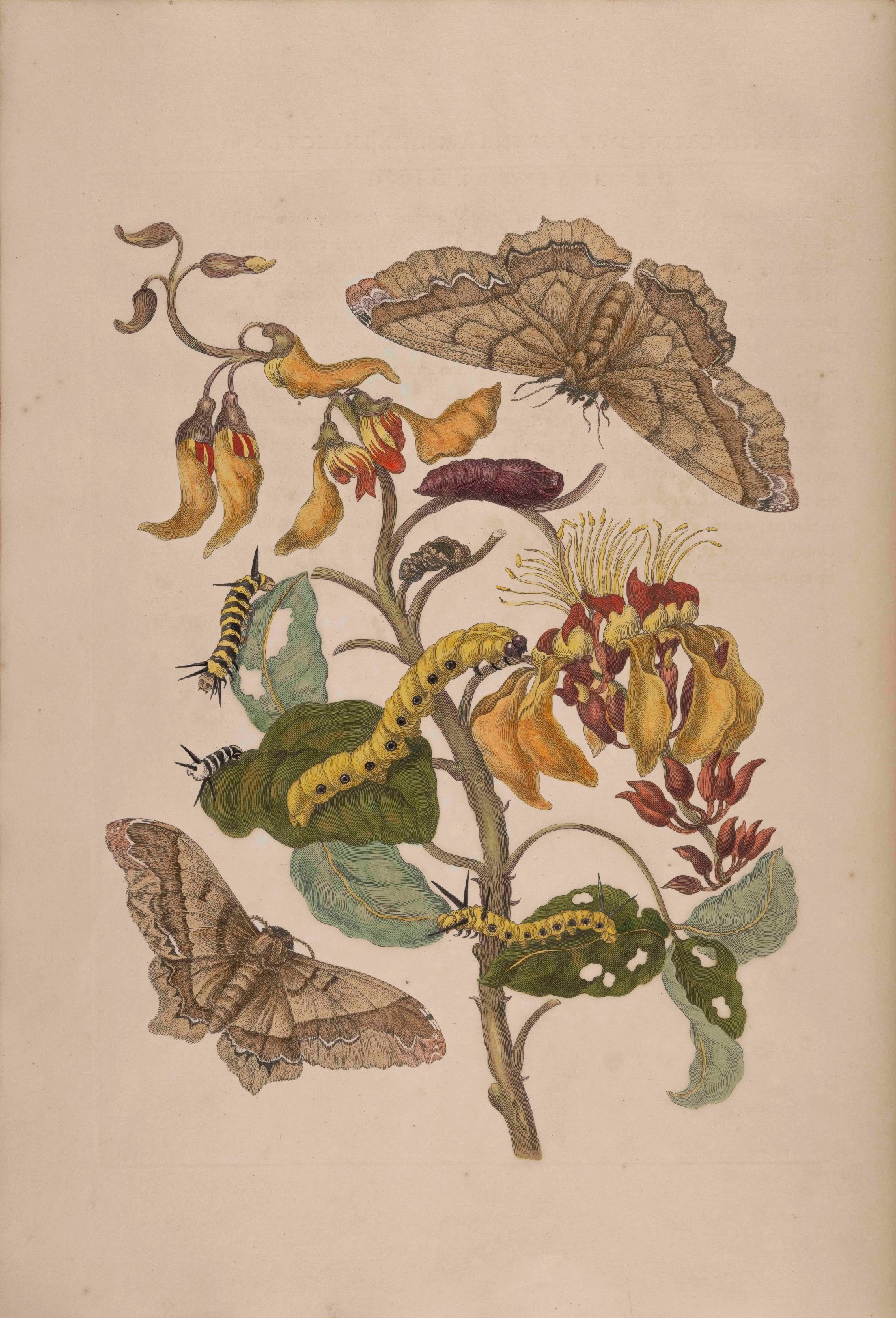
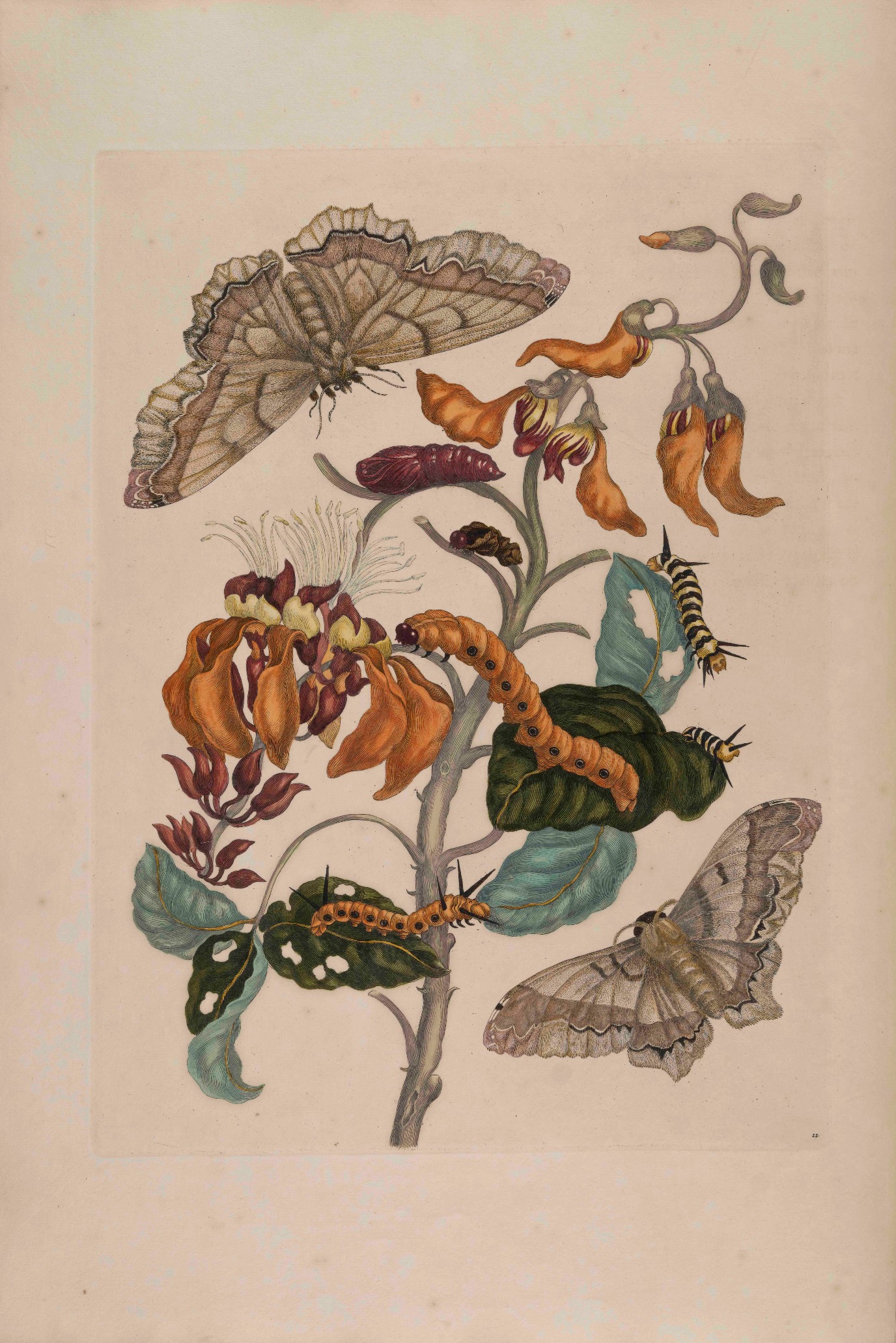
The colours used in both copies also differ. Because the prints had to be coloured in by hand, this is understandable. If two people colour in an image it is difficult to get the exact same colour yellow, for instance. It is also striking that at times a plant or insect has a completely different colour. In the images below the caterpillar on the left is yellow (image 6), whilst it is orange in the other copy (image 7). Perhaps the purchaser indicated which colours they wanted to be used. Furthermore, the front page is missing in M1 O---- 2, the copy that is not a counterproof. A similarity between both copies is that they are printed on the same paper. You can tell this from the watermark, a logo representing a particular papermaker which is visible when a page is held up to the light. Such a watermark is always visible in handmade paper. Based on the watermark and the book Wasserzeichen Lilie I could deduce that the paper was made in Neurenberg.
All in all, the book Metamorphosis Insectorum Surinamensium ofte Verandering der Surinaamsche insecten by Maria Sibylla Merian is a special work. It does not only provide us with information about plants and the metamorphoses of insects, but also tells us about the colonial past and native peoples. Furthermore the plates are a pleasure to look at. A rare first edition copy was purchased by the Rijksmuseum in 2024; it is exciting to realise that Groningen has three copies of the second edition from 1719, which contains twelve extra plates! Would you like to view this masterpiece? You are always welcome at the Special Collections department of the Groningen University Library.