

Ontological design as a foundation for data requirements in the digital twin of the renovation projects in the Living Lab.
In the EaSiCon project, a digital twin (DT) is developed for the construction sector to optimize processes, support decision-making, and reduce emissions. Work package 2 highlighted the importance of a standardized data model for the successful implementation of the DT.
This article focuses on work package 3, which outlines what data is required, what sources are available, and how this data can be structured and applied within a semantic model. The resulting ontological design serves as the foundation for the data requirements of a digital twin, in the context of the renovation projects in the Eemsdelta (Living Lab).
Required data for the digital twin
The research identified seven key data categories essential for developing a functional digital twin:
-
Construction activity
-
Destination
-
Material
-
Load carriers
-
Date (time)
-
Volume
-
Transport volume
In addition to the values themselves, the corresponding units of measurement are crucial for correct interpretation of the data.
Available data
Ideally, this data would be sourced directly from a BIM model. However, in the Living Lab, BIM is not used due to the lack of repetition across renovation projects. Additionally, BIM models require a high level of detail, which is often unavailable in renovation contexts.
Instead, the primary data source is the cost estimates prepared by the main contractors on behalf of the National Coordinator Groningen (NCG). This estimate contains detailed information on reinforcement measures and corresponding materials but lacks planning components and logistical specifications. Therefore, additional calculations and the expertise of logistics partner VWML are required to reconstruct missing data.
Structuring data through ontology
Ontology enables complex and heterogeneous data to be processed, structured, and linked to both logistical and construction processes in a consistent and reusable way. The ability to connect multiple data sources in a structured manner creates a solid foundation for further digitalization of construction logistics.
To structure the required data, a hybrid ontology was developed based on two international standards:
-
OWL (Web Ontology Language)
-
OM (Ontology of Units of Measure)
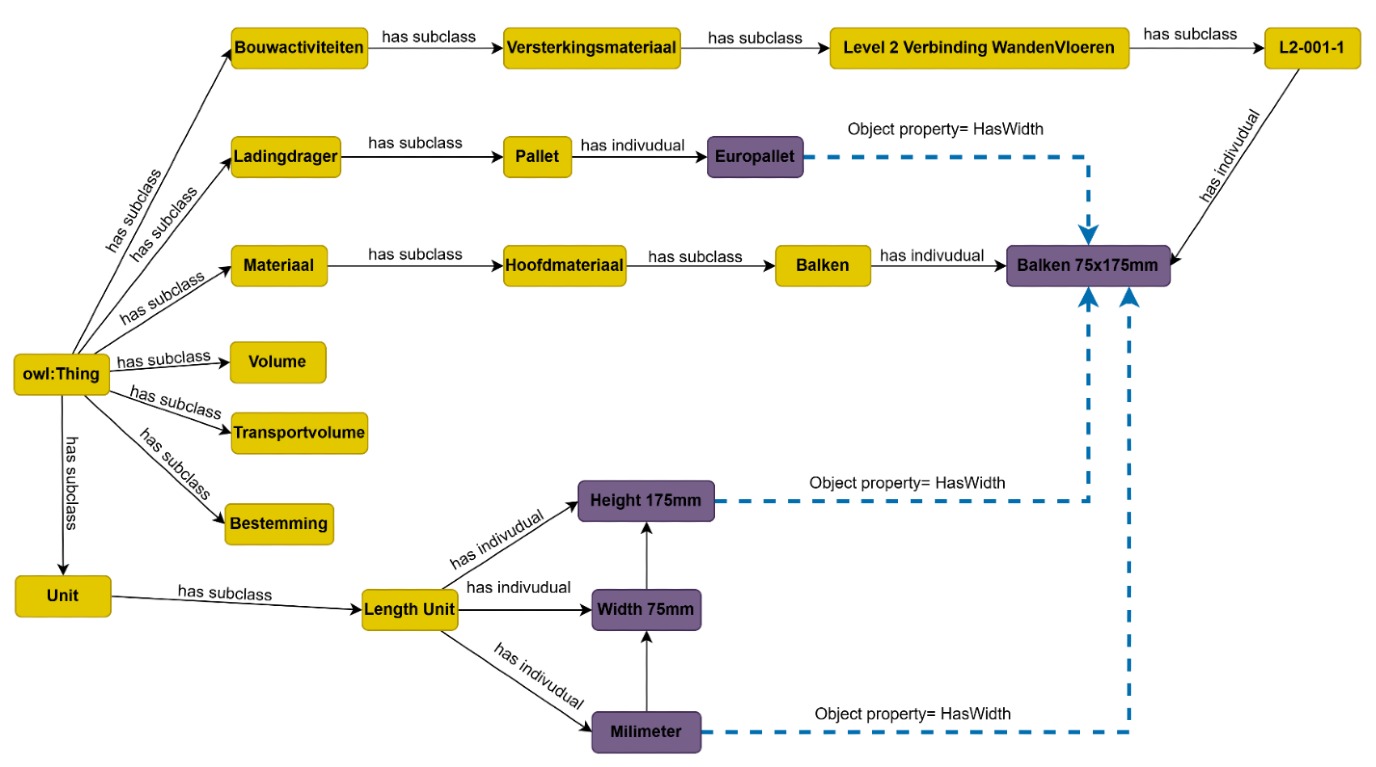
This hybrid approach combines a hierarchical structure with a poly‑categorical modeling method, ensuring both clarity and sufficient detail. The figure below presents a visualization of the use case developed during the study.
Testing the proposed approach in practice
The ontology was tested using a standard renovation home from the Living Lab. The seven data categories were modeled, linked to measurement units, and connected to reinforcement measures from the Groningen Measures Catalogue (GMC).
The results show that the ontology can effectively integrate and enrich heterogeneous data from various sources. By applying semantic relationships and standardized data types, data interoperability improves substantially, laying a strong foundation for further digitalization of construction logistics and Digital Twin development.
Next steps
In work package 4, we will continue to improve, extend, and refine the ontology. Additional data sources like BIM models, planning software (KYP), and sensor data will be integrated. As well as interoperability with existing systems. These steps will enable the Digital Twin to grow into a powerful tool for data‑driven decision‑making in the construction sector.
For more information, please contact:
Ragnar Klabbers
Ivo Agricola
Kees Jan Roodbergen
Michael Dienstknecht
Jeroen Laarman