


Open access publication in the spotlight - 'Dogwhistles, Discrimination, Humour and the Law: Regulating Implicit Messaging'
Each month, the open access team of the University of Groningen Library (UB) puts a recent open access article by UG authors in the spotlight. This publication is highlighted via social media and the library’s newsletter and website.
The article in the spotlight for the month of December 2025 is titled 'Dogwhistles, Discrimination, Humour and the Law: Regulating Implicit Messaging’, written by Jennifer Young (Faculty of Arts).
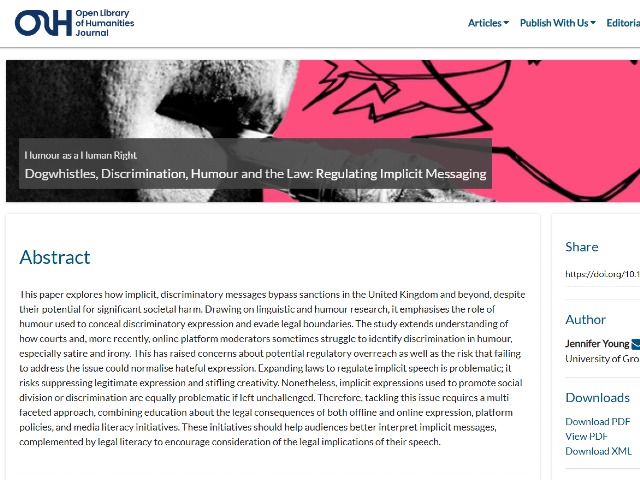
Abstract
This paper explores how implicit, discriminatory messages bypass sanctions in the United Kingdom and beyond, despite their potential for significant societal harm. Drawing on linguistic and humour research, it emphasises the role of humour used to conceal discriminatory expression and evade legal boundaries. The study extends understanding of how courts and, more recently, online platform moderators sometimes struggle to identify discrimination in humour, especially satire and irony. This has raised concerns about potential regulatory overreach as well as the risk that failing to address the issue could normalise hateful expression. Expanding laws to regulate implicit speech is problematic; it risks suppressing legitimate expression and stifling creativity. Nonetheless, implicit expressions used to promote social division or discrimination are equally problematic if left unchallenged. Therefore, tackling this issue requires a multi-faceted approach, combining education about the legal consequences of both offline and online expression, platform policies, and media literacy initiatives. These initiatives should help audiences better interpret implicit messages, complemented by legal literacy to encourage consideration of the legal implications of their speech.
We asked author Jennifer Young a few questions about the article:
How is humour used to conceal discriminatory messages and evade legal boundaries?
It’s about covering your true intentions by using implicit messaging, giving the appearance of being playful with language rather than malicious. The phrase ‘only joking’ can be used as an excuse for saying statements which could be threatening or discriminatory. It gives the speaker the ability to plausibly deny they meant anything hateful. If they are called out on their behaviour, then it gives them the opportunity to say that the audience misunderstood, or that they weren’t making a serious point. Using humour can also enable the speaker to turn the tables and play the victim – accusing the listener of having no sense of humour and that they are in the wrong for thinking that the speaker meant something discriminatory when they were only having ‘a bit of a laugh’, being ironic or using satire. This then potentially helps them avoid legal consequences. For example, one of the tests for incitement to hostility or violence is the speaker’s intention, and this intent is difficult to prove if they can plausibly say they didn’t mean anything malicious. These things take it into the (huge!) grey areas of the laws around restricting or protecting people’s right to freedom of expression.
You mention education and media literacy as part of the solution for effectively countering the challenges of socio-political dogwhistles. What specific programs or initiatives do you think would be most effective in helping audiences recognize and critically engage with implicit discriminatory messaging?
We know already that in most European countries (and lots of others globally) children are taught media literacy at school, and that seems to be pretty effective. On a supranational level there is an EU wide initiative called Better Internet for Kids, which has a wide range of resources and it is tailored for different audiences such as children, parents and teachers. What concerns me more (and probably not just me!) is older people – their parents and grandparents (55+ - and I am in that age range and see it first hand from my peers) - need to understand the damage that these dogwhistles can do to democracy. There’s been recent research from Brazil and the US which indicates that the older population are more likely to share misinformation and contentious content which aligns with their political ideology. I am sure the result would be replicated in Europe if it were carried out here. If we could each do a course in critical discourse analysis, we’d all be a lot better off!
How did you select the journal in which to publish? Why did you choose the Open Library of Humanities journal?
This choice was influenced by my lovely colleague Alberto Godioli. It is a great journal and has a special collection in a rolling format which is dedicated to the research topic Humour as a Human Right.
Could you reflect on your experiences with open access and open science in general?
This was the first article that I had authored alone, my others have all been in collaboration with Alberto. I was a little overwhelmed at first by the process, finding a journal and then submitting, and the article got rejected by the first journal I chose. I learned to not take rejection personally and to use their comments to improve the paper! When the Open Library of Humanities accepted my article, I had to learn not to take the reviewers’ comments personally and not get too annoyed by the fact that they were in parts contradictory because they helped a lot in reframing the work. The editorial team at the journal was really supportive. I think in terms of reach it’s important to publish open access, especially in diamond open access journals. This way there are no financial barriers either for authors or for readers, and that seems to me to be a more principled approach to academic publishing.
Useful links:
The Open Library of Humanities journal is a diamond open access journal. Diamond open access journals are free to access/read and free to publish in, authors don’t need to pay article processing charges. The University of Groningen supports several diamond open access initiatives, see this overview.
University of Groningen Press (UGP) is an open access publisher that also publishes multiple diamond open access journals.
Citation:
Young, J., (2025) “Dogwhistles, Discrimination, Humour and the Law: Regulating Implicit Messaging”, Open Library of Humanities 11(2). doi: https://doi.org/10.16995/olh.19789
If you would like us to highlight your open access publication here, please get in touch with us.