
Page content
Section menu
Main menu
Associative links
Page content:
Nederlands

Star and Planet formation and the Interstellar Medium of Galaxies


Observations with the CHAMP+ (Carbon Heterodyne Array of the MPIfR) instrument on the Atacama Pathfinder EXperiment (APEX) telescope in Hawaii. Colour map of the Omega nebula in 12CO J=7-6, contour lines correspond to 12CO J=6-5 emission. The gas has a temperature of at least 100 Kelvin, leading to high-mass star formation.

All stars and planets, throughout the history of the universe, are made from interstellar matter (ISM), which is gas and dust that floats freely in space as enormous clouds. The gas comprises atomic hydrogen and helium as well as molecules like carbon-monoxide, water, methane (and many more). The dust consists of small silicate particles (sand) and carbonaceous material (soot), and forms the material from which planets, like the Earth, are formed. Interstellar matter is part of the life and death cycle of stars and is enriched with fresh material when stars explode as (super)novae. Interstellar material serves as the fuel for super-massive black holes in the centres of active galaxies. Under the influence of gravity, material is accreted and allows black holes to grow and radiate very large amounts of energy. Furthermore, new stars form from interstellar gas under the influence of gravity, while every galaxy in the early universe starts out as mostly gas and no stars.

Supernovae, stellar winds, photons from massive stars, galactic jets, AGN and cosmic rays cause the ISM to enjoy wide ranges in temperature, density and elemental abundance. As such, interstellar matter forms an integral part of the evolution of galaxies. The ISM is present as diffuse ionized gas, warm atomic HI complexes, and cold molecular clouds. Dense cores form inside molecular clouds through gravitational contraction and cooling. A core leads to the formation of stars when it collapses under its own weight, fragments and forms protostars. During the collapse phase, a rotating disk forms around the protostar and most of the parental cloud material is accreted through the disk onto the central star. As the system evolves, the disk material (gas and dust) forms a planetary system such as our own Solar System.

Simulation of Star formation
Seyit Hocuk ran several simulations of star formation in interstellar molecular clouds with varying environmental parameters (e.g. metallicity and rotational energy). In this movie a scenario with solar metallicity and low rotational energy is shown. The result is a relatively large amount of relatively low mass stars (the white dots that appear after a few seconds).
Chemical layering in the Orion Bar (near the belt of the Orion constellation), as observed in legacy data from the James Clerk Maxwell Telescope. UV photons emitted by young massive stars impinge on the molecular cloud and give rise to a layered structure.

Fundamental questions in the above, be it for the Milky Way or active and primordial galaxies, are:

  • What are the necessary conditions for low and high mass stars to form efficiently?
  • How do young stars and massive black holes affect their surroundings?
  • How do dust particles evolve and coagulate in proto-planetary disks to form planets?

The ubiquitous presence of dust obscures our view of stellar birth sites in the optical, so that star formation is best studied at infrared and (sub-)mm wavelengths. It is the continuing advance in ground-based and space-borne observational facilities that allow us to probe proto-stars and (active) galaxies with increasing spatial and spectral resolution, and to greater distances. We are strongly involved in (sub-)mm observatories like Herschel and ALMA. The latter will be ready in 2013 and is an interferometer that comprises 66 antennas.

Numerical simulations of star formation in a collapsing molecular cloud. High angular momentum in the parental cloud leads to binaries, while low angular momentum systems allow single stars to be formed.

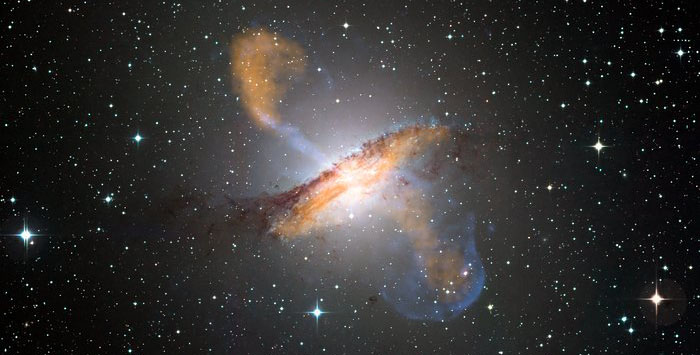
Our studies include the formation of high-mass stars in local Galactic clouds, the ISM of active (ULIRG, Seyfert, starburst) galaxies like Arp 220, NGC 1068 and M 82, the ISM of primordial galaxies, the formation of the first stars and black holes at high redshift, and the origin of the stellar initial mass function. Further specific areas are the gas and dust surface chemistry of interstellar clouds, radiative and mechanical feedback from massive young stars and super-massive black holes, and masers. On smaller physical scales, research is done on the structure and chemistry of proto-planetary disks, the formation of planetesimals in these disks and proto-planetary disk evolution during the entire planet forming phase.

Faculty active in these areas: Spaans, Kamp, Barthel, van der Hulst, Verheijen, Zaroubi, van der Tak (SRON), Baryshev (SRON), Shipman (SRON), Ossenkopf (SRON)

See the ISM group web site for more details.

Last modified:July 18, 2011 13:38
Associative links:

Respond to this page?