Skip to ContentSkip to Navigation
founded in 1614  -  top 100 university
Education Master's and PhD degree programmes Behavioural and Social Sciences - Research
Header image Behavioural and Social Sciences

Behavioural and Social Sciences

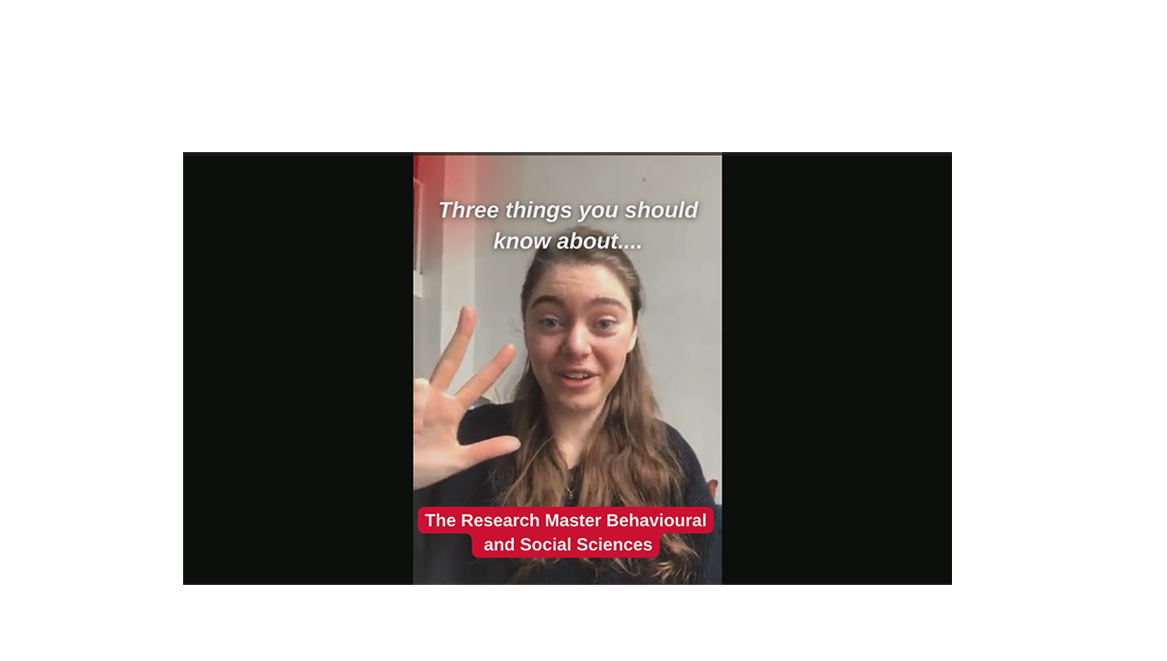
Do you want to advance your research skills in the social sciences? Learn from different disciplines, find your specialization and dive into the topics you wish to engage in!

In this research master's, you develop into an independent researcher in academic or applied settings or prepare for a combined scientist-practitioner career in the mental health field.

Theme-specific courses provide a broad view on the multidisciplinary theme and introduce you to the unique perspectives of theme-related specializations. You will explore complex social questions, generate new insights into human behaviour and society, and cross disciplinary boundaries.

You choose the theme that aligns with your interests.

1. Mental Health: Perspectives from Neuro- and Clinical Psychology
What are the origins of psychopathological and brain disorders? Improve diagnostic methods and treatment strategies for people with mental and neurological disorders.

2. Individual Development in Social Context
How do individuals develop across their lifespan? Help education, healthcare and policy to better support development and well-being in different stages of life.

3. Understanding Societal Change
How do individuals and groups adapt to the changing world? Help governments, organisations and communities to respond better to societal challenges such as social inequality, climate adaptation and diversity.

Interested? Read more about the three themes and their specialisations, and check out the information events or contact our study advisor.
Facts & Figures
Degree
MSc in Behavioural and Social Sciences (research)
Course type
Research master
Duration
24 months (120 EC)
Croho code
60654
Language of instruction
English
Start
September
Faculty
Behavioural and Social Sciences

Why study this programme in Groningen?

  • Learn from five disciplines Psychology, sociology, pedagogy, educational sciences, and psychometrics and statistics within an interdisciplinary social sciences programme, in close interaction with academic staff and highly motivated fellow students
  • Flexible programme Within the themes, you have the freedom to tailor your programme with specialization electives within and outside the programme that challenge you and develop your academic skills
  • Prepare for the career you want Build your own research profile based on your interests and prepare for a PhD or (applied) research-oriented career, or scientist-practitioner career in the mental health field
  • Research and practice Develop your skills as a researcher with real-world experience through traineeship and projects in active research groups
  • Small-scale and personal Benefit from intensive guidance and small groups that focus on your growth and development
  • Social impact Work on current topics such as sustainability, social inequality and health that matter to people and society.

Programme

The BSS Research Master's programme consists of

  • Compulsory courses for all themes (20 EC) provide the basis for theory of science, statistics and research methodology
  • A traineeship (10 EC): where you learn how to conduct high-quality scientific research by participating in an ongoing research project (clinical traineeship: see Year 2)
  • Compulsory theme-specific modules (15 EC) introduce the theme, offering a broad view and the unique perspectives of the theme-related specializations
  • Specialization courses offer theme-related specialization (10/20 EC)
  • Electives (year 1 + 2 in total: 10 EC): chosen out of all modules in the BSS research master's or, in consultation, also from other UG programmes
Find descriptions,
Semesters
CoursesCourse Catalog >1a1b2a2b
)
Advanced clinical neuropsychology (5 EC)
Advanced Statistics (7.5 EC)
Applied Statistics (10EC)
Clinical interventions and e-health for adults and youth (5 EC) or Neuropsychological Assessment (5 EC)
CLINICAL NEUROPSYCHOLOGY (MH specialization 10 EC)
CLINICAL PSYCHOLOGY (MH specialization: 10 EC)
Complexity, dynamics and development (5 EC)
COMPULSORY COURSES (all themes: MH-IDS-USC)
  • Advanced Statistics (7.5 EC) * Advanced Statistics (7.5 EC) *How to Theorize (2.5 EC) * Reflecting on Science and Integrity (7.5 EC) * Master's thesis (30 EC) * Multidisciplinary Research in Action (5 EC) * Seminars (2.5 EC) * Preparing for your master's thesis: Writing your proposal (5 EC) * Traineeship (10 EC) or Clinical Traineeship (20 EC)
COMPULSORY COURSES (all themes: MH-IDS-USC)
  • Advanced Statistics (7.5 EC)
  • Advanced Statistics (7.5 EC)
  • How to Theorize (2.5 EC)
  • Reflecting on Science and Integrity (7.5 EC)
  • Master's thesis (30 EC)
  • Multidisciplinary Research in Action (5 EC)
  • Seminars (2.5 EC)
  • Preparing for your master's thesis: Writing your proposal (5 EC)
  • Traineeship (10 EC) or Clinical Traineeship (20 EC)
Contextualized Assessments & Interventions (5 EC)
Cooperation and communication (5 EC)
Culture and Diversity (5 EC)
Development, learning and instruction (5 EC)
DEVELOPMENTAL PSYCHOLOGY (IDS specialization 10 EC)
Economy and society: Critical transitions in Advanced Industrialised Societies (5 EC)
Environmental psychology (5 EC)
ENVIRONMENTAL PSYCHOLOGY (USC specialization 10 EC)
Evidence-based Interventions (5 EC)
Explaining Psychopathology (5 EC)
From problem analysis to intervention design (7.5 EC)
How to Theorize (2.5 EC)
IDS| THEME-SPECIFIC COURSES (15 EC)
  • Lifespan development (5 EC) *Modelling persons and variables over time (5 EC) *Socialization (5 EC)
IDS| THEME-SPECIFIC COURSES (15 EC)
  • Lifespan development (5 EC) *Modelling persons and variables over time (5 EC) *Socialization (5 EC)
IDS-1 THEME-SPECIFIC COURSES(15 EC)
  • Lifespan development (5 EC)
  • Modelling persons and variables over time (5 EC)
  • Socialization (5 EC)
IDS-2 SPECIALIZATION COURSES: Developmental Psychology (10 EC)
  • Complexity, dynamics and development (5 EC) *Development, learning and instruction (5 EC)
IDS-2 SPECIALIZATION COURSES: Developmental Psychology (10 EC)
  • Complexity, dynamics and development (5 EC)
  • Development, learning and instruction (5 EC)
IDS-2 SPECIALIZATION COURSES: Orthopedagogy (10 EC)
  • Development, learning and instruction (5 EC) *Contextualized Assessments & Interventions (5 EC)
IDS-2 SPECIALIZATION COURSES: Pedagogical & Educational Sciencse (10 EC)
  • Literature Study (5 EC)
  • Development, learning and instruction (5 EC)
IDS-2 SPECIALIZATION COURSES: Psychometrics & Statistics (10 EC)
  • Network methods for policy research (5 EC)
  • Structural Equation Modelling (5 EC)
  • Multilevel Analysis (5 EC)
  • Statistical modelling of single cases (5 EC)
IDS-2 SPECIALIZATION COURSES: Sociology (10 EC)
  • Economy and society: Critical transitions in Advanced Industrialised Societies (5 EC) *Solidarity and social contexts (5 EC) *Networks methods for policy research (5 EC)
IDS-2 SPECIALIZATION COURSES: Sociology (10 EC)
  • Economy and society: Critical transitions in Advanced Industrialised Societies (5 EC) *Solidarity and social contexts (5 EC)
  • Networks methods for policy research (5 EC)
Lifespan development (5 EC)
Literature Study (5 EC)
Master's thesis (30 EC)
Mental Health: Advanced Research Methods (5 EC)
Mental Health: a multidimensional perspective (5 EC)
MH| Clinical Neuropsychology SPECIALIZATION courses(10 EC)
  • Advanced clinical neuropsychology (5 EC) *Neuropsychological rehabilitation and treatment (5 EC) *Literature Study (5 EC)
MH| Clinical Psychology SPECIALIZATION courses (10 EC)
  • Evidence-based Interventions (5 EC) *Explaining Psychopathology (5 EC)
MH| THEME-SPECIFIC COURSES (15 EC)
  • Mental Health: a multidimensional perspective (5 EC) *Mental Health: Advanced Research Methods (5 EC) *Clinical interventions and e-health for adults and youth (5 EC) or Neuropsychological Assessment (5 EC)
MH-1 THEME-SPECIFIC COURSES (15 EC)
  • Mental Health: a multidimensional perspective (5 EC)
  • Mental Health: Advanced Research Methods (5 EC)
  • Clinical interventions and e-health for adults and youth (5 EC) or Neuropsychological Assessment (5 EC)
MH-2 SPECIALIZATION COURSES: Clinical Neurosychology (10 EC)
  • Advanced clinical neuropsychology (5 EC)
  • Neuropsychological rehabilitation and treatment (5 EC)
  • Literature Study (5 EC)
MH-2 SPECIALIZATION COURSES: Clinical Psychology (10 EC)
  • Evidence-based Interventions (5 EC)
  • Explaining Psychopathology (5 EC)
MH-2 SPECIALIZATION COURSES: Psychometrics & Statistics (10 EC)
  • Network methods for policy research (5 EC)
  • Structural Equation Modelling (5 EC)
  • Multilevel Analysis (5 EC)
  • Statistical modelling of single cases (5 EC)
Modelling persons and variables over time (5 EC)
Multidisciplinary Research in Action - (5 EC)
Multilevel Analysis (5 EC)
Network methods for policy research (5 EC)
Networks methods for policy research (5 EC)
Neuropsychological rehabilitation and treatment (5 EC)
ORGANIZATIONAL PSYCHOLOGY (USC specialization 10 EC)
ORTHOPEDAGOGY (IDS specialization 10 EC)
PEDAGOGICAL & EDUCATIONAL SCIENCES (specialization 10 EC)
Power and Leadership (5 EC)
Preparing for your master's thesis: Writing your proposal (5 EC)
PSYCHOMETRIC & STATISTICS (MH-IDS-USC spec: 10 EC)
Reflecting on Science and Integrity (7.5 EC)
Selection, assessment and job performance (5 EC)
Seminars (2.5 EC)
Socialization (5 EC)
SOCIAL PSYCHOLOGY (USC specialization 10 EC)
SOCIOLOGY (IDS-USC specialization 10 EC)
Solidarity and social contexts (5 EC)
Statistical modelling of single cases (5 EC)
Structural Equation Modelling (5 EC)
Theorizing Change (7.5 EC)
Traineeship (10 EC) or Clinical Traineeship (20 EC)
USC| THEME-SPECIFIC COURSES (15 EC)
  • Theorizing Change (7.5 EC) *From problem analysis to intervention design (7.5 EC)
USC-1 THEME-SPECIFIC COURSES (15 EC)
  • Theorizing Change (7.5 EC) *From problem analysis to intervention design (7.5 EC)
USC-2 SPECIALIZATION COURSES: Environmental Psychology (10 EC)
  • Literature Study (5 EC)
  • Environmental psychology (5 EC)
USC-2 SPECIALIZATION COURSES: Organizational Psychology (10 EC)
  • Power and Leadership (5 EC)
  • Selection, assessment and job performance (5 EC)
USC-2 SPECIALIZATION COURSES: Psychometrics & Statistics (10 EC)
  • Network methods for policy research (5 EC)
  • Structural Equation Modelling (5 EC)
  • Multilevel Analysis (5 EC)
  • Statistical modelling of single cases (5 EC)
USC-2 SPECIALIZATION COURSES: Social Psychology (10 EC)
  • Culture and Diversity (5 EC)
  • Cooperation and communication (5 EC)
USC THEME-SPECIFIC COURSES (15 EC)
*Advanced statistics (7.5 EC)
*How to theorize (2.5 EC)
IDSC | Lifespan development (5 EC)
MH | Mental Health: a multidimensional perspective (5 EC)
UCS | Theorizing change (7.5 EC)
*Seminars (2.5 EC)
*Traineeship (10 EC)
Complexity Dynamics and development (5 EC)
Culture and diversity (5 EC)
Economy and Society: Critical Transitions in Advanced Industrialised Societies (5 EC)
Environmental Psychology (5 EC)
Evidence based interventions (5 EC)
Explaining Psychopathology (5 EC)
IDSC | Modelling persons and variables over time (5 EC)
IDSC | Socialization (5 EC)
MH | Mental Health: advanced research methods (5 EC)
Power and leadership (5 EC)
Qualitative Research Methods (5 EC)
Solidarity and social contexts (5 EC)
Statistical Analysis of Social Networks (5 EC)
Structural Equation Modelling (5 EC)
USC | From problem analysis to intervention design (7.5 EC)
*Specialization courses (see online catalogue) (10 EC)
Elective courses (see the online catalogue) (10 EC)
*Applied statistics (10 EC)
Advanced Clinical neuropsychology (5 EC)
Cooperation and communication (5 EC)
Development, learning and instruction (5 EC)
MH | Clinical interventions and e-health for adults and youth OR Neuropsychological assessment (5 EC)
Neuropsychological assessment (5 EC)
Contextualized Assessments & interventions (5 EC)
Multilevel analysis (5 EC)
Neuropsychological rehabilitation and treatment (5 EC)
Preparing for you master thesis: Writing your proposal (5 EC)
Selection, assessment and job performance (5 EC)
Statistical modelling of single cases (5 EC)

The BSS Research Master's programme consists of

  • Compulsory courses for all themes (20 EC) provide the basis for multidisciplinary research, scientific reflection and thesis preparation
  • Electives (year 1 + 2 in total: 10 EC): chosen out of all modules in the bss research master's or in consultation, also from other UG programmes
  • Clinical traineeship (20 EC)only for students from the theme MH and IDS specialization Orthopedagogy
  • Master's thesis (30 EC)
Semesters
CoursesCourse Catalog >1a1b2a2b
*Multidisciplinary research in action (5 EC)
*Reflecting on Science and Integrity (7.5 EC)
*Preparing for your master's thesis: Writing your proposal (5 EC)
Electives (see online catalogue)
Master's thesis (30 EC)
*Clinical traineeship (20 EC)
*Specialization courses (see online catalogue) (10 EC)

Study abroad

  • Study abroad is optional

The Traineeship and Master thesis projects can be performed internally at the Faculty of Behavioural and Social Sciences of the University of Groningen, or externally at another university or research institute in the Netherlands or abroad. The teaching staff has an extensive national and international network, resulting from cooperations with top-level researchers across the world.

Entry requirements

Admission requirements

Specific requirementsMore information
assessment interview

If you apply for the programme, you may be invited for an additional assignment and/or an interview with the Admission Board to provide additional information about your motives and aspirations to enter the research master's programme.

language test

Sufficient knowledge of the English language:

IELTS academic: 7-overall, 7-speaking and writing | TOEFL as of 2026: >= 5-overall, >= 5-speaking and writing (internet-based) & TOEFL before 2026: >= 100-overall, >= 25-speaking and writing (internet-based) | CPE in Advanced English: minimum score 185 (C1) / 200 (C2) | Pearson Academic: 71-overall, 64-speaking, 75-writing | LanguageCert Academic: 75-overall, 75-speaking and writing.

  • TOEFL Home Edition is not accepted.
reference letter

You must arrange for two names of academic referees who have knowledge of your academic record. Please note: only provide two names, it is not necessary to arrange letters of references.

(motivation-) letter

A letter (800 words at maximum) in which you explain why you wish to follow this particular degree programme, theme and specialization and what your expectations and ambitions are.

other admission requirements
  • High performance during the bachelor's degree programme (weighted average BA grade at least 7.5 or equivalent).
  • Preference for one of the three domains.
  • Knowledge of relevant theories and statistics (including multiple regression and analysis of variance), and experience with statistical software packages.

Not sure if you meet these statistical requirements? Please read the Statistical Entrance requirements. This pdf document includes a self-test.

Transfer options

Transferring from...

Study programmeOrganizationTransition
SociologyAll Research universitiesAdditional requirements
Psychologie (NL), Psychology (EN)All Research universitiesAdditional requirements
Pedagogical SciencesAll Research universitiesAdditional requirements
Interdisciplinary Social ScienceAll Research universitiesAdditional requirements
Study programmeOrganizationTransition

Registration procedure

The application process involves four steps, which differ for students from a non-Dutch university and those from a Dutch university.

Roughly the steps are:
1) Sign up in Studielink
2) Provide information
> Students with a non-Dutch university diploma receive an email from the Admissions Office.
> Students with a Dutch university diploma fill out a form for the Admissions Board.
3) Selection procedure by the Admissions Board
4) You receive the admission decision.

Please read the detailed application procedure carefully.

Selection procedure

Application deadlines

Type of studentDeadlineStart course
Dutch students01 May 202701 September 2027
EU/EEA students01 May 202701 September 2027
non-EU/EEA students01 April 202701 September 2027

Admission requirements

Specific requirementsMore information
previous education

University bachelor in a social science (e.g., Psychology, Sociology, Pedagogics, Educational Sciences).

assessment interview

If you apply for the programme, you may be invited for an interview with the Admission Board to provide additional information about their motives and aspirations to enter the research master's programme.

language test

Sufficient knowledge of the English language. | CPE in Advanced English:>=185 | TOEFL: an overall score of >= 100, with >= 25 on speaking and writing on the internet-based form | IELTS: an overall score of >= 7, with >=7 on speaking and writing (academic version) |

reference letter

You must arrange for two names of academic referees who have knowledge of your academic record. Please note: only provide two names, it is not necessary to arrange letters of references.

(motivation-) letter

Your motivation to enter the research master's programme and your professional background are important elements in successful completion of the programme. Also, it is very important for us to know what your objectives are in completing the research master so your needs can be assessed. Please write (type) a short report (no longer than 1 to 2 pages) listing your motivation, relevant study or work experience and any other information which you think is related to your admission such as thesis proposals, areas of particular interest and/or professional qualifications in social and behavioural sciences.

other admission requirements
  • High performance during the Bachelor's degree programme (weighted average BA grade at least 7.5 or equivalent)
  • Preference for one of the three domains
  • Knowledge of relevant theories and statistics (including multiple regression and analysis of variance), and experience with statistical software packages.

Not sure if you meet these statistical requirements? Please read the statistical entrance requirements. This document includes a self-test.

Registration procedure

The application process involves four steps, which differ for students from a non-Dutch university and those from a Dutch university.

Roughly the steps are:
1) Sign up in Studielink
2) Provide information
> Students with a non-Dutch university diploma receive an email from the Admissions Office
> Students with a Dutch university diploma fill out a form for the Admissions Board
3) Selection procedure by the Admissions Board
4) You receive the admission decision.

Please read the detailed application procedure carefully.

Selection procedure

Application deadlines

Type of studentDeadlineStart course
Dutch students01 May 202701 September 2027
EU/EEA students01 May 202701 September 2027
non-EU/EEA students01 April 202701 September 2027

Tuition fees

NationalityYearFeeProgramme form
EU/EEA2026-2027€ 2694full-time
non-EU/EEA2026-2027€ 22200full-time

Practical information for:

After your studies

Job prospects

Graduates of the Research Master in Behavioural and Social Sciences have excellent career prospects. A majority of our alumni (59%) continue into a PhD position, either at the University of Groningen (67%), at another Dutch university (12%), or at a university abroad (21%). Students from all thematic tracks successfully progress to doctoral research.

Others pursue research-oriented careers in academia, policy, and applied settings. Below are examples of career paths followed by alumni from the different thematic tracks.

Career services BSS

Where do you want to work after your studies? You can contact Career Services already during your studies. They will help you orientate on your career, develop your skills, apply for jobs and find an internship.

Job examples

  • Mental Health: Perspectives from Neuro- and Clinical Psychology
    • clinical psychologist
    • neuropsychologist
    • management consultant
    • data analyst.
  • Understanding Societal Change
    • consultant
    • researcher at research company (eg. NIDI, SCP, TNO)
    • policy advisor
    • scientific advisor
    • lecturer
    • data analyst or scientist
    • project leader
    • information specialist
    • developer
    • political advisor.
  • Individual Development in Social Context
    • researcher at a research company (eg. NIDI, SCP, TNO)
    • lecturer
    • orthopedagoog
    • educational scientist
    • information specialist
    • policy advisor
    • political advisor.

Research

Research Master & Research Groups

The programme builds upon a long-standing collaboration within the faculty between a number of research groups in sociology, psychology, and pedagogical and educational sciences with a shared interest in the social behaviour of individuals in institutional and cultural contexts. They all focus on methodologically and theoretically advanced research on applied problems. Typical research topics include, for example, motivation, solidarity behaviour, or commitment.

Research groups in the themes:

Thesis topic

You will explore a wide range of questions in the behavioural and social sciences, from mental health and education to societal challenges and real-world contexts. Past theses have examined depression treatments, social and political identity, human trafficking, algorithmic management, and even polar tourism. You have the freedom to design your thesis around your own research interests, pursuing topics that truly matter to you.

Examples of thesis titles:
Mental Health: Perspectives from Neuro- and Clinical Psychology
  • Therapy or Medication: Comparing Strength of Evidence of Psychological and Pharmacological Depression Treatments.
  • Social Identity and Well-Being: Insights from a Cross-Sectional and a Daily Diary Study.
  • Predictors of Secondary Traumatization Symptoms in Mental Health Professionals Working with Traumatized Clients.
  • Lessons from a Wisdom-embedded mindfulness intervention.
Individual Development in Social Context
  • Youth Political Identity Development - A Systematic Review.
  • Building Common Ground in Collaborative Learning: Exploring Higher Education Student's Experiences Across Two Tasks.
  • The X-Factor: Investigating Turning Points in Psychotherapy for Depression.
  • The Oldest Profession in the Modern Age: Developing a Revised Risk Score Assessment Model to Predict the Possible Presence of Human Trafficking and Illegal Prostitution in Online Escort Advertisements.
Understanding Societal Change
  • The Role of Misrecognition in the Belief in Upward Conspiracy Theories.
  • Guiding on Thinning Ice: A Qualitative Approach to Polar Tour Guides' Motivations, Goals, Guiding Behaviour and Agency Perception.
  • When Algorithmic Managers Break Promises: The Moderating Role of Anthropomorphism in Justice Perceptions.
  • Context Matters: A Comparative Study of Self-Censorship Motivations in Personal and Professional Settings.
Apply nowBrochureEventsContact
Master's Open Daydiverse locatiesMore information
Online Master's WeekMore information
Master's Open Daydiverse locatiesMore information

Contact

  • Study Advisor Research Master Bss (about the programme, enrollment, studying)
    Email: studyadvice.rema.bss rug.nl
  • Graduate School Bss (for students with a Dutch diploma)
    Email: rema.bss rug.nl
  • Admissions Office Bss (for students with a non-Dutch diploma)
  • Aya Ezzedinne (Any questions about the IDS theme? You can email a current student)
    Email: a.ezzedinne student.rug.nl
  • Tara Scheer (Any questions about the USC theme? You can email a current student)
    Email: t.s.scheer student.rug.nl
  • Mailer Al-Rabadi (Any questions about the MH theme? You can email a current student)
    Email: f.s.m.al-rabadi student.rug.nl

For the Research Master BSS

Student profile

You

  • are considering a research career in an academic or a clinical, industry, or governmental setting
  • aim to specialize within a field of (social) science
  • love to learn from other disciplines
  • find it important to obtain a firm methodological, research oriented basis
  • are interested to develop your statistical skills
Yes?
Then our two-year English taught research master programme could be the right choice for you.
Study support

The focus of your programme is to be shaped via your choices for one of the themes, for the optional modules and for your traineeship and master's thesis. You compose and monitor your personal study plan in close consultation with the study advisor.

At least twice a year you will be invited by the study advisor to discuss your study progress. You can also visit the study advisor for confidential or study-related issues. You can contact the student advisor via email: studyadvice.rema.bss rug.nl.

A mentor (i.e., a staff member of the theme in which you plan to specialize) is assigned to you at the start of the programme. The mentor provides substantive information and guidance about your specialization, individually and/ or in groups. You and your mentor meet several times during the year. In the second year, your supervisor of the master's thesis will take over the role of mentor.